

MOI)f:I.ING 'THE ATMOSI'I4EWIC BOL'NDARY LAYER
20 I
I 0
I
I
I
1
I
I
I
I
0 9 -
.,
-
I
o #%30"
+ '#=60°
( 1972 1
0 0 -
-
0 7 -
- - DEARDORFF
0 6 - 0
-
-
I
I'
0 5
-.p
-
-
-
0 2 -
-
-+
0 1 -
. <++
= %
+ = 0 - +
-
0
I
1
I
1
I
I
I T * -
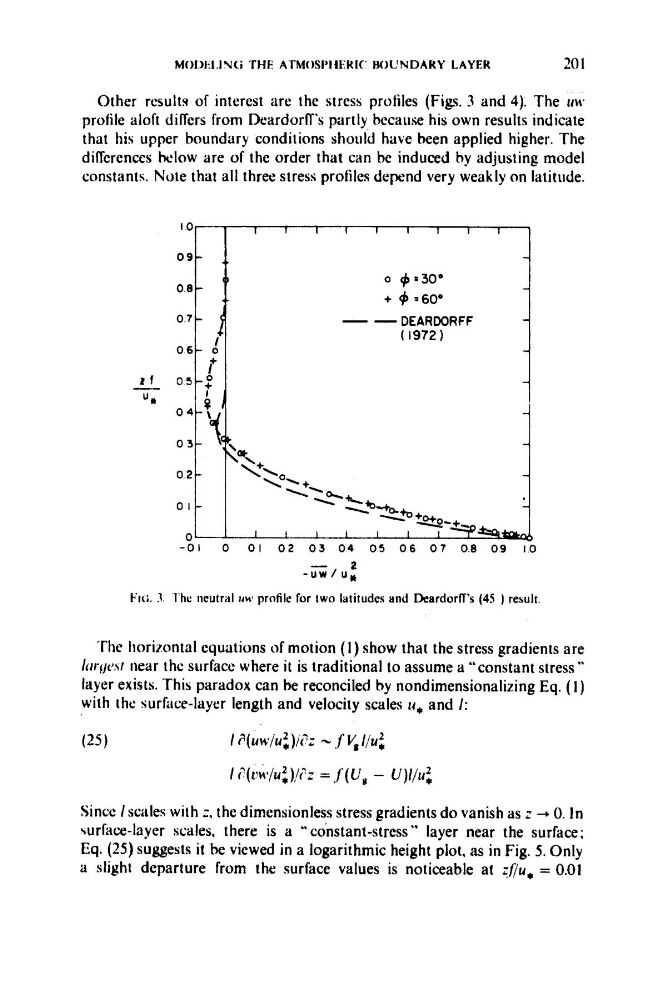
Other results of interest are the stress profiles (Figs. 3 and 4). The tow
profile aloft differs from Deardorff's partly hecause his own results indicate
that his upper boundary conditions should have been applied higher. The
differences hc.low are of the order that can he induced by adjusting model
constants. Note that all three stress profiles depend very weakly on latitude.
FIG. 3. I'hc neutral I~H' profile for IWO latitudes and DeardorR's (4s ) result.
'rhe liorizontal equations of motion ( I ) show that the stress gradients are
I r r p s r near the surface where it is traditional to assume a "constant stress''
layer exists. This paradox can be reconciled by nondimensionalizing Eq. ( 1)
with thc surface-layer length and velocity scales 14* and I:
( 2 5 )
I ?(uw/U;)/cz - f va I / U i
I i ( t i ' / U : ) j i z = j( u, - u)I/u;
Since I scales with z, the dimensionless stress gradients do vanish as z --., 0. In
wrfaw-layer scales, there is a "constant-stress" layer near the surface;
Eq. (25) suggests it be viewed in a logarithmic height plot, as in Fig. 5. Only
a slight departure from the surface values is noticeable at ;flu, = 0.01
20 I
I 0
I
I
I
1
I
I
I
I
0 9 -
.,
-
I
o #%30"
+ '#=60°
( 1972 1
0 0 -
-
0 7 -
- - DEARDORFF
0 6 - 0
-
-
I
I'
0 5
-.p
-
-
-
0 2 -
-
-+
0 1 -
. <++
= %
+ = 0 - +
-
0
I
1
I
1
I
I
I T * -
Other results of interest are the stress profiles (Figs. 3 and 4). The tow
profile aloft differs from Deardorff's partly hecause his own results indicate
that his upper boundary conditions should have been applied higher. The
differences hc.low are of the order that can he induced by adjusting model
constants. Note that all three stress profiles depend very weakly on latitude.
FIG. 3. I'hc neutral I~H' profile for IWO latitudes and DeardorR's (4s ) result.
'rhe liorizontal equations of motion ( I ) show that the stress gradients are
I r r p s r near the surface where it is traditional to assume a "constant stress''
layer exists. This paradox can be reconciled by nondimensionalizing Eq. ( 1)
with thc surface-layer length and velocity scales 14* and I:
( 2 5 )
I ?(uw/U;)/cz - f va I / U i
I i ( t i ' / U : ) j i z = j( u, - u)I/u;
Since I scales with z, the dimensionless stress gradients do vanish as z --., 0. In
wrfaw-layer scales, there is a "constant-stress" layer near the surface;
Eq. (25) suggests it be viewed in a logarithmic height plot, as in Fig. 5. Only
a slight departure from the surface values is noticeable at ;flu, = 0.01