

MOLXiLING OF TURRUI.ENT TRANSPORT
173
In addition, of course, we may make use of the more familiar fact that
derivatives which are external to correlations correspond to scales in the
energy containing range. while derivatives within the correlation correspond
to dissipation scales. We wish to apply this sort of reasoning to every term
appearing in the equations, but particularly to the equations for the dissipation of energy (and of temperature or concentration variance); applied to
these equations, it is particularly productive because the dynamics of these
quantities is dominated by the small scales. and interacts only weakly with
the energy containing eddies. Proceeding in this way, the equation for the
mean dissipation of energy may be reduced [as is done with the (equivalent)
vorticity equation in Tennekes and Lumley, 19721 to the form
- . .
___
. I
(1)
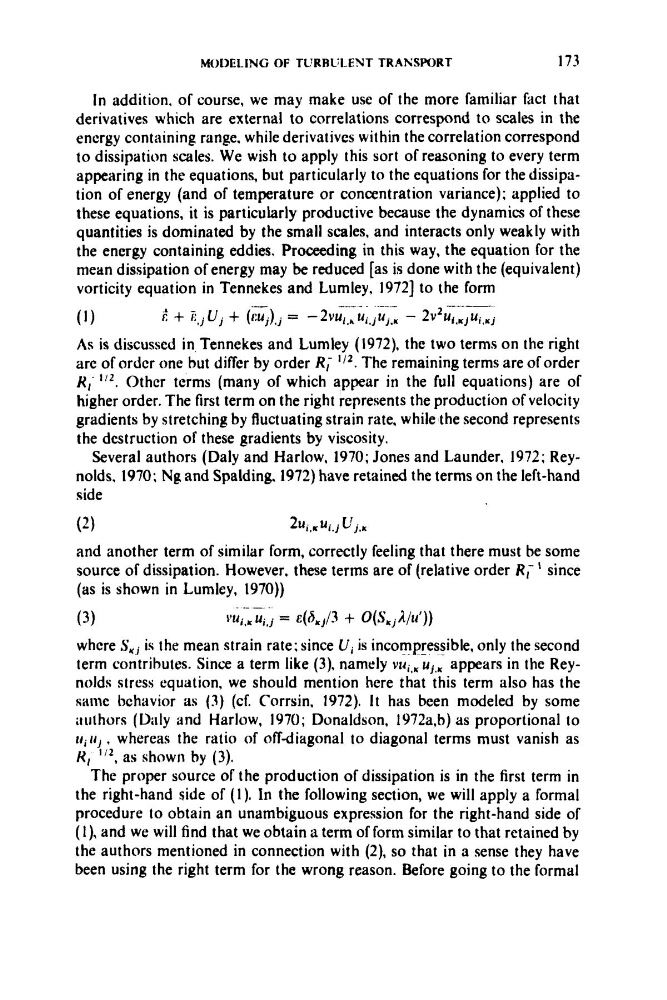
; 3- “,Uj + (u4j).j = -2vul.k Ui.jUj.* - 2v*U,#,,Ui.Kj
As is discussed in, Tennekes and Lumley (1972), the two terms on the right
are of order one but differ by order R; I/’. The remaining terms are of order
Other terms (many of which appear in the full equations) are of
higher order. The first term on the right represents the production of velocity
gradients by stretching by fluctuating strain rate, while the second represents
the destruction of these gradients by viscosity.
Several authors (Daly and Harlow, 1970; Jones and Launder, 1972; Reynolds, 1970: Ng and Spalding. 1972) have retained the terms on the left-hand
side
(2)
2ui.Kui.j L‘j,K
and another term of similar form, correctly feeling that there must be some
source of dissipation. However, these terms are of (relative order R; ’ since
(as is shown in Lumley, 1970))
. . . -. .
(3)
I’Uj+K Ui,j = &(hej/3 + O(SKjA/U’))
where S M i is the mean strain rate; since U i is incompressible, ~. - . ~only the second
term contributes. Since a term like (3). namely viiiSK u ~ . ~
appears in the Reynolds stress equation, we should mention here that this term also has the
same behavior as (3) (cf. Corrsin. 1972). I t has been modeled by some
ittlthors (Daly and Harlow, 1970; Donaldson, 1972a,b) as proportional to
i i i ~ i j ,
whereas the ratio of offdiagonal to diagonal terms must vanish as
HI I”, as shown by (3).
The proper source of the production of dissipation is in the first term in
the right-hand side of (1). In the following section, we will apply a formal
procedure to obtain an unambiguous expression for the right-hand side of
(l), and we will find that we obtain a term of form similar to that retained by
the authors mentioned in connection with ( 2 ) , so that in a sense they have
been using the right term for the wrong reason. Before going to the formal
173
In addition, of course, we may make use of the more familiar fact that
derivatives which are external to correlations correspond to scales in the
energy containing range. while derivatives within the correlation correspond
to dissipation scales. We wish to apply this sort of reasoning to every term
appearing in the equations, but particularly to the equations for the dissipation of energy (and of temperature or concentration variance); applied to
these equations, it is particularly productive because the dynamics of these
quantities is dominated by the small scales. and interacts only weakly with
the energy containing eddies. Proceeding in this way, the equation for the
mean dissipation of energy may be reduced [as is done with the (equivalent)
vorticity equation in Tennekes and Lumley, 19721 to the form
- . .
___
. I
(1)
; 3- “,Uj + (u4j).j = -2vul.k Ui.jUj.* - 2v*U,#,,Ui.Kj
As is discussed in, Tennekes and Lumley (1972), the two terms on the right
are of order one but differ by order R; I/’. The remaining terms are of order
Other terms (many of which appear in the full equations) are of
higher order. The first term on the right represents the production of velocity
gradients by stretching by fluctuating strain rate, while the second represents
the destruction of these gradients by viscosity.
Several authors (Daly and Harlow, 1970; Jones and Launder, 1972; Reynolds, 1970: Ng and Spalding. 1972) have retained the terms on the left-hand
side
(2)
2ui.Kui.j L‘j,K
and another term of similar form, correctly feeling that there must be some
source of dissipation. However, these terms are of (relative order R; ’ since
(as is shown in Lumley, 1970))
. . . -. .
(3)
I’Uj+K Ui,j = &(hej/3 + O(SKjA/U’))
where S M i is the mean strain rate; since U i is incompressible, ~. - . ~only the second
term contributes. Since a term like (3). namely viiiSK u ~ . ~
appears in the Reynolds stress equation, we should mention here that this term also has the
same behavior as (3) (cf. Corrsin. 1972). I t has been modeled by some
ittlthors (Daly and Harlow, 1970; Donaldson, 1972a,b) as proportional to
i i i ~ i j ,
whereas the ratio of offdiagonal to diagonal terms must vanish as
HI I”, as shown by (3).
The proper source of the production of dissipation is in the first term in
the right-hand side of (1). In the following section, we will apply a formal
procedure to obtain an unambiguous expression for the right-hand side of
(l), and we will find that we obtain a term of form similar to that retained by
the authors mentioned in connection with ( 2 ) , so that in a sense they have
been using the right term for the wrong reason. Before going to the formal