

168
HJALMAR FRANZ
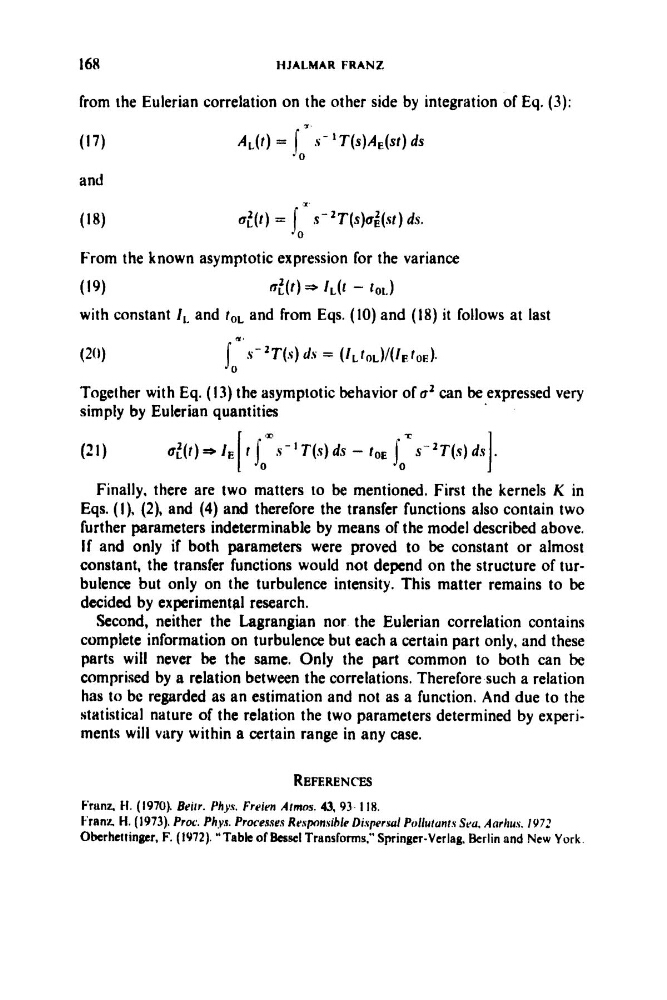
from the Eulerian correlation on the other side by integration of Eq. (3):
and
From the known asymptotic expression for the variance
(19)
&) * fL(t - to,.)
with constant I,. and toL and from Eqs. (10) and (18) it follows at last
n ,
[ s - 2 7 y s ) d . v = (fLtOL)/(IEtOE).
J D
Together with Eq. (13) the asymptotic behavior of c2 can be expressed very
simply by Eulerian quantities
Finally, there are two matters to be mentioned. First the kernels K in
Eqs. (I), (2), and (4) and therefore the transfer functions also contain two
further parameters indeterminable by means of the model described above.
If and only if both parameters were proved to be constant or almost
constant, the transfer functions would not depend on the structure of turbulence but only on the turbulence intensity. This matter remains to be
decided by experimental research.
Second, neither the Lagrangian nor the Eulerian correlation contains
complete information on turbulence but each a certain part only, and these
parts will never be the same. Only the part common to both can be
comprised by a relation between the correlations. Therefore such a relation
has to be regarded as an estimation and not as a function. And due to the
statistical nature of the relation the two parameters determined by experiments will vary within a certain range in any case.
REFERENCES
Frunz. 11. (1970). BriJr. fhys. Frrirn Airnos. 43, 93. 118.
tranr H. (1973). P r w . Phys. Processes Rrspnnsihle Dispersul follutants Sru. Anrhus. I972
Oberhciiinger, F. (1972). "Tabk of k s e l Transforms." Springer-Verlag. Berlin nnd New York.
HJALMAR FRANZ
from the Eulerian correlation on the other side by integration of Eq. (3):
and
From the known asymptotic expression for the variance
(19)
&) * fL(t - to,.)
with constant I,. and toL and from Eqs. (10) and (18) it follows at last
n ,
[ s - 2 7 y s ) d . v = (fLtOL)/(IEtOE).
J D
Together with Eq. (13) the asymptotic behavior of c2 can be expressed very
simply by Eulerian quantities
Finally, there are two matters to be mentioned. First the kernels K in
Eqs. (I), (2), and (4) and therefore the transfer functions also contain two
further parameters indeterminable by means of the model described above.
If and only if both parameters were proved to be constant or almost
constant, the transfer functions would not depend on the structure of turbulence but only on the turbulence intensity. This matter remains to be
decided by experimental research.
Second, neither the Lagrangian nor the Eulerian correlation contains
complete information on turbulence but each a certain part only, and these
parts will never be the same. Only the part common to both can be
comprised by a relation between the correlations. Therefore such a relation
has to be regarded as an estimation and not as a function. And due to the
statistical nature of the relation the two parameters determined by experiments will vary within a certain range in any case.
REFERENCES
Frunz. 11. (1970). BriJr. fhys. Frrirn Airnos. 43, 93. 118.
tranr H. (1973). P r w . Phys. Processes Rrspnnsihle Dispersul follutants Sru. Anrhus. I972
Oberhciiinger, F. (1972). "Tabk of k s e l Transforms." Springer-Verlag. Berlin nnd New York.