

IS8
RICHARD 1.. PESKIN
0.8
Y
t
0.0
; ... / ....***.......*** i rF/i
* * e a / * ; >
,
.
,
* , *# ,,.. . * ’
***aw
- x
4 0 0.0
y 0.80
0
0
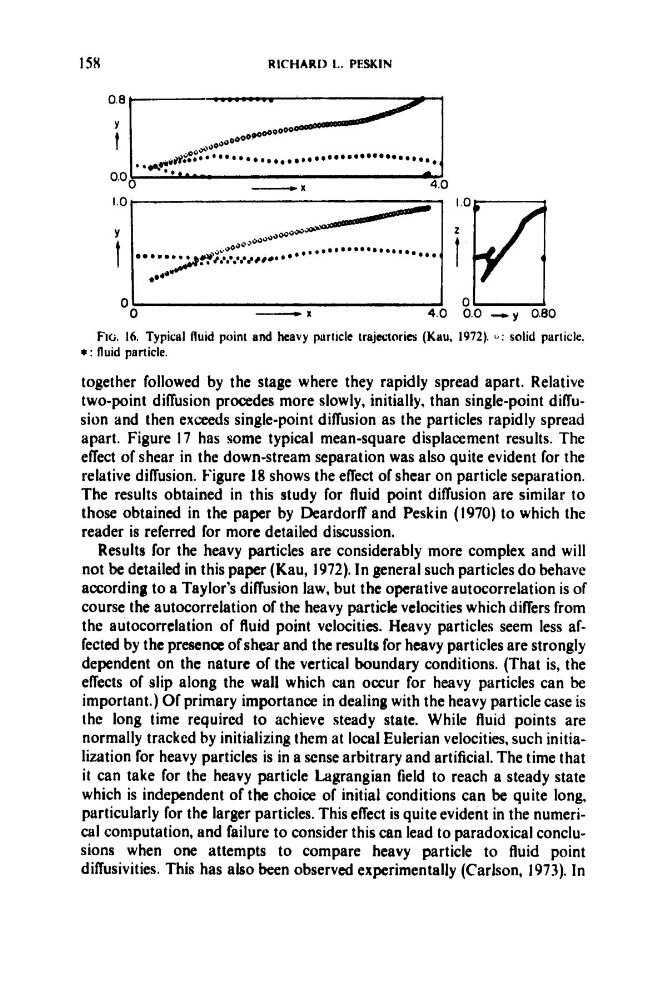
FIG. 16. Typical fluid point and heavy purticle trajectories (Kau. 1972). ‘ I : solid particle.
* : fluid particle.
together followed by the stage where they rapidly spread apart. Relative
two-point diffusion procedes more slowly, initially. than single-point diffusion and then exceeds single-point diffusion as the particles rapidly spread
apart. Figure 17 has some typical mean-square displacement results. The
effect of shear in the down-stream separation was also quite evident for the
relative diffusion. Figure 18 shows the effect of shear on particle separation.
The results obtained in this study for fluid point diffusion are similar to
those obtained in the paper by Deardorff and Peskin (1970) to which the
reader is referred for more detailed discussion.
Results for the heavy particles are considerably more complex and will
not be detailed in this paper (Kau, 1972). In general such particles do behave
according to a Taylor’s diffusion law, but the operative autocorrelation is of
course the autocorrelation of the heavy partick velocities which differs from
the autocorrelation of fluid point velocities. Heavy particles seem less affected by the presence of shear and the results for heavy particles are strongly
dependent on the nature of the vertical boundary conditions. (That is, the
effects of dip along the wall which can occur for heavy particles can be
important.) Of primary importance in dealing with the heavy particle case is
the long time required to achieve steady state. While fluid points are
normally tracked by initializing them at local Eulerian velocities, such initialization for heavy particles is in a sense arbitrary and artificial. The time that
it can take for the heavy particle hgrangian field to reach a steady state
which is independent of the choice of initial conditions can be quite long,
particularly for the larger particles. This effect is quite evident in the numerical computation, and failure to consider this can lead to paradoxical conclusions when one attempts to compare heavy particle to fluid point
diffusivities. This has also been observed experimentally (Carlson, 1973). In
RICHARD 1.. PESKIN
0.8
Y
t
0.0
; ... / ....***.......*** i rF/i
* * e a / * ; >
,
.
,
* , *# ,,.. . * ’
***aw
- x
4 0 0.0
y 0.80
0
0
FIG. 16. Typical fluid point and heavy purticle trajectories (Kau. 1972). ‘ I : solid particle.
* : fluid particle.
together followed by the stage where they rapidly spread apart. Relative
two-point diffusion procedes more slowly, initially. than single-point diffusion and then exceeds single-point diffusion as the particles rapidly spread
apart. Figure 17 has some typical mean-square displacement results. The
effect of shear in the down-stream separation was also quite evident for the
relative diffusion. Figure 18 shows the effect of shear on particle separation.
The results obtained in this study for fluid point diffusion are similar to
those obtained in the paper by Deardorff and Peskin (1970) to which the
reader is referred for more detailed discussion.
Results for the heavy particles are considerably more complex and will
not be detailed in this paper (Kau, 1972). In general such particles do behave
according to a Taylor’s diffusion law, but the operative autocorrelation is of
course the autocorrelation of the heavy partick velocities which differs from
the autocorrelation of fluid point velocities. Heavy particles seem less affected by the presence of shear and the results for heavy particles are strongly
dependent on the nature of the vertical boundary conditions. (That is, the
effects of dip along the wall which can occur for heavy particles can be
important.) Of primary importance in dealing with the heavy particle case is
the long time required to achieve steady state. While fluid points are
normally tracked by initializing them at local Eulerian velocities, such initialization for heavy particles is in a sense arbitrary and artificial. The time that
it can take for the heavy particle hgrangian field to reach a steady state
which is independent of the choice of initial conditions can be quite long,
particularly for the larger particles. This effect is quite evident in the numerical computation, and failure to consider this can lead to paradoxical conclusions when one attempts to compare heavy particle to fluid point
diffusivities. This has also been observed experimentally (Carlson, 1973). In