

STEADY-SrAE STABLE IIN!Nl>ARY LAYER
89
K, mom
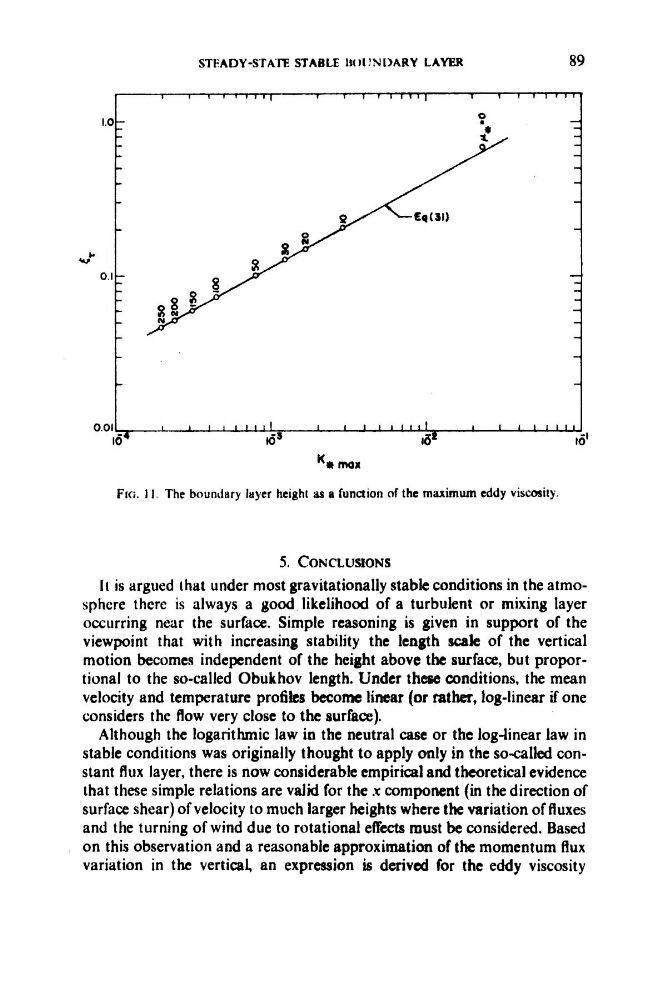
FIG. 1 I . The boundary layer height as a fundion of the maximum eddy viscosity
5. CONCLUSIONS
It is argued that under most gravitationally stable conditions in the atmosphere thcre is always a good likelihood of a turbulent or mixing layer
occurring near the surface. Simple reasoning is given in support of the
viewpoint that with increasing stability the length scale of the vertical
motion becomes independent of the height above the surface, but proportional to the so-called Obukhov length. Under thaie conditions, the mean
velocity and temperature profiles become linear (or rather, log-linear if one
considers the flow very close to the surface).
Although the logarithmic law in the neutral case or the log-linear law in
stable conditions was originally thought to apply only in the so-called constant flux layer, there is now considerable empirical and theoretical evidence
that these simple relations are valid for the x component (in the direction of
surface shear) of velocity to much larger heights where the variation of fluxes
and the turning of wind due to rotational effects must be considered. Based
on this observation and a reasonable approximation of the momentum flux
variation in the vertical, an expression is derived for the eddy viscosity
89
K, mom
FIG. 1 I . The boundary layer height as a fundion of the maximum eddy viscosity
5. CONCLUSIONS
It is argued that under most gravitationally stable conditions in the atmosphere thcre is always a good likelihood of a turbulent or mixing layer
occurring near the surface. Simple reasoning is given in support of the
viewpoint that with increasing stability the length scale of the vertical
motion becomes independent of the height above the surface, but proportional to the so-called Obukhov length. Under thaie conditions, the mean
velocity and temperature profiles become linear (or rather, log-linear if one
considers the flow very close to the surface).
Although the logarithmic law in the neutral case or the log-linear law in
stable conditions was originally thought to apply only in the so-called constant flux layer, there is now considerable empirical and theoretical evidence
that these simple relations are valid for the x component (in the direction of
surface shear) of velocity to much larger heights where the variation of fluxes
and the turning of wind due to rotational effects must be considered. Based
on this observation and a reasonable approximation of the momentum flux
variation in the vertical, an expression is derived for the eddy viscosity