

1900
1950
2000
Y
Mean Sea Level
ear
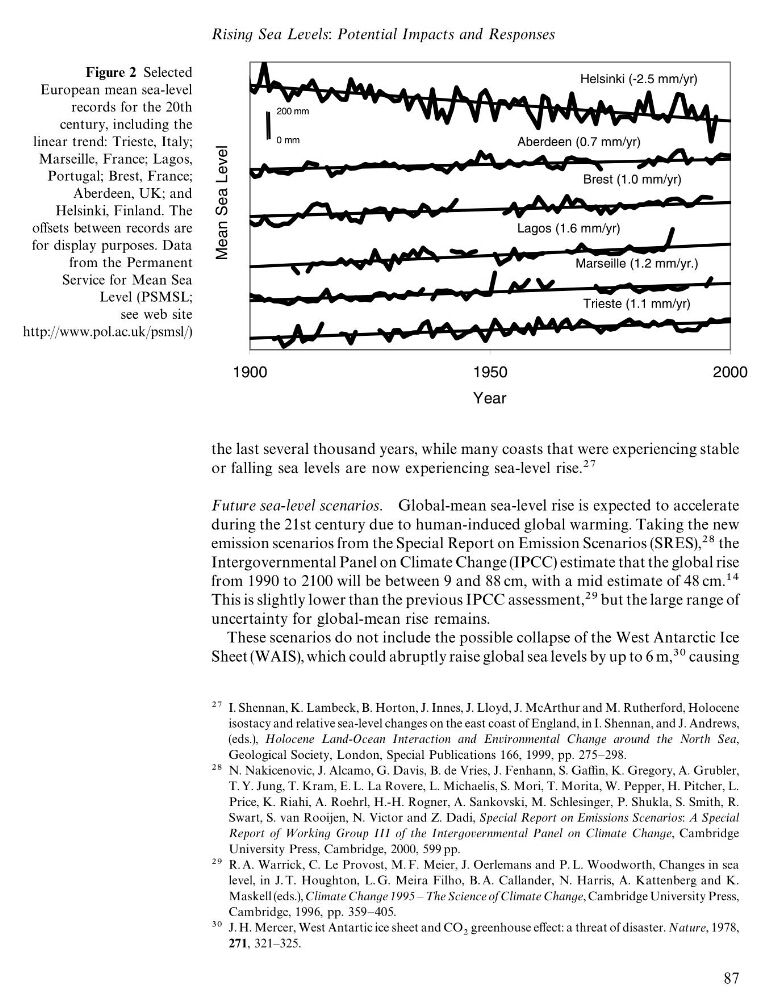
Trieste (1.1 mm/yr)
Marseille (1.2 mm/yr.)
Lagos (1.6 mm/yr)
Brest (1.0 mm/yr)
Aberdeen (0.7 mm/yr)
Helsinki (-2.5 mm/yr)
0 mm
200 mm
Figure 2 Selected
European mean sea-level
records for the 20th
century, including the
linear trend: Trieste, Italy;
Marseille, France; Lagos,
Portugal; Brest, France;
Aberdeen, UK; and
Helsinki, Finland. The
offsets between records are
for display purposes. Data
from the Permanent
Service for Mean Sea
Level (PSMSL;
see web site
http://www.pol.ac.uk/psmsl/)
the last several thousand years, while many coasts that were experiencing stable
or falling sea levels are now experiencing sea-level rise.
Future sea-level scenarios. Global-mean sea-level rise is expected to accelerate
during the 21st century due to human-induced global warming. Taking the new
emission scenarios from the Special Report on Emission Scenarios (SRES), the
Intergovernmental Panel on Climate Change (IPCC) estimate that the global rise
from 1990 to 2100 will be between 9 and 88 cm, with a mid estimate of 48 cm.
This is slightly lower than the previous IPCC assessment, but the large range of
uncertainty for global-mean rise remains.
These scenarios do not include the possible collapse of the West Antarctic Ice
Sheet (WAIS), which could abruptly raise global sea levels by up to 6 m, causing
I. Shennan, K. Lambeck, B. Horton, J. Innes, J. Lloyd, J. McArthur and M. Rutherford, Holocene
isostacy and relative sea-level changes on the east coast of England, in I. Shennan, and J. Andrews,
(eds.), Holocene Land-Ocean Interaction and Environmental Change around the North Sea,
Geological Society, London, Special Publications 166, 1999, pp. 275—298.
N. Nakicenovic, J. Alcamo, G. Davis, B. de Vries, J. Fenhann, S. Gaffin, K. Gregory, A. Grubler,
T. Y. Jung, T. Kram, E. L. La Rovere, L. Michaelis, S. Mori, T. Morita, W. Pepper, H. Pitcher, L.
Price, K. Riahi, A. Roehrl, H.-H. Rogner, A. Sankovski, M. Schlesinger, P. Shukla, S. Smith, R.
Swart, S. van Rooijen, N. Victor and Z. Dadi, Special Report on Emissions Scenarios: A Special
Report of Working Group III of the Intergovernmental Panel on Climate Change, Cambridge
University Press, Cambridge, 2000, 599 pp.
R. A. Warrick, C. Le Provost, M. F. Meier, J. Oerlemans and P. L. Woodworth, Changes in sea
level, in J. T. Houghton, L. G. Meira Filho, B. A. Callander, N. Harris, A. Kattenberg and K.
Maskell (eds.), Climate Change 1995 — The Science of Climate Change, Cambridge University Press,
Cambridge, 1996, pp. 359—405.
J. H. Mercer, West Antartic ice sheet and CO
greenhouse effect: a threat of disaster. Nature, 1978,
271, 321—325.
Rising Sea Levels: Potential Impacts and Responses
87
1950
2000
Y
Mean Sea Level
ear
Trieste (1.1 mm/yr)
Marseille (1.2 mm/yr.)
Lagos (1.6 mm/yr)
Brest (1.0 mm/yr)
Aberdeen (0.7 mm/yr)
Helsinki (-2.5 mm/yr)
0 mm
200 mm
Figure 2 Selected
European mean sea-level
records for the 20th
century, including the
linear trend: Trieste, Italy;
Marseille, France; Lagos,
Portugal; Brest, France;
Aberdeen, UK; and
Helsinki, Finland. The
offsets between records are
for display purposes. Data
from the Permanent
Service for Mean Sea
Level (PSMSL;
see web site
http://www.pol.ac.uk/psmsl/)
the last several thousand years, while many coasts that were experiencing stable
or falling sea levels are now experiencing sea-level rise.
Future sea-level scenarios. Global-mean sea-level rise is expected to accelerate
during the 21st century due to human-induced global warming. Taking the new
emission scenarios from the Special Report on Emission Scenarios (SRES), the
Intergovernmental Panel on Climate Change (IPCC) estimate that the global rise
from 1990 to 2100 will be between 9 and 88 cm, with a mid estimate of 48 cm.
This is slightly lower than the previous IPCC assessment, but the large range of
uncertainty for global-mean rise remains.
These scenarios do not include the possible collapse of the West Antarctic Ice
Sheet (WAIS), which could abruptly raise global sea levels by up to 6 m, causing
I. Shennan, K. Lambeck, B. Horton, J. Innes, J. Lloyd, J. McArthur and M. Rutherford, Holocene
isostacy and relative sea-level changes on the east coast of England, in I. Shennan, and J. Andrews,
(eds.), Holocene Land-Ocean Interaction and Environmental Change around the North Sea,
Geological Society, London, Special Publications 166, 1999, pp. 275—298.
N. Nakicenovic, J. Alcamo, G. Davis, B. de Vries, J. Fenhann, S. Gaffin, K. Gregory, A. Grubler,
T. Y. Jung, T. Kram, E. L. La Rovere, L. Michaelis, S. Mori, T. Morita, W. Pepper, H. Pitcher, L.
Price, K. Riahi, A. Roehrl, H.-H. Rogner, A. Sankovski, M. Schlesinger, P. Shukla, S. Smith, R.
Swart, S. van Rooijen, N. Victor and Z. Dadi, Special Report on Emissions Scenarios: A Special
Report of Working Group III of the Intergovernmental Panel on Climate Change, Cambridge
University Press, Cambridge, 2000, 599 pp.
R. A. Warrick, C. Le Provost, M. F. Meier, J. Oerlemans and P. L. Woodworth, Changes in sea
level, in J. T. Houghton, L. G. Meira Filho, B. A. Callander, N. Harris, A. Kattenberg and K.
Maskell (eds.), Climate Change 1995 — The Science of Climate Change, Cambridge University Press,
Cambridge, 1996, pp. 359—405.
J. H. Mercer, West Antartic ice sheet and CO
greenhouse effect: a threat of disaster. Nature, 1978,
271, 321—325.
Rising Sea Levels: Potential Impacts and Responses
87