

100
-100
-300
-500
1910
1930
1950
1970
1990
ACI (WE)
Pacific salmon
Californian sardine
Japanese sardine
Peruvian sardine
Alaska pollock
Catch (relative units)
Zonal ACI index
1990
1910
1930
19
Year
50
1970
1990
Catch (relative units)
Atlantic cod
ACI (C)
300
100
-100
Meridonal ACI index
Atlantic herring
South African sardine
Pacific herring
Peruvian anchovy
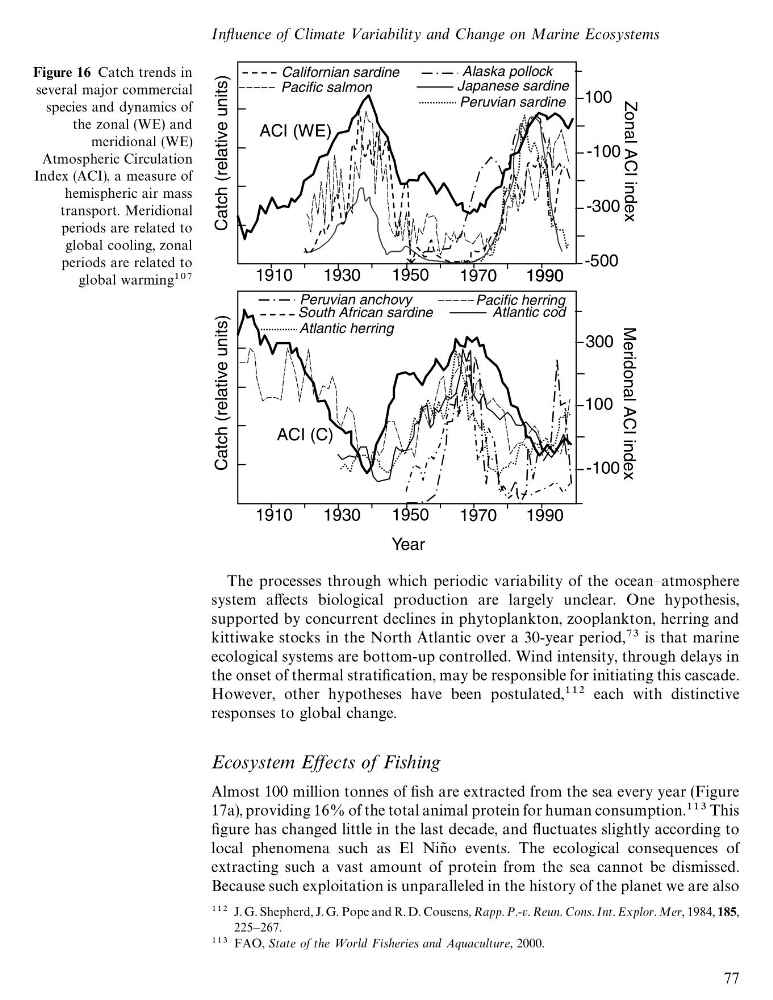
Figure 16 Catch trends in
several major commercial
species and dynamics of
the zonal (WE) and
meridional (WE)
Atmospheric Circulation
Index (ACI), a measure of
hemispheric air mass
transport. Meridional
periods are related to
global cooling, zonal
periods are related to
global warming
The processes through which periodic variability of the ocean—atmosphere
system affects biological production are largely unclear. One hypothesis,
supported by concurrent declines in phytoplankton, zooplankton, herring and
kittiwake stocks in the North Atlantic over a 30-year period, is that marine
ecological systems are bottom-up controlled. Wind intensity, through delays in
the onset of thermal stratification, may be responsible for initiating this cascade.
However, other hypotheses have been postulated, each with distinctive
responses to global change.
Ecosystem Effects of Fishing
Almost 100 million tonnes of fish are extracted from the sea every year (Figure
17a), providing 16% of the total animal protein for human consumption. This
figure has changed little in the last decade, and fluctuates slightly according to
local phenomena such as El Nin o events. The ecological consequences of
extracting such a vast amount of protein from the sea cannot be dismissed.
Because such exploitation is unparalleled in the history of the planet we are also
J. G. Shepherd, J. G. Pope and R. D. Cousens, Rapp. P.-v. Reun. Cons. Int. Explor. Mer, 1984, 185,
225—267.
FAO, State of the World Fisheries and Aquaculture, 2000.
Influence of Climate Variability and Change on Marine Ecosystems
77
-100
-300
-500
1910
1930
1950
1970
1990
ACI (WE)
Pacific salmon
Californian sardine
Japanese sardine
Peruvian sardine
Alaska pollock
Catch (relative units)
Zonal ACI index
1990
1910
1930
19
Year
50
1970
1990
Catch (relative units)
Atlantic cod
ACI (C)
300
100
-100
Meridonal ACI index
Atlantic herring
South African sardine
Pacific herring
Peruvian anchovy
Figure 16 Catch trends in
several major commercial
species and dynamics of
the zonal (WE) and
meridional (WE)
Atmospheric Circulation
Index (ACI), a measure of
hemispheric air mass
transport. Meridional
periods are related to
global cooling, zonal
periods are related to
global warming
The processes through which periodic variability of the ocean—atmosphere
system affects biological production are largely unclear. One hypothesis,
supported by concurrent declines in phytoplankton, zooplankton, herring and
kittiwake stocks in the North Atlantic over a 30-year period, is that marine
ecological systems are bottom-up controlled. Wind intensity, through delays in
the onset of thermal stratification, may be responsible for initiating this cascade.
However, other hypotheses have been postulated, each with distinctive
responses to global change.
Ecosystem Effects of Fishing
Almost 100 million tonnes of fish are extracted from the sea every year (Figure
17a), providing 16% of the total animal protein for human consumption. This
figure has changed little in the last decade, and fluctuates slightly according to
local phenomena such as El Nin o events. The ecological consequences of
extracting such a vast amount of protein from the sea cannot be dismissed.
Because such exploitation is unparalleled in the history of the planet we are also
J. G. Shepherd, J. G. Pope and R. D. Cousens, Rapp. P.-v. Reun. Cons. Int. Explor. Mer, 1984, 185,
225—267.
FAO, State of the World Fisheries and Aquaculture, 2000.
Influence of Climate Variability and Change on Marine Ecosystems
77