

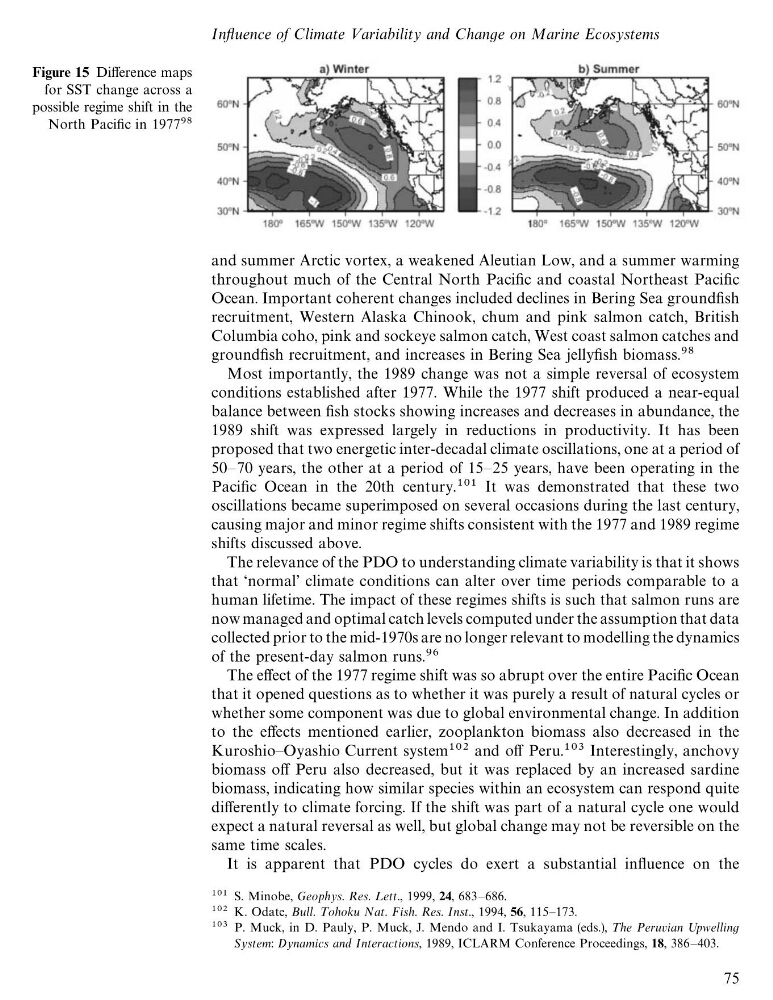
Figure 15 Difference maps
for SST change across a
possible regime shift in the
North Pacific in 1977
and summer Arctic vortex, a weakened Aleutian Low, and a summer warming
throughout much of the Central North Pacific and coastal Northeast Pacific
Ocean. Important coherent changes included declines in Bering Sea groundfish
recruitment, Western Alaska Chinook, chum and pink salmon catch, British
Columbia coho, pink and sockeye salmon catch, West coast salmon catches and
groundfish recruitment, and increases in Bering Sea jellyfish biomass.
Most importantly, the 1989 change was not a simple reversal of ecosystem
conditions established after 1977. While the 1977 shift produced a near-equal
balance between fish stocks showing increases and decreases in abundance, the
1989 shift was expressed largely in reductions in productivity. It has been
proposed that two energetic inter-decadal climate oscillations, one at a period of
50—70 years, the other at a period of 15—25 years, have been operating in the
Pacific Ocean in the 20th century. It was demonstrated that these two
oscillations became superimposed on several occasions during the last century,
causing major and minor regime shifts consistent with the 1977 and 1989 regime
shifts discussed above.
The relevance of the PDO to understanding climate variability is that it shows
that ‘normal’ climate conditions can alter over time periods comparable to a
human lifetime. The impact of these regimes shifts is such that salmon runs are
now managed and optimal catch levels computed under the assumption that data
collected prior to the mid-1970s are no longer relevant to modelling the dynamics
of the present-day salmon runs.
The effect of the 1977 regime shift was so abrupt over the entire Pacific Ocean
that it opened questions as to whether it was purely a result of natural cycles or
whether some component was due to global environmental change. In addition
to the effects mentioned earlier, zooplankton biomass also decreased in the
Kuroshio—Oyashio Current system and off Peru. Interestingly, anchovy
biomass off Peru also decreased, but it was replaced by an increased sardine
biomass, indicating how similar species within an ecosystem can respond quite
differently to climate forcing. If the shift was part of a natural cycle one would
expect a natural reversal as well, but global change may not be reversible on the
same time scales.
It is apparent that PDO cycles do exert a substantial influence on the
S. Minobe, Geophys. Res. Lett., 1999, 24, 683—686.
K. Odate, Bull. Tohoku Nat. Fish. Res. Inst., 1994, 56, 115—173.
P. Muck, in D. Pauly, P. Muck, J. Mendo and I. Tsukayama (eds.), The Peruvian Upwelling
System: Dynamics and Interactions, 1989, ICLARM Conference Proceedings, 18, 386—403.
Influence of Climate Variability and Change on Marine Ecosystems
75
for SST change across a
possible regime shift in the
North Pacific in 1977
and summer Arctic vortex, a weakened Aleutian Low, and a summer warming
throughout much of the Central North Pacific and coastal Northeast Pacific
Ocean. Important coherent changes included declines in Bering Sea groundfish
recruitment, Western Alaska Chinook, chum and pink salmon catch, British
Columbia coho, pink and sockeye salmon catch, West coast salmon catches and
groundfish recruitment, and increases in Bering Sea jellyfish biomass.
Most importantly, the 1989 change was not a simple reversal of ecosystem
conditions established after 1977. While the 1977 shift produced a near-equal
balance between fish stocks showing increases and decreases in abundance, the
1989 shift was expressed largely in reductions in productivity. It has been
proposed that two energetic inter-decadal climate oscillations, one at a period of
50—70 years, the other at a period of 15—25 years, have been operating in the
Pacific Ocean in the 20th century. It was demonstrated that these two
oscillations became superimposed on several occasions during the last century,
causing major and minor regime shifts consistent with the 1977 and 1989 regime
shifts discussed above.
The relevance of the PDO to understanding climate variability is that it shows
that ‘normal’ climate conditions can alter over time periods comparable to a
human lifetime. The impact of these regimes shifts is such that salmon runs are
now managed and optimal catch levels computed under the assumption that data
collected prior to the mid-1970s are no longer relevant to modelling the dynamics
of the present-day salmon runs.
The effect of the 1977 regime shift was so abrupt over the entire Pacific Ocean
that it opened questions as to whether it was purely a result of natural cycles or
whether some component was due to global environmental change. In addition
to the effects mentioned earlier, zooplankton biomass also decreased in the
Kuroshio—Oyashio Current system and off Peru. Interestingly, anchovy
biomass off Peru also decreased, but it was replaced by an increased sardine
biomass, indicating how similar species within an ecosystem can respond quite
differently to climate forcing. If the shift was part of a natural cycle one would
expect a natural reversal as well, but global change may not be reversible on the
same time scales.
It is apparent that PDO cycles do exert a substantial influence on the
S. Minobe, Geophys. Res. Lett., 1999, 24, 683—686.
K. Odate, Bull. Tohoku Nat. Fish. Res. Inst., 1994, 56, 115—173.
P. Muck, in D. Pauly, P. Muck, J. Mendo and I. Tsukayama (eds.), The Peruvian Upwelling
System: Dynamics and Interactions, 1989, ICLARM Conference Proceedings, 18, 386—403.
Influence of Climate Variability and Change on Marine Ecosystems
75