

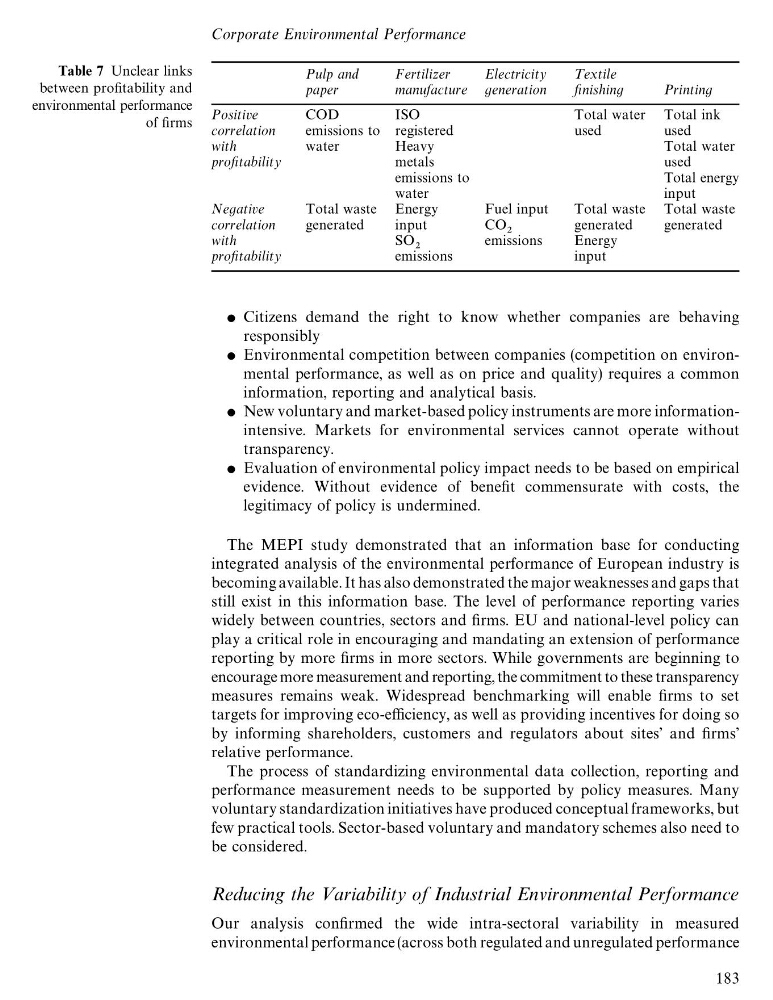
Table 7 Unclear links
between profitability and
environmental performance
of firms
Pulp and
Fertilizer
Electricity
Textile
paper
manufacture generation
finishing
Printing
Positive
correlation
with
profitability
COD
emissions to
water
ISO
registered
Heavy
metals
emissions to
water
Total water
used
Total ink
used
Total water
used
Total energy
input
Negative
correlation
with
profitability
Total waste
generated
Energy
input
SO
emissions
Fuel input
CO
emissions
Total waste
generated
Energy
input
Total waste
generated
E Citizens demand the right to know whether companies are behaving
responsibly
E Environmental competition between companies (competition on environmental performance, as well as on price and quality) requires a common
information, reporting and analytical basis.
E New voluntary and market-based policy instruments are more informationintensive. Markets for environmental services cannot operate without
transparency.
E Evaluation of environmental policy impact needs to be based on empirical
evidence. Without evidence of benefit commensurate with costs, the
legitimacy of policy is undermined.
The MEPI study demonstrated that an information base for conducting
integrated analysis of the environmental performance of European industry is
becoming available. It has also demonstrated the major weaknesses and gaps that
still exist in this information base. The level of performance reporting varies
widely between countries, sectors and firms. EU and national-level policy can
play a critical role in encouraging and mandating an extension of performance
reporting by more firms in more sectors. While governments are beginning to
encourage more measurement and reporting, the commitment to these transparency
measures remains weak. Widespread benchmarking will enable firms to set
targets for improving eco-efficiency, as well as providing incentives for doing so
by informing shareholders, customers and regulators about sites’ and firms’
relative performance.
The process of standardizing environmental data collection, reporting and
performance measurement needs to be supported by policy measures. Many
voluntary standardization initiatives have produced conceptual frameworks, but
few practical tools. Sector-based voluntary and mandatory schemes also need to
be considered.
Reducing the Variability of Industrial Environmental Performance
Our analysis confirmed the wide intra-sectoral variability in measured
environmental performance (across both regulated and unregulated performance
Corporate Environmental Performance
183
between profitability and
environmental performance
of firms
Pulp and
Fertilizer
Electricity
Textile
paper
manufacture generation
finishing
Printing
Positive
correlation
with
profitability
COD
emissions to
water
ISO
registered
Heavy
metals
emissions to
water
Total water
used
Total ink
used
Total water
used
Total energy
input
Negative
correlation
with
profitability
Total waste
generated
Energy
input
SO
emissions
Fuel input
CO
emissions
Total waste
generated
Energy
input
Total waste
generated
E Citizens demand the right to know whether companies are behaving
responsibly
E Environmental competition between companies (competition on environmental performance, as well as on price and quality) requires a common
information, reporting and analytical basis.
E New voluntary and market-based policy instruments are more informationintensive. Markets for environmental services cannot operate without
transparency.
E Evaluation of environmental policy impact needs to be based on empirical
evidence. Without evidence of benefit commensurate with costs, the
legitimacy of policy is undermined.
The MEPI study demonstrated that an information base for conducting
integrated analysis of the environmental performance of European industry is
becoming available. It has also demonstrated the major weaknesses and gaps that
still exist in this information base. The level of performance reporting varies
widely between countries, sectors and firms. EU and national-level policy can
play a critical role in encouraging and mandating an extension of performance
reporting by more firms in more sectors. While governments are beginning to
encourage more measurement and reporting, the commitment to these transparency
measures remains weak. Widespread benchmarking will enable firms to set
targets for improving eco-efficiency, as well as providing incentives for doing so
by informing shareholders, customers and regulators about sites’ and firms’
relative performance.
The process of standardizing environmental data collection, reporting and
performance measurement needs to be supported by policy measures. Many
voluntary standardization initiatives have produced conceptual frameworks, but
few practical tools. Sector-based voluntary and mandatory schemes also need to
be considered.
Reducing the Variability of Industrial Environmental Performance
Our analysis confirmed the wide intra-sectoral variability in measured
environmental performance (across both regulated and unregulated performance
Corporate Environmental Performance
183