

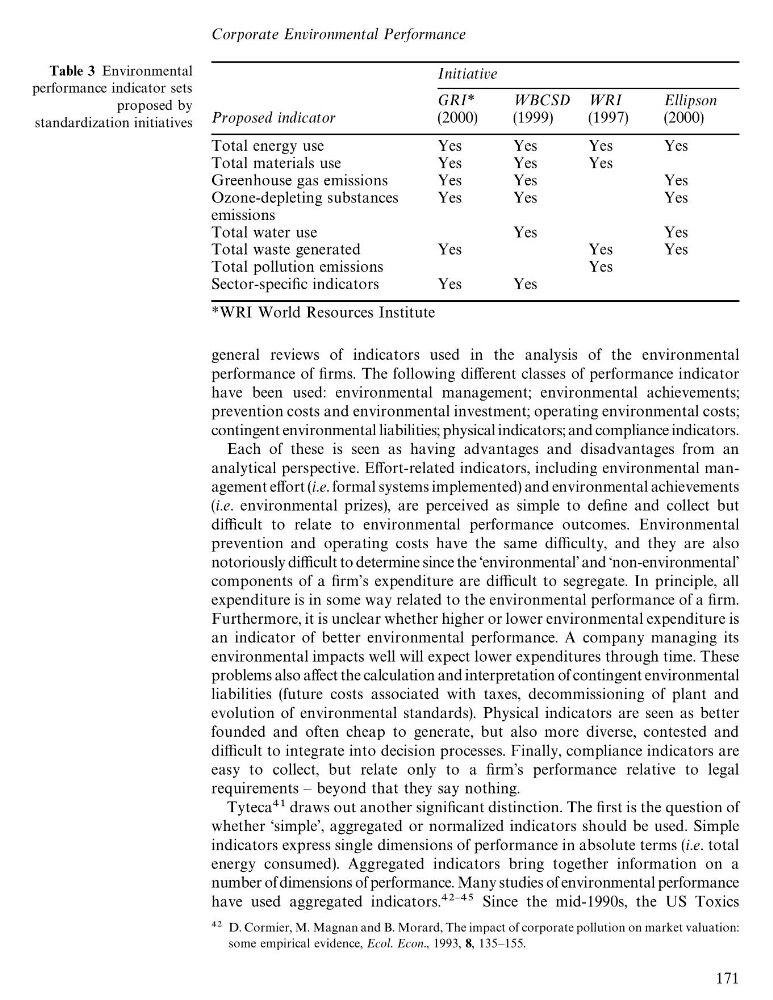
Table 3 Environmental
performance indicator sets
proposed by
standardization initiatives
Initiative
Proposed indicator
GRI*
(2000)
WBCSD
(1999)
WRI
(1997)
Ellipson
(2000)
Total energy use
Yes
Yes
Yes
Yes
Total materials use
Yes
Yes
Yes
Greenhouse gas emissions
Yes
Yes
Yes
Ozone-depleting substances
emissions
Yes
Yes
Yes
Total water use
Yes
Yes
Total waste generated
Yes
Yes
Yes
Total pollution emissions
Yes
Sector-specific indicators
Yes
Yes
*WRI World Resources Institute
general reviews of indicators used in the analysis of the environmental
performance of firms. The following different classes of performance indicator
have been used: environmental management; environmental achievements;
prevention costs and environmental investment; operating environmental costs;
contingent environmental liabilities; physical indicators; and compliance indicators.
Each of these is seen as having advantages and disadvantages from an
analytical perspective. Effort-related indicators, including environmental management effort (i.e. formal systems implemented) and environmental achievements
(i.e. environmental prizes), are perceived as simple to define and collect but
difficult to relate to environmental performance outcomes. Environmental
prevention and operating costs have the same difficulty, and they are also
notoriously difficult to determine since the ‘environmental’ and ‘non-environmental’
components of a firm’s expenditure are difficult to segregate. In principle, all
expenditure is in some way related to the environmental performance of a firm.
Furthermore, it is unclear whether higher or lower environmental expenditure is
an indicator of better environmental performance. A company managing its
environmental impacts well will expect lower expenditures through time. These
problems also affect the calculation and interpretation of contingent environmental
liabilities (future costs associated with taxes, decommissioning of plant and
evolution of environmental standards). Physical indicators are seen as better
founded and often cheap to generate, but also more diverse, contested and
difficult to integrate into decision processes. Finally, compliance indicators are
easy to collect, but relate only to a firm’s performance relative to legal
requirements — beyond that they say nothing.
Tyteca draws out another significant distinction. The first is the question of
whether ‘simple’, aggregated or normalized indicators should be used. Simple
indicators express single dimensions of performance in absolute terms (i.e. total
energy consumed). Aggregated indicators bring together information on a
number of dimensions of performance. Many studies of environmental performance
have used aggregated indicators.
—
Since the mid-1990s, the US Toxics
D. Cormier, M. Magnan and B. Morard, The impact of corporate pollution on market valuation:
some empirical evidence, Ecol. Econ., 1993, 8, 135—155.
Corporate Environmental Performance
171
performance indicator sets
proposed by
standardization initiatives
Initiative
Proposed indicator
GRI*
(2000)
WBCSD
(1999)
WRI
(1997)
Ellipson
(2000)
Total energy use
Yes
Yes
Yes
Yes
Total materials use
Yes
Yes
Yes
Greenhouse gas emissions
Yes
Yes
Yes
Ozone-depleting substances
emissions
Yes
Yes
Yes
Total water use
Yes
Yes
Total waste generated
Yes
Yes
Yes
Total pollution emissions
Yes
Sector-specific indicators
Yes
Yes
*WRI World Resources Institute
general reviews of indicators used in the analysis of the environmental
performance of firms. The following different classes of performance indicator
have been used: environmental management; environmental achievements;
prevention costs and environmental investment; operating environmental costs;
contingent environmental liabilities; physical indicators; and compliance indicators.
Each of these is seen as having advantages and disadvantages from an
analytical perspective. Effort-related indicators, including environmental management effort (i.e. formal systems implemented) and environmental achievements
(i.e. environmental prizes), are perceived as simple to define and collect but
difficult to relate to environmental performance outcomes. Environmental
prevention and operating costs have the same difficulty, and they are also
notoriously difficult to determine since the ‘environmental’ and ‘non-environmental’
components of a firm’s expenditure are difficult to segregate. In principle, all
expenditure is in some way related to the environmental performance of a firm.
Furthermore, it is unclear whether higher or lower environmental expenditure is
an indicator of better environmental performance. A company managing its
environmental impacts well will expect lower expenditures through time. These
problems also affect the calculation and interpretation of contingent environmental
liabilities (future costs associated with taxes, decommissioning of plant and
evolution of environmental standards). Physical indicators are seen as better
founded and often cheap to generate, but also more diverse, contested and
difficult to integrate into decision processes. Finally, compliance indicators are
easy to collect, but relate only to a firm’s performance relative to legal
requirements — beyond that they say nothing.
Tyteca draws out another significant distinction. The first is the question of
whether ‘simple’, aggregated or normalized indicators should be used. Simple
indicators express single dimensions of performance in absolute terms (i.e. total
energy consumed). Aggregated indicators bring together information on a
number of dimensions of performance. Many studies of environmental performance
have used aggregated indicators.
—
Since the mid-1990s, the US Toxics
D. Cormier, M. Magnan and B. Morard, The impact of corporate pollution on market valuation:
some empirical evidence, Ecol. Econ., 1993, 8, 135—155.
Corporate Environmental Performance
171