

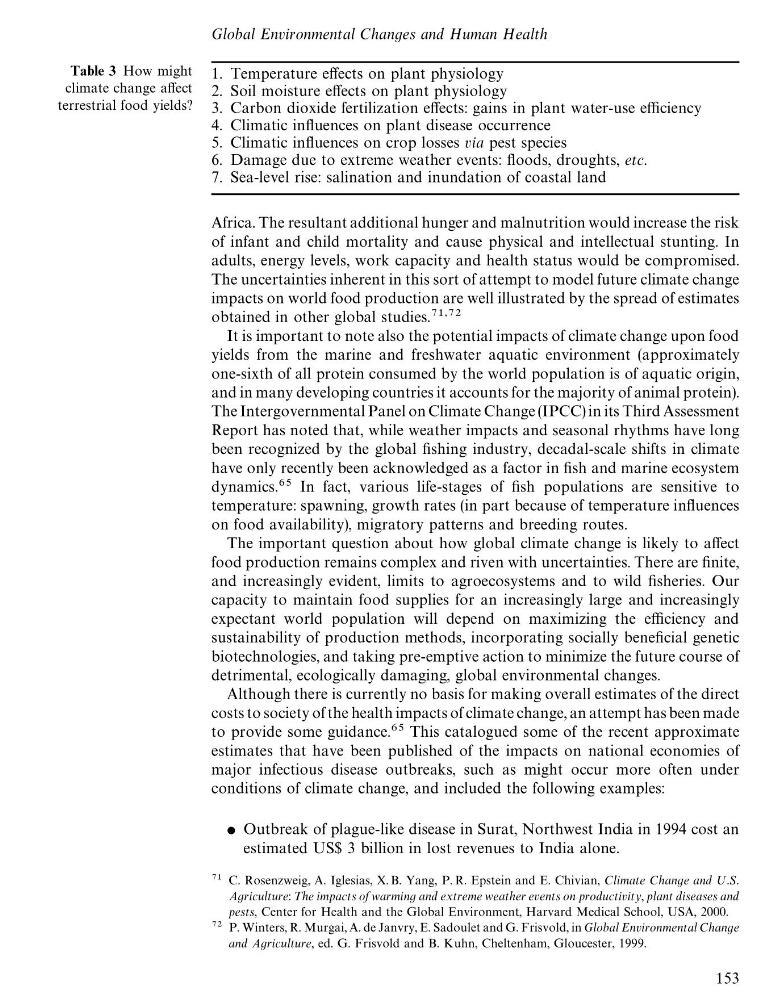
Table 3 How might
climate change affect
terrestrial food yields?
1. Temperature effects on plant physiology
2. Soil moisture effects on plant physiology
3. Carbon dioxide fertilization effects: gains in plant water-use efficiency
4. Climatic influences on plant disease occurrence
5. Climatic influences on crop losses via pest species
6. Damage due to extreme weather events: floods, droughts, etc.
7. Sea-level rise: salination and inundation of coastal land
Africa. The resultant additional hunger and malnutrition would increase the risk
of infant and child mortality and cause physical and intellectual stunting. In
adults, energy levels, work capacity and health status would be compromised.
The uncertainties inherent in this sort of attempt to model future climate change
impacts on world food production are well illustrated by the spread of estimates
obtained in other global studies.
It is important to note also the potential impacts of climate change upon food
yields from the marine and freshwater aquatic environment (approximately
one-sixth of all protein consumed by the world population is of aquatic origin,
and in many developing countries it accounts for the majority of animal protein).
The Intergovernmental Panel on Climate Change (IPCC) in its Third Assessment
Report has noted that, while weather impacts and seasonal rhythms have long
been recognized by the global fishing industry, decadal-scale shifts in climate
have only recently been acknowledged as a factor in fish and marine ecosystem
dynamics. In fact, various life-stages of fish populations are sensitive to
temperature: spawning, growth rates (in part because of temperature influences
on food availability), migratory patterns and breeding routes.
The important question about how global climate change is likely to affect
food production remains complex and riven with uncertainties. There are finite,
and increasingly evident, limits to agroecosystems and to wild fisheries. Our
capacity to maintain food supplies for an increasingly large and increasingly
expectant world population will depend on maximizing the efficiency and
sustainability of production methods, incorporating socially beneficial genetic
biotechnologies, and taking pre-emptive action to minimize the future course of
detrimental, ecologically damaging, global environmental changes.
Although there is currently no basis for making overall estimates of the direct
costs to society of the health impacts of climate change, an attempt has been made
to provide some guidance. This catalogued some of the recent approximate
estimates that have been published of the impacts on national economies of
major infectious disease outbreaks, such as might occur more often under
conditions of climate change, and included the following examples:
E Outbreak of plague-like disease in Surat, Northwest India in 1994 cost an
estimated US$ 3 billion in lost revenues to India alone.
C. Rosenzweig, A. Iglesias, X. B. Yang, P. R. Epstein and E. Chivian, Climate Change and U.S.
Agriculture: The impacts of warming and extreme weather events on productivity, plant diseases and
pests, Center for Health and the Global Environment, Harvard Medical School, USA, 2000.
P. Winters, R. Murgai, A. de Janvry, E. Sadoulet and G. Frisvold, in Global Environmental Change
and Agriculture, ed. G. Frisvold and B. Kuhn, Cheltenham, Gloucester, 1999.
Global Environmental Changes and Human Health
153
climate change affect
terrestrial food yields?
1. Temperature effects on plant physiology
2. Soil moisture effects on plant physiology
3. Carbon dioxide fertilization effects: gains in plant water-use efficiency
4. Climatic influences on plant disease occurrence
5. Climatic influences on crop losses via pest species
6. Damage due to extreme weather events: floods, droughts, etc.
7. Sea-level rise: salination and inundation of coastal land
Africa. The resultant additional hunger and malnutrition would increase the risk
of infant and child mortality and cause physical and intellectual stunting. In
adults, energy levels, work capacity and health status would be compromised.
The uncertainties inherent in this sort of attempt to model future climate change
impacts on world food production are well illustrated by the spread of estimates
obtained in other global studies.
It is important to note also the potential impacts of climate change upon food
yields from the marine and freshwater aquatic environment (approximately
one-sixth of all protein consumed by the world population is of aquatic origin,
and in many developing countries it accounts for the majority of animal protein).
The Intergovernmental Panel on Climate Change (IPCC) in its Third Assessment
Report has noted that, while weather impacts and seasonal rhythms have long
been recognized by the global fishing industry, decadal-scale shifts in climate
have only recently been acknowledged as a factor in fish and marine ecosystem
dynamics. In fact, various life-stages of fish populations are sensitive to
temperature: spawning, growth rates (in part because of temperature influences
on food availability), migratory patterns and breeding routes.
The important question about how global climate change is likely to affect
food production remains complex and riven with uncertainties. There are finite,
and increasingly evident, limits to agroecosystems and to wild fisheries. Our
capacity to maintain food supplies for an increasingly large and increasingly
expectant world population will depend on maximizing the efficiency and
sustainability of production methods, incorporating socially beneficial genetic
biotechnologies, and taking pre-emptive action to minimize the future course of
detrimental, ecologically damaging, global environmental changes.
Although there is currently no basis for making overall estimates of the direct
costs to society of the health impacts of climate change, an attempt has been made
to provide some guidance. This catalogued some of the recent approximate
estimates that have been published of the impacts on national economies of
major infectious disease outbreaks, such as might occur more often under
conditions of climate change, and included the following examples:
E Outbreak of plague-like disease in Surat, Northwest India in 1994 cost an
estimated US$ 3 billion in lost revenues to India alone.
C. Rosenzweig, A. Iglesias, X. B. Yang, P. R. Epstein and E. Chivian, Climate Change and U.S.
Agriculture: The impacts of warming and extreme weather events on productivity, plant diseases and
pests, Center for Health and the Global Environment, Harvard Medical School, USA, 2000.
P. Winters, R. Murgai, A. de Janvry, E. Sadoulet and G. Frisvold, in Global Environmental Change
and Agriculture, ed. G. Frisvold and B. Kuhn, Cheltenham, Gloucester, 1999.
Global Environmental Changes and Human Health
153