

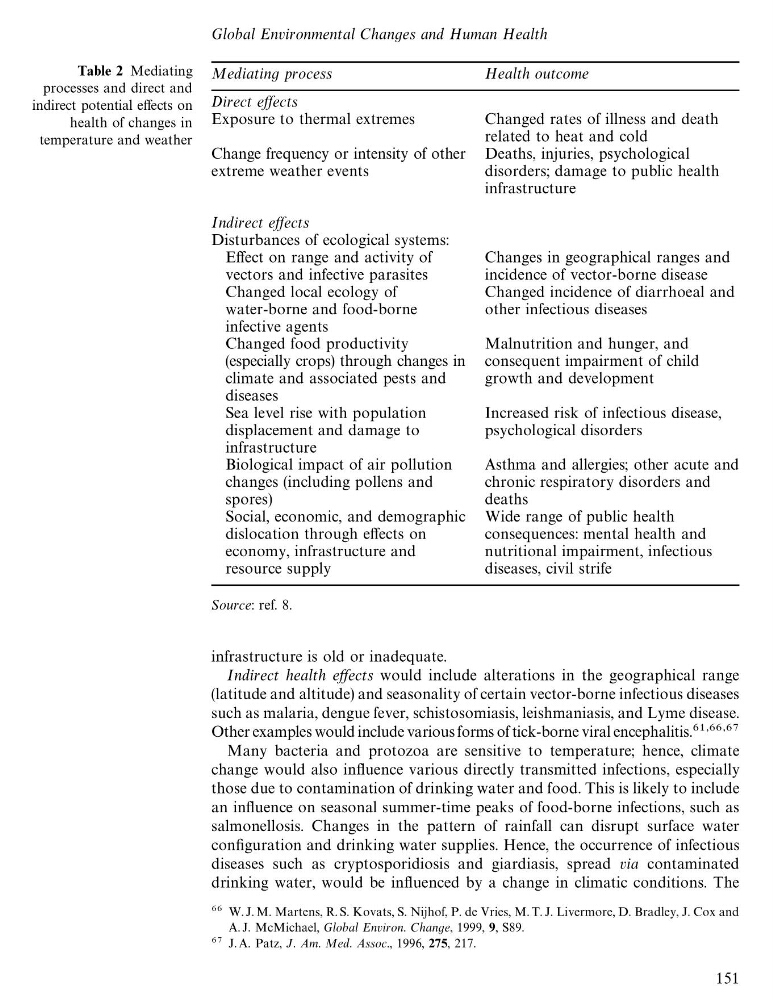
Table 2 Mediating
processes and direct and
indirect potential effects on
health of changes in
temperature and weather
Mediating process
Health outcome
Direct effects
Exposure to thermal extremes
Changed rates of illness and death
related to heat and cold
Change frequency or intensity of other
extreme weather events
Deaths, injuries, psychological
disorders; damage to public health
infrastructure
Indirect effects
Disturbances of ecological systems:
Effect on range and activity of
vectors and infective parasites
Changes in geographical ranges and
incidence of vector-borne disease
Changed local ecology of
water-borne and food-borne
infective agents
Changed incidence of diarrhoeal and
other infectious diseases
Changed food productivity
(especially crops) through changes in
climate and associated pests and
diseases
Malnutrition and hunger, and
consequent impairment of child
growth and development
Sea level rise with population
displacement and damage to
infrastructure
Increased risk of infectious disease,
psychological disorders
Biological impact of air pollution
changes (including pollens and
spores)
Asthma and allergies; other acute and
chronic respiratory disorders and
deaths
Social, economic, and demographic
dislocation through effects on
economy, infrastructure and
resource supply
Wide range of public health
consequences: mental health and
nutritional impairment, infectious
diseases, civil strife
Source: ref. 8.
infrastructure is old or inadequate.
Indirect health effects would include alterations in the geographical range
(latitude and altitude) and seasonality of certain vector-borne infectious diseases
such as malaria, dengue fever, schistosomiasis, leishmaniasis, and Lyme disease.
Other examples would include various forms of tick-borne viral encephalitis.
Many bacteria and protozoa are sensitive to temperature; hence, climate
change would also influence various directly transmitted infections, especially
those due to contamination of drinking water and food. This is likely to include
an influence on seasonal summer-time peaks of food-borne infections, such as
salmonellosis. Changes in the pattern of rainfall can disrupt surface water
configuration and drinking water supplies. Hence, the occurrence of infectious
diseases such as cryptosporidiosis and giardiasis, spread via contaminated
drinking water, would be influenced by a change in climatic conditions. The
W. J. M. Martens, R. S. Kovats, S. Nijhof, P. de Vries, M. T. J. Livermore, D. Bradley, J. Cox and
A. J. McMichael, Global Environ. Change, 1999, 9, S89.
J. A. Patz, J. Am. Med. Assoc., 1996, 275, 217.
Global Environmental Changes and Human Health
151
processes and direct and
indirect potential effects on
health of changes in
temperature and weather
Mediating process
Health outcome
Direct effects
Exposure to thermal extremes
Changed rates of illness and death
related to heat and cold
Change frequency or intensity of other
extreme weather events
Deaths, injuries, psychological
disorders; damage to public health
infrastructure
Indirect effects
Disturbances of ecological systems:
Effect on range and activity of
vectors and infective parasites
Changes in geographical ranges and
incidence of vector-borne disease
Changed local ecology of
water-borne and food-borne
infective agents
Changed incidence of diarrhoeal and
other infectious diseases
Changed food productivity
(especially crops) through changes in
climate and associated pests and
diseases
Malnutrition and hunger, and
consequent impairment of child
growth and development
Sea level rise with population
displacement and damage to
infrastructure
Increased risk of infectious disease,
psychological disorders
Biological impact of air pollution
changes (including pollens and
spores)
Asthma and allergies; other acute and
chronic respiratory disorders and
deaths
Social, economic, and demographic
dislocation through effects on
economy, infrastructure and
resource supply
Wide range of public health
consequences: mental health and
nutritional impairment, infectious
diseases, civil strife
Source: ref. 8.
infrastructure is old or inadequate.
Indirect health effects would include alterations in the geographical range
(latitude and altitude) and seasonality of certain vector-borne infectious diseases
such as malaria, dengue fever, schistosomiasis, leishmaniasis, and Lyme disease.
Other examples would include various forms of tick-borne viral encephalitis.
Many bacteria and protozoa are sensitive to temperature; hence, climate
change would also influence various directly transmitted infections, especially
those due to contamination of drinking water and food. This is likely to include
an influence on seasonal summer-time peaks of food-borne infections, such as
salmonellosis. Changes in the pattern of rainfall can disrupt surface water
configuration and drinking water supplies. Hence, the occurrence of infectious
diseases such as cryptosporidiosis and giardiasis, spread via contaminated
drinking water, would be influenced by a change in climatic conditions. The
W. J. M. Martens, R. S. Kovats, S. Nijhof, P. de Vries, M. T. J. Livermore, D. Bradley, J. Cox and
A. J. McMichael, Global Environ. Change, 1999, 9, S89.
J. A. Patz, J. Am. Med. Assoc., 1996, 275, 217.
Global Environmental Changes and Human Health
151