

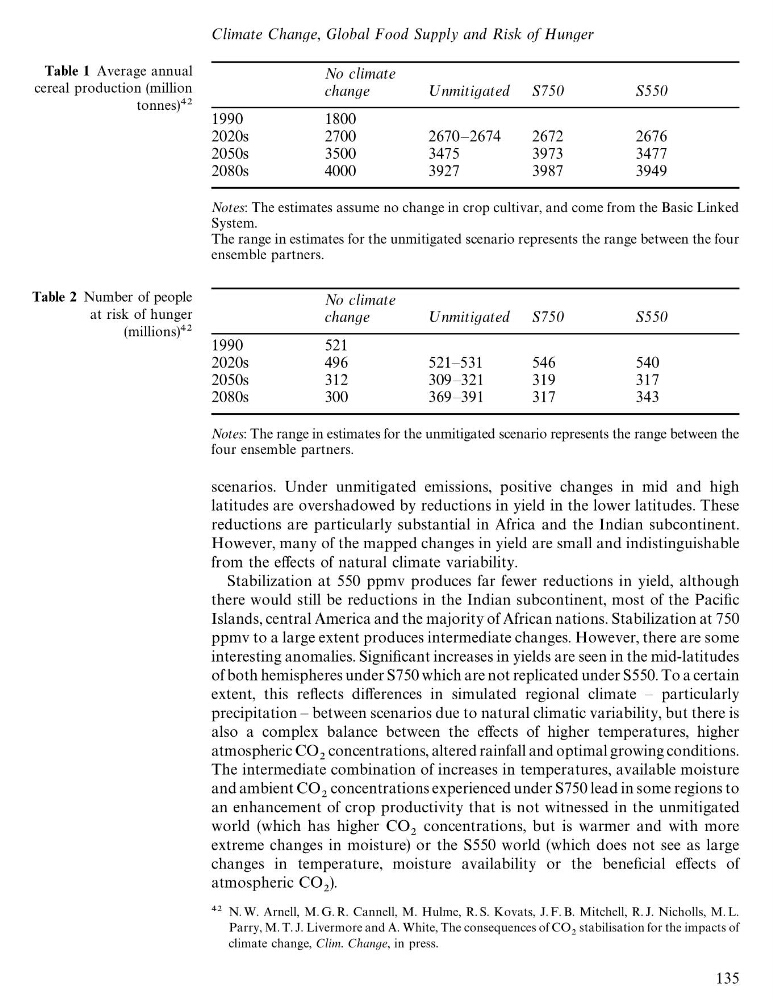
Table 1 Average annual
cereal production (million
tonnes)
No climate
change
Unmitigated S750
S550
1990
1800
2020s
2700
2670—2674
2672
2676
2050s
3500
3475
3973
3477
2080s
4000
3927
3987
3949
Notes: The estimates assume no change in crop cultivar, and come from the Basic Linked
System.
The range in estimates for the unmitigated scenario represents the range between the four
ensemble partners.
Table 2 Number of people
at risk of hunger
(millions)
No climate
change
Unmitigated S750
S550
1990
521
2020s
496
521—531
546
540
2050s
312
309—321
319
317
2080s
300
369—391
317
343
Notes: The range in estimates for the unmitigated scenario represents the range between the
four ensemble partners.
scenarios. Under unmitigated emissions, positive changes in mid and high
latitudes are overshadowed by reductions in yield in the lower latitudes. These
reductions are particularly substantial in Africa and the Indian subcontinent.
However, many of the mapped changes in yield are small and indistinguishable
from the effects of natural climate variability.
Stabilization at 550 ppmv produces far fewer reductions in yield, although
there would still be reductions in the Indian subcontinent, most of the Pacific
Islands, central America and the majority of African nations. Stabilization at 750
ppmv to a large extent produces intermediate changes. However, there are some
interesting anomalies. Significant increases in yields are seen in the mid-latitudes
of both hemispheres under S750 which are not replicated under S550. To a certain
extent, this reflects differences in simulated regional climate — particularly
precipitation — between scenarios due to natural climatic variability, but there is
also a complex balance between the effects of higher temperatures, higher
atmospheric CO
concentrations, altered rainfall and optimal growing conditions.
The intermediate combination of increases in temperatures, available moisture
and ambient CO
concentrations experienced under S750 lead in some regions to
an enhancement of crop productivity that is not witnessed in the unmitigated
world (which has higher CO
concentrations, but is warmer and with more
extreme changes in moisture) or the S550 world (which does not see as large
changes in temperature, moisture availability or the beneficial effects of
atmospheric CO
).
N. W. Arnell, M. G. R. Cannell, M. Hulme, R. S. Kovats, J. F. B. Mitchell, R. J. Nicholls, M. L.
Parry, M. T. J. Livermore and A. White, The consequences of CO
stabilisation for the impacts of
climate change, Clim. Change, in press.
Climate Change, Global Food Supply and Risk of Hunger
135
cereal production (million
tonnes)
No climate
change
Unmitigated S750
S550
1990
1800
2020s
2700
2670—2674
2672
2676
2050s
3500
3475
3973
3477
2080s
4000
3927
3987
3949
Notes: The estimates assume no change in crop cultivar, and come from the Basic Linked
System.
The range in estimates for the unmitigated scenario represents the range between the four
ensemble partners.
Table 2 Number of people
at risk of hunger
(millions)
No climate
change
Unmitigated S750
S550
1990
521
2020s
496
521—531
546
540
2050s
312
309—321
319
317
2080s
300
369—391
317
343
Notes: The range in estimates for the unmitigated scenario represents the range between the
four ensemble partners.
scenarios. Under unmitigated emissions, positive changes in mid and high
latitudes are overshadowed by reductions in yield in the lower latitudes. These
reductions are particularly substantial in Africa and the Indian subcontinent.
However, many of the mapped changes in yield are small and indistinguishable
from the effects of natural climate variability.
Stabilization at 550 ppmv produces far fewer reductions in yield, although
there would still be reductions in the Indian subcontinent, most of the Pacific
Islands, central America and the majority of African nations. Stabilization at 750
ppmv to a large extent produces intermediate changes. However, there are some
interesting anomalies. Significant increases in yields are seen in the mid-latitudes
of both hemispheres under S750 which are not replicated under S550. To a certain
extent, this reflects differences in simulated regional climate — particularly
precipitation — between scenarios due to natural climatic variability, but there is
also a complex balance between the effects of higher temperatures, higher
atmospheric CO
concentrations, altered rainfall and optimal growing conditions.
The intermediate combination of increases in temperatures, available moisture
and ambient CO
concentrations experienced under S750 lead in some regions to
an enhancement of crop productivity that is not witnessed in the unmitigated
world (which has higher CO
concentrations, but is warmer and with more
extreme changes in moisture) or the S550 world (which does not see as large
changes in temperature, moisture availability or the beneficial effects of
atmospheric CO
).
N. W. Arnell, M. G. R. Cannell, M. Hulme, R. S. Kovats, J. F. B. Mitchell, R. J. Nicholls, M. L.
Parry, M. T. J. Livermore and A. White, The consequences of CO
stabilisation for the impacts of
climate change, Clim. Change, in press.
Climate Change, Global Food Supply and Risk of Hunger
135