

/
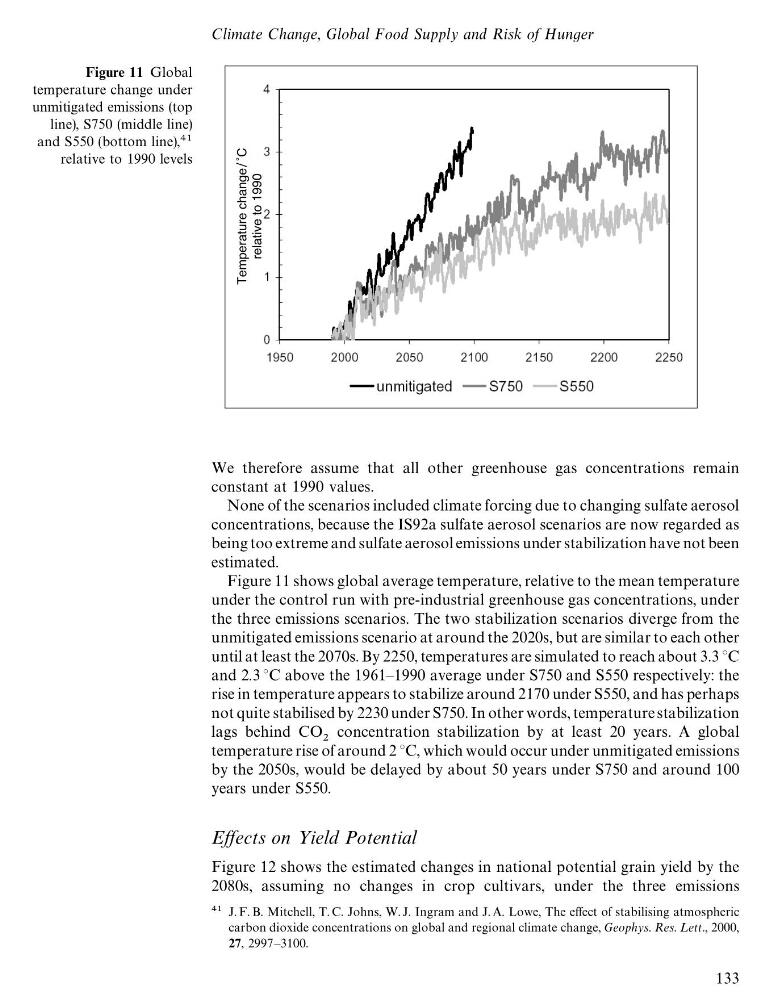
Figure 11 Global
temperature change under
unmitigated emissions (top
line), S750 (middle line)
and S550 (bottom line),
relative to 1990 levels
We therefore assume that all other greenhouse gas concentrations remain
constant at 1990 values.
None of the scenarios included climate forcing due to changing sulfate aerosol
concentrations, because the IS92a sulfate aerosol scenarios are now regarded as
being too extreme and sulfate aerosol emissions under stabilization have not been
estimated.
Figure 11 shows global average temperature, relative to the mean temperature
under the control run with pre-industrial greenhouse gas concentrations, under
the three emissions scenarios. The two stabilization scenarios diverge from the
unmitigated emissions scenario at around the 2020s, but are similar to each other
until at least the 2070s. By 2250, temperatures are simulated to reach about 3.3 °C
and 2.3 °C above the 1961—1990 average under S750 and S550 respectively: the
rise in temperature appears to stabilize around 2170 under S550, and has perhaps
not quite stabilised by 2230 under S750. In other words, temperature stabilization
lags behind CO
concentration stabilization by at least 20 years. A global
temperature rise of around 2 °C, which would occur under unmitigated emissions
by the 2050s, would be delayed by about 50 years under S750 and around 100
years under S550.
Effects on Yield Potential
Figure 12 shows the estimated changes in national potential grain yield by the
2080s, assuming no changes in crop cultivars, under the three emissions
J. F. B. Mitchell, T. C. Johns, W. J. Ingram and J. A. Lowe, The effect of stabilising atmospheric
carbon dioxide concentrations on global and regional climate change, Geophys. Res. Lett., 2000,
27, 2997—3100.
Climate Change, Global Food Supply and Risk of Hunger
133
Figure 11 Global
temperature change under
unmitigated emissions (top
line), S750 (middle line)
and S550 (bottom line),
relative to 1990 levels
We therefore assume that all other greenhouse gas concentrations remain
constant at 1990 values.
None of the scenarios included climate forcing due to changing sulfate aerosol
concentrations, because the IS92a sulfate aerosol scenarios are now regarded as
being too extreme and sulfate aerosol emissions under stabilization have not been
estimated.
Figure 11 shows global average temperature, relative to the mean temperature
under the control run with pre-industrial greenhouse gas concentrations, under
the three emissions scenarios. The two stabilization scenarios diverge from the
unmitigated emissions scenario at around the 2020s, but are similar to each other
until at least the 2070s. By 2250, temperatures are simulated to reach about 3.3 °C
and 2.3 °C above the 1961—1990 average under S750 and S550 respectively: the
rise in temperature appears to stabilize around 2170 under S550, and has perhaps
not quite stabilised by 2230 under S750. In other words, temperature stabilization
lags behind CO
concentration stabilization by at least 20 years. A global
temperature rise of around 2 °C, which would occur under unmitigated emissions
by the 2050s, would be delayed by about 50 years under S750 and around 100
years under S550.
Effects on Yield Potential
Figure 12 shows the estimated changes in national potential grain yield by the
2080s, assuming no changes in crop cultivars, under the three emissions
J. F. B. Mitchell, T. C. Johns, W. J. Ingram and J. A. Lowe, The effect of stabilising atmospheric
carbon dioxide concentrations on global and regional climate change, Geophys. Res. Lett., 2000,
27, 2997—3100.
Climate Change, Global Food Supply and Risk of Hunger
133