

Retreat
Accommodation
·
Protection
-- soft or hard
·
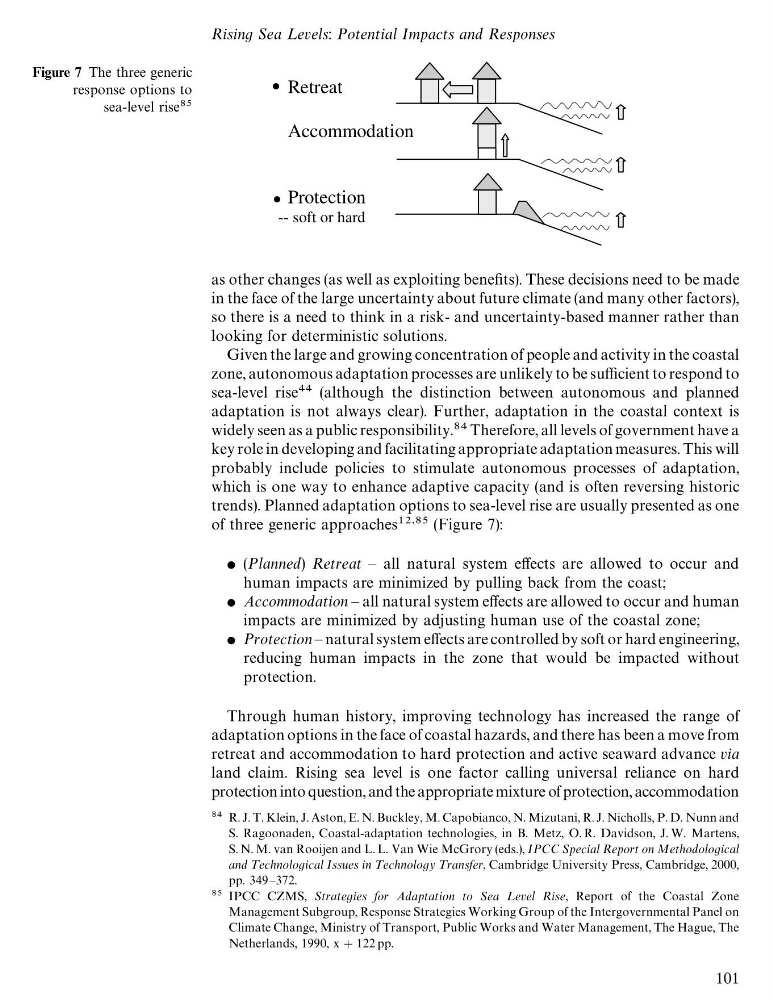
Figure 7 The three generic
response options to
sea-level rise
as other changes (as well as exploiting benefits). These decisions need to be made
in the face of the large uncertainty about future climate (and many other factors),
so there is a need to think in a risk- and uncertainty-based manner rather than
looking for deterministic solutions.
Given the large and growing concentration of people and activity in the coastal
zone, autonomous adaptation processes are unlikely to be sufficient to respond to
sea-level rise (although the distinction between autonomous and planned
adaptation is not always clear). Further, adaptation in the coastal context is
widely seen as a public responsibility. Therefore, all levels of government have a
key role in developing and facilitating appropriate adaptation measures. This will
probably include policies to stimulate autonomous processes of adaptation,
which is one way to enhance adaptive capacity (and is often reversing historic
trends). Planned adaptation options to sea-level rise are usually presented as one
of three generic approaches (Figure 7):
E (Planned) Retreat — all natural system effects are allowed to occur and
human impacts are minimized by pulling back from the coast;
E Accommodation — all natural system effects are allowed to occur and human
impacts are minimized by adjusting human use of the coastal zone;
E Protection — natural system effects are controlled by soft or hard engineering,
reducing human impacts in the zone that would be impacted without
protection.
Through human history, improving technology has increased the range of
adaptation options in the face of coastal hazards, and there has been a move from
retreat and accommodation to hard protection and active seaward advance via
land claim. Rising sea level is one factor calling universal reliance on hard
protection into question, and the appropriate mixture of protection, accommodation
R. J. T. Klein, J. Aston, E. N. Buckley, M. Capobianco, N. Mizutani, R. J. Nicholls, P. D. Nunn and
S. Ragoonaden, Coastal-adaptation technologies, in B. Metz, O. R. Davidson, J. W. Martens,
S. N. M. van Rooijen and L. L. Van Wie McGrory (eds.), IPCC Special Report on Methodological
and Technological Issues in Technology Transfer, Cambridge University Press, Cambridge, 2000,
pp. 349—372.
IPCC CZMS, Strategies for Adaptation to Sea Level Rise, Report of the Coastal Zone
Management Subgroup, Response Strategies Working Group of the Intergovernmental Panel on
Climate Change, Ministry of Transport, Public Works and Water Management, The Hague, The
Netherlands, 1990, x ; 122 pp.
Rising Sea Levels: Potential Impacts and Responses
101
Accommodation
·
Protection
-- soft or hard
·
Figure 7 The three generic
response options to
sea-level rise
as other changes (as well as exploiting benefits). These decisions need to be made
in the face of the large uncertainty about future climate (and many other factors),
so there is a need to think in a risk- and uncertainty-based manner rather than
looking for deterministic solutions.
Given the large and growing concentration of people and activity in the coastal
zone, autonomous adaptation processes are unlikely to be sufficient to respond to
sea-level rise (although the distinction between autonomous and planned
adaptation is not always clear). Further, adaptation in the coastal context is
widely seen as a public responsibility. Therefore, all levels of government have a
key role in developing and facilitating appropriate adaptation measures. This will
probably include policies to stimulate autonomous processes of adaptation,
which is one way to enhance adaptive capacity (and is often reversing historic
trends). Planned adaptation options to sea-level rise are usually presented as one
of three generic approaches (Figure 7):
E (Planned) Retreat — all natural system effects are allowed to occur and
human impacts are minimized by pulling back from the coast;
E Accommodation — all natural system effects are allowed to occur and human
impacts are minimized by adjusting human use of the coastal zone;
E Protection — natural system effects are controlled by soft or hard engineering,
reducing human impacts in the zone that would be impacted without
protection.
Through human history, improving technology has increased the range of
adaptation options in the face of coastal hazards, and there has been a move from
retreat and accommodation to hard protection and active seaward advance via
land claim. Rising sea level is one factor calling universal reliance on hard
protection into question, and the appropriate mixture of protection, accommodation
R. J. T. Klein, J. Aston, E. N. Buckley, M. Capobianco, N. Mizutani, R. J. Nicholls, P. D. Nunn and
S. Ragoonaden, Coastal-adaptation technologies, in B. Metz, O. R. Davidson, J. W. Martens,
S. N. M. van Rooijen and L. L. Van Wie McGrory (eds.), IPCC Special Report on Methodological
and Technological Issues in Technology Transfer, Cambridge University Press, Cambridge, 2000,
pp. 349—372.
IPCC CZMS, Strategies for Adaptation to Sea Level Rise, Report of the Coastal Zone
Management Subgroup, Response Strategies Working Group of the Intergovernmental Panel on
Climate Change, Ministry of Transport, Public Works and Water Management, The Hague, The
Netherlands, 1990, x ; 122 pp.
Rising Sea Levels: Potential Impacts and Responses
101