

1000
3000
2000
0
Constant Protection
Low estimate
2020s
2050s
2080s
Year
% Increase
0
Mid estimate
2020s
2050s
2080s
0
High estimate
2020s
2050s
2080s
0
Evolving Protection
Low estimate
2020s
2050s
2080s
0
Mid estimate
2020s
2050s
2080s
0
High estimate
2020s
2050s
2080s
1000
3000
2000
% Increase
1000
3000
2000
% Increase
1000
3000
2000
% Increase
1000
3000
2000
% Increase
1000
3000
2000
% Increase
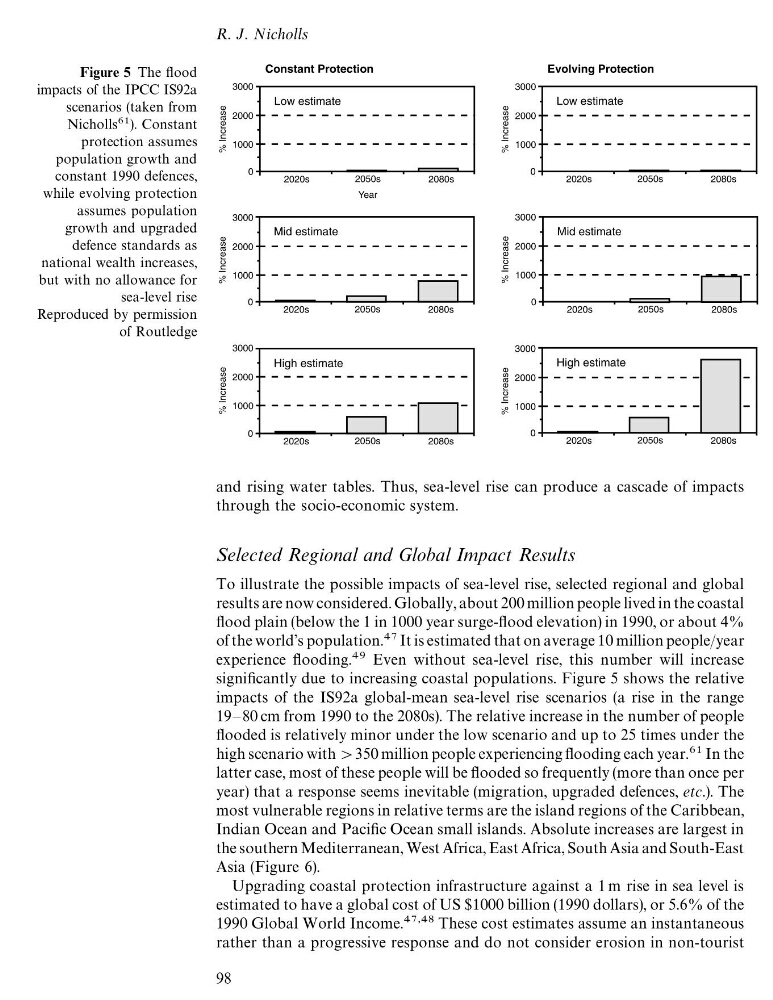
Figure 5 The flood
impacts of the IPCC IS92a
scenarios (taken from
Nicholls). Constant
protection assumes
population growth and
constant 1990 defences,
while evolving protection
assumes population
growth and upgraded
defence standards as
national wealth increases,
but with no allowance for
sea-level rise
Reproduced by permission
of Routledge
and rising water tables. Thus, sea-level rise can produce a cascade of impacts
through the socio-economic system.
Selected Regional and Global Impact Results
To illustrate the possible impacts of sea-level rise, selected regional and global
results are now considered. Globally, about 200 million people lived in the coastal
flood plain (below the 1 in 1000 year surge-flood elevation) in 1990, or about 4%
of the world’s population. It is estimated that on average 10 million people/year
experience flooding. Even without sea-level rise, this number will increase
significantly due to increasing coastal populations. Figure 5 shows the relative
impacts of the IS92a global-mean sea-level rise scenarios (a rise in the range
19—80 cm from 1990 to the 2080s). The relative increase in the number of people
flooded is relatively minor under the low scenario and up to 25 times under the
high scenario with 9350 million people experiencing flooding each year. In the
latter case, most of these people will be flooded so frequently (more than once per
year) that a response seems inevitable (migration, upgraded defences, etc.). The
most vulnerable regions in relative terms are the island regions of the Caribbean,
Indian Ocean and Pacific Ocean small islands. Absolute increases are largest in
the southern Mediterranean, West Africa, East Africa, South Asia and South-East
Asia (Figure 6).
Upgrading coastal protection infrastructure against a 1 m rise in sea level is
estimated to have a global cost of US $1000 billion (1990 dollars), or 5.6% of the
1990 Global World Income. These cost estimates assume an instantaneous
rather than a progressive response and do not consider erosion in non-tourist
R. J. Nicholls
98
3000
2000
0
Constant Protection
Low estimate
2020s
2050s
2080s
Year
% Increase
0
Mid estimate
2020s
2050s
2080s
0
High estimate
2020s
2050s
2080s
0
Evolving Protection
Low estimate
2020s
2050s
2080s
0
Mid estimate
2020s
2050s
2080s
0
High estimate
2020s
2050s
2080s
1000
3000
2000
% Increase
1000
3000
2000
% Increase
1000
3000
2000
% Increase
1000
3000
2000
% Increase
1000
3000
2000
% Increase
Figure 5 The flood
impacts of the IPCC IS92a
scenarios (taken from
Nicholls). Constant
protection assumes
population growth and
constant 1990 defences,
while evolving protection
assumes population
growth and upgraded
defence standards as
national wealth increases,
but with no allowance for
sea-level rise
Reproduced by permission
of Routledge
and rising water tables. Thus, sea-level rise can produce a cascade of impacts
through the socio-economic system.
Selected Regional and Global Impact Results
To illustrate the possible impacts of sea-level rise, selected regional and global
results are now considered. Globally, about 200 million people lived in the coastal
flood plain (below the 1 in 1000 year surge-flood elevation) in 1990, or about 4%
of the world’s population. It is estimated that on average 10 million people/year
experience flooding. Even without sea-level rise, this number will increase
significantly due to increasing coastal populations. Figure 5 shows the relative
impacts of the IS92a global-mean sea-level rise scenarios (a rise in the range
19—80 cm from 1990 to the 2080s). The relative increase in the number of people
flooded is relatively minor under the low scenario and up to 25 times under the
high scenario with 9350 million people experiencing flooding each year. In the
latter case, most of these people will be flooded so frequently (more than once per
year) that a response seems inevitable (migration, upgraded defences, etc.). The
most vulnerable regions in relative terms are the island regions of the Caribbean,
Indian Ocean and Pacific Ocean small islands. Absolute increases are largest in
the southern Mediterranean, West Africa, East Africa, South Asia and South-East
Asia (Figure 6).
Upgrading coastal protection infrastructure against a 1 m rise in sea level is
estimated to have a global cost of US $1000 billion (1990 dollars), or 5.6% of the
1990 Global World Income. These cost estimates assume an instantaneous
rather than a progressive response and do not consider erosion in non-tourist
R. J. Nicholls
98