

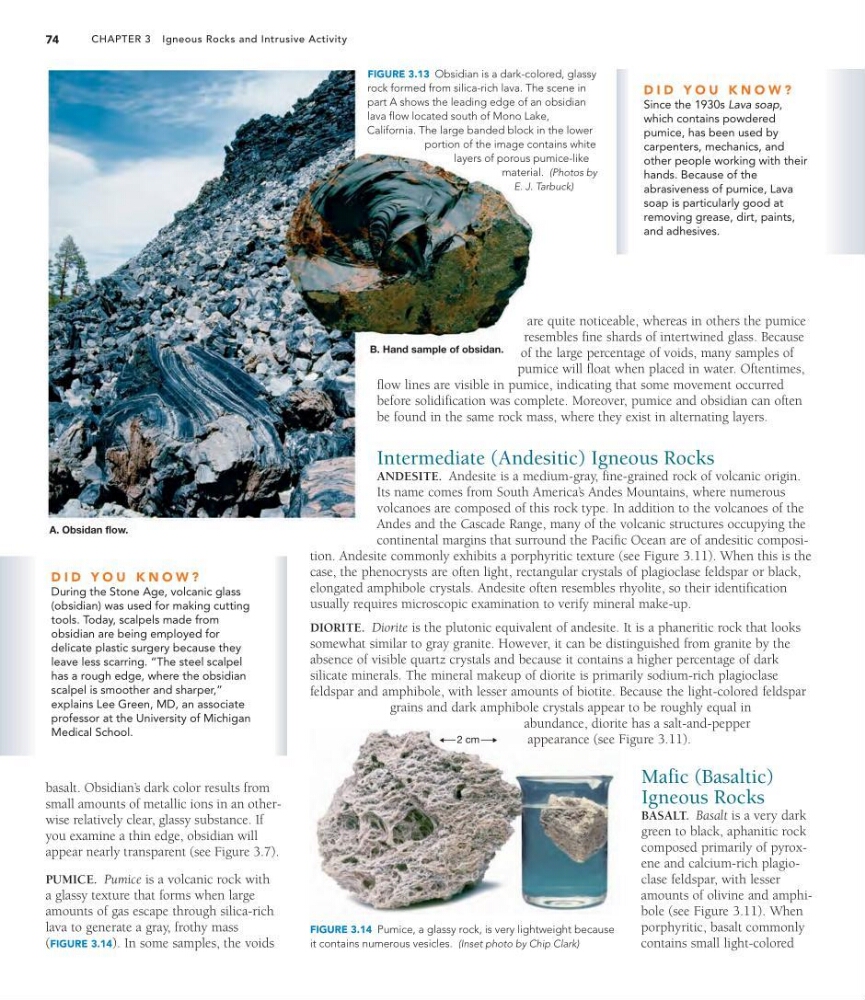
2 cm
B. Hand sample of obsidan.
A. Obsidan flow.
CHAPTER 3 Igneous Rocks and Intrusive Activity
74
FIGURE 3.13 Obsidian is a dark-colored, glassy
rock formed from silica-rich lava. The scene in
part A shows the leading edge of an obsidian
lava flow located south of Mono Lake,
California. The large banded block in the lower
portion of the image contains white
layers of porous pumice-like
material. (Photos by
E. J. Tarbuck)
D I D Y O U K N O W ?
During the Stone Age, volcanic glass
(obsidian) was used for making cutting
tools. Today, scalpels made from
obsidian are being employed for
delicate plastic surgery because they
leave less scarring. “The steel scalpel
has a rough edge, where the obsidian
scalpel is smoother and sharper,”
explains Lee Green, MD, an associate
professor at the University of Michigan
Medical School.
D I D Y O U K N O W ?
Since the 1930s Lava soap,
which contains powdered
pumice, has been used by
carpenters, mechanics, and
other people working with their
hands. Because of the
abrasiveness of pumice, Lava
soap is particularly good at
removing grease, dirt, paints,
and adhesives.
basalt. Obsidian’ s dark color results from
small amounts of metallic ions in an otherwise relatively clear, glassy substance. If
you examine a thin edge, obsidian will
appear nearly transparent (see Figure 3.7).
PUMICE. Pumice is a volcanic rock with
a glassy texture that forms when large
amounts of gas escape through silica-rich
lava to generate a gray, frothy mass
(FIGURE 3.14). In some samples, the voids
are quite noticeable, whereas in others the pumice
resembles fine shards of intertwined glass. Because
of the large percentage of voids, many samples of
pumice will float when placed in water. Oftentimes,
flow lines are visible in pumice, indicating that some movement occurred
before solidification was complete. Moreover, pumice and obsidian can often
be found in the same rock mass, where they exist in alternating layers.
Intermediate (Andesitic) Igneous Rocks
ANDESITE. Andesite is a medium-gray, fine-grained rock of volcanic origin.
Its name comes from South America’ s Andes Mountains, where numerous
volcanoes are composed of this rock type. In addition to the volcanoes of the
Andes and the Cascade Range, many of the volcanic structures occupying the
continental margins that surround the Pacific Ocean are of andesitic composition. Andesite commonly exhibits a porphyritic texture (see Figure 3.11). When this is the
case, the phenocrysts are often light, rectangular crystals of plagioclase feldspar or black,
elongated amphibole crystals. Andesite often resembles rhyolite, so their identification
usually requires microscopic examination to verify mineral make-up.
DIORITE. Diorite is the plutonic equivalent of andesite. It is a phaneritic rock that looks
somewhat similar to gray granite. However, it can be distinguished from granite by the
absence of visible quartz crystals and because it contains a higher percentage of dark
silicate minerals. The mineral makeup of diorite is primarily sodium-rich plagioclase
feldspar and amphibole, with lesser amounts of biotite. Because the light-colored feldspar
grains and dark amphibole crystals appear to be roughly equal in
abundance, diorite has a salt-and-pepper
appearance (see Figure 3.11).
Mafic (Basaltic)
Igneous Rocks
BASALT. Basalt is a very dark
green to black, aphanitic rock
composed primarily of pyroxene and calcium-rich plagioclase feldspar, with lesser
amounts of olivine and amphibole (see Figure 3.11). When
porphyritic, basalt commonly
contains small light-colored
FIGURE 3.14 Pumice, a glassy rock, is very lightweight because
it contains numerous vesicles. (Inset photo by Chip Clark)
B. Hand sample of obsidan.
A. Obsidan flow.
CHAPTER 3 Igneous Rocks and Intrusive Activity
74
FIGURE 3.13 Obsidian is a dark-colored, glassy
rock formed from silica-rich lava. The scene in
part A shows the leading edge of an obsidian
lava flow located south of Mono Lake,
California. The large banded block in the lower
portion of the image contains white
layers of porous pumice-like
material. (Photos by
E. J. Tarbuck)
D I D Y O U K N O W ?
During the Stone Age, volcanic glass
(obsidian) was used for making cutting
tools. Today, scalpels made from
obsidian are being employed for
delicate plastic surgery because they
leave less scarring. “The steel scalpel
has a rough edge, where the obsidian
scalpel is smoother and sharper,”
explains Lee Green, MD, an associate
professor at the University of Michigan
Medical School.
D I D Y O U K N O W ?
Since the 1930s Lava soap,
which contains powdered
pumice, has been used by
carpenters, mechanics, and
other people working with their
hands. Because of the
abrasiveness of pumice, Lava
soap is particularly good at
removing grease, dirt, paints,
and adhesives.
basalt. Obsidian’ s dark color results from
small amounts of metallic ions in an otherwise relatively clear, glassy substance. If
you examine a thin edge, obsidian will
appear nearly transparent (see Figure 3.7).
PUMICE. Pumice is a volcanic rock with
a glassy texture that forms when large
amounts of gas escape through silica-rich
lava to generate a gray, frothy mass
(FIGURE 3.14). In some samples, the voids
are quite noticeable, whereas in others the pumice
resembles fine shards of intertwined glass. Because
of the large percentage of voids, many samples of
pumice will float when placed in water. Oftentimes,
flow lines are visible in pumice, indicating that some movement occurred
before solidification was complete. Moreover, pumice and obsidian can often
be found in the same rock mass, where they exist in alternating layers.
Intermediate (Andesitic) Igneous Rocks
ANDESITE. Andesite is a medium-gray, fine-grained rock of volcanic origin.
Its name comes from South America’ s Andes Mountains, where numerous
volcanoes are composed of this rock type. In addition to the volcanoes of the
Andes and the Cascade Range, many of the volcanic structures occupying the
continental margins that surround the Pacific Ocean are of andesitic composition. Andesite commonly exhibits a porphyritic texture (see Figure 3.11). When this is the
case, the phenocrysts are often light, rectangular crystals of plagioclase feldspar or black,
elongated amphibole crystals. Andesite often resembles rhyolite, so their identification
usually requires microscopic examination to verify mineral make-up.
DIORITE. Diorite is the plutonic equivalent of andesite. It is a phaneritic rock that looks
somewhat similar to gray granite. However, it can be distinguished from granite by the
absence of visible quartz crystals and because it contains a higher percentage of dark
silicate minerals. The mineral makeup of diorite is primarily sodium-rich plagioclase
feldspar and amphibole, with lesser amounts of biotite. Because the light-colored feldspar
grains and dark amphibole crystals appear to be roughly equal in
abundance, diorite has a salt-and-pepper
appearance (see Figure 3.11).
Mafic (Basaltic)
Igneous Rocks
BASALT. Basalt is a very dark
green to black, aphanitic rock
composed primarily of pyroxene and calcium-rich plagioclase feldspar, with lesser
amounts of olivine and amphibole (see Figure 3.11). When
porphyritic, basalt commonly
contains small light-colored
FIGURE 3.14 Pumice, a glassy rock, is very lightweight because
it contains numerous vesicles. (Inset photo by Chip Clark)