

CHAPTER 2 Matter and Minerals
60
G I V E I T S O M E T H O U G H T
Using the geologic definition of mineral as your guide, determine
which of the items on the list are minerals and which are not. If not
a mineral, explain.
a. gold nugget
b. sea water
c. quartz
d. cubic zirconia
e. obsidian
f. ruby
g. glacial ice
h. amber
Refer to the Periodic Table of the Elements (Figure 2.5) to help you
answer questions 2, 3, and 4:
If the number of protons in a neutral atom is 92 and its mass
number is 238:
a. What is the name of that element?
b. How many electrons does it have?
c. How many neutrons does it have?
Which of the following elements is more likely to form chemical
bonds: Xenon (Xe) or Sodium (Na)? Explain why.
The information below refers to three isotopes of the element
potassium. Using this information, determine the appropriate
number of protons and neutrons for each isotope. Label each
isotope in the manner used in the chapter.
Gold has a specific gravity of almost 20. A 5-gallon bucket of water
weighs 40 pounds. How much would a 5-gallon bucket of gold
weigh?
5
4
3
2
1
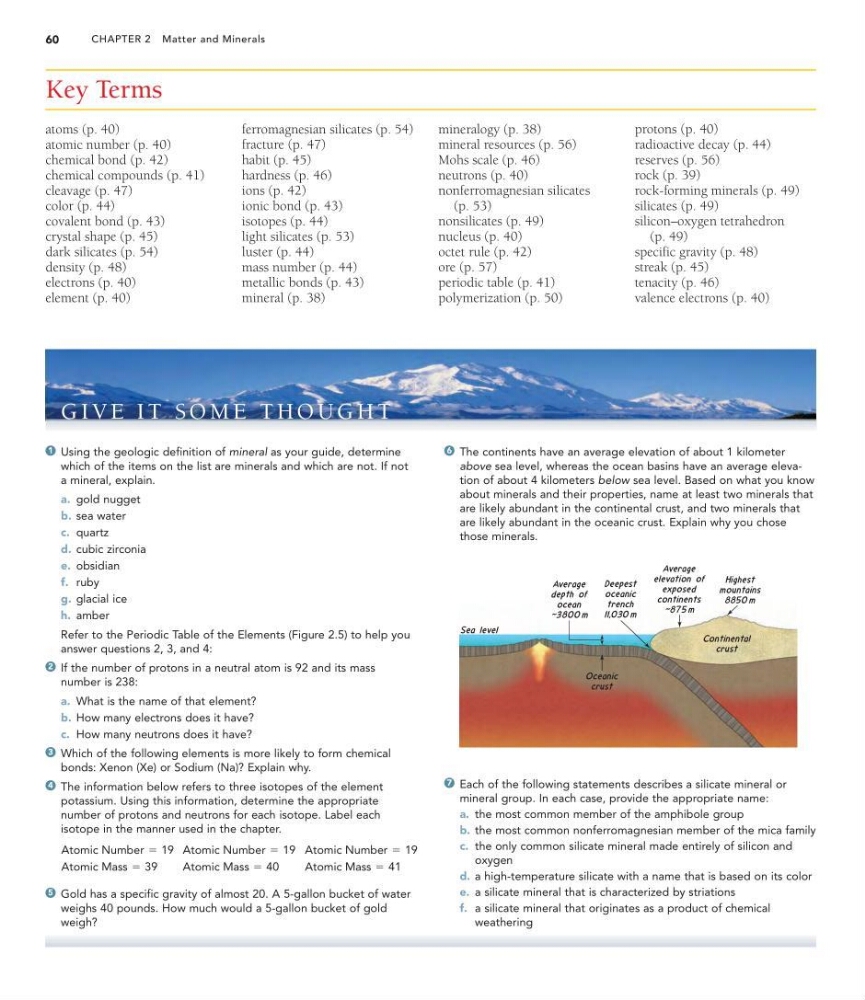
The continents have an average elevation of about 1 kilometer
above sea level, whereas the ocean basins have an average elevation of about 4 kilometers below sea level. Based on what you know
about minerals and their properties, name at least two minerals that
are likely abundant in the continental crust, and two minerals that
are likely abundant in the oceanic crust. Explain why you chose
those minerals.
Each of the following statements describes a silicate mineral or
mineral group. In each case, provide the appropriate name:
a. the most common member of the amphibole group
b. the most common nonferromagnesian member of the mica family
c. the only common silicate mineral made entirely of silicon and
oxygen
d. a high-temperature silicate with a name that is based on its color
e. a silicate mineral that is characterized by striations
f. a silicate mineral that originates as a product of chemical
weathering
7
6
Average
depth of
ocean
~ 3800 m
Highest
mountains
8850 m
Deepest
oceanic
trench
11,030 m
Sea level
Oceanic
crust
Continental
crust
Average
elevation of
exposed
continents
~ 875 m
Atomic Number = 19 Atomic Number = 19 Atomic Number = 19
Atomic Mass = 39
Atomic Mass = 40
Atomic Mass = 41
Key Terms
atoms (p. 40)
atomic number (p. 40)
chemical bond (p. 42)
chemical compounds (p. 41)
cleavage (p. 47)
color (p. 44)
covalent bond (p. 43)
crystal shape (p. 45)
dark silicates (p. 54)
density (p. 48)
electrons (p. 40)
element (p. 40)
ferromagnesian silicates (p. 54)
fracture (p. 47)
habit (p. 45)
hardness (p. 46)
ions (p. 42)
ionic bond (p. 43)
isotopes (p. 44)
light silicates (p. 53)
luster (p. 44)
mass number (p. 44)
metallic bonds (p. 43)
mineral (p. 38)
mineralogy (p. 38)
mineral resources (p. 56)
Mohs scale (p. 46)
neutrons (p. 40)
nonferromagnesian silicates
(p. 53)
nonsilicates (p. 49)
nucleus (p. 40)
octet rule (p. 42)
ore (p. 57)
periodic table (p. 41)
polymerization (p. 50)
protons (p. 40)
radioactive decay (p. 44)
reserves (p. 56)
rock (p. 39)
rock-forming minerals (p. 49)
silicates (p. 49)
silicon–oxygen tetrahedron
(p. 49)
specific gravity (p. 48)
streak (p. 45)
tenacity (p. 46)
valence electrons (p. 40)
60
G I V E I T S O M E T H O U G H T
Using the geologic definition of mineral as your guide, determine
which of the items on the list are minerals and which are not. If not
a mineral, explain.
a. gold nugget
b. sea water
c. quartz
d. cubic zirconia
e. obsidian
f. ruby
g. glacial ice
h. amber
Refer to the Periodic Table of the Elements (Figure 2.5) to help you
answer questions 2, 3, and 4:
If the number of protons in a neutral atom is 92 and its mass
number is 238:
a. What is the name of that element?
b. How many electrons does it have?
c. How many neutrons does it have?
Which of the following elements is more likely to form chemical
bonds: Xenon (Xe) or Sodium (Na)? Explain why.
The information below refers to three isotopes of the element
potassium. Using this information, determine the appropriate
number of protons and neutrons for each isotope. Label each
isotope in the manner used in the chapter.
Gold has a specific gravity of almost 20. A 5-gallon bucket of water
weighs 40 pounds. How much would a 5-gallon bucket of gold
weigh?
5
4
3
2
1
The continents have an average elevation of about 1 kilometer
above sea level, whereas the ocean basins have an average elevation of about 4 kilometers below sea level. Based on what you know
about minerals and their properties, name at least two minerals that
are likely abundant in the continental crust, and two minerals that
are likely abundant in the oceanic crust. Explain why you chose
those minerals.
Each of the following statements describes a silicate mineral or
mineral group. In each case, provide the appropriate name:
a. the most common member of the amphibole group
b. the most common nonferromagnesian member of the mica family
c. the only common silicate mineral made entirely of silicon and
oxygen
d. a high-temperature silicate with a name that is based on its color
e. a silicate mineral that is characterized by striations
f. a silicate mineral that originates as a product of chemical
weathering
7
6
Average
depth of
ocean
~ 3800 m
Highest
mountains
8850 m
Deepest
oceanic
trench
11,030 m
Sea level
Oceanic
crust
Continental
crust
Average
elevation of
exposed
continents
~ 875 m
Atomic Number = 19 Atomic Number = 19 Atomic Number = 19
Atomic Mass = 39
Atomic Mass = 40
Atomic Mass = 41
Key Terms
atoms (p. 40)
atomic number (p. 40)
chemical bond (p. 42)
chemical compounds (p. 41)
cleavage (p. 47)
color (p. 44)
covalent bond (p. 43)
crystal shape (p. 45)
dark silicates (p. 54)
density (p. 48)
electrons (p. 40)
element (p. 40)
ferromagnesian silicates (p. 54)
fracture (p. 47)
habit (p. 45)
hardness (p. 46)
ions (p. 42)
ionic bond (p. 43)
isotopes (p. 44)
light silicates (p. 53)
luster (p. 44)
mass number (p. 44)
metallic bonds (p. 43)
mineral (p. 38)
mineralogy (p. 38)
mineral resources (p. 56)
Mohs scale (p. 46)
neutrons (p. 40)
nonferromagnesian silicates
(p. 53)
nonsilicates (p. 49)
nucleus (p. 40)
octet rule (p. 42)
ore (p. 57)
periodic table (p. 41)
polymerization (p. 50)
protons (p. 40)
radioactive decay (p. 44)
reserves (p. 56)
rock (p. 39)
rock-forming minerals (p. 49)
silicates (p. 49)
silicon–oxygen tetrahedron
(p. 49)
specific gravity (p. 48)
streak (p. 45)
tenacity (p. 46)
valence electrons (p. 40)