

By contrast, some minerals rarely
develop perfect geometric forms. Many of
these, however, develop other characteristic
shapes useful for identification. Some
minerals tend to grow equally in all three
dimensions, whereas others tend to be
elongated in one direction, or flattened if
growth in one dimension is suppressed.
Commonly used terms to describe these
and other crystal habits include equant
(equidimensional), bladed, fibrous, tabular,
prismatic, platy, blocky, and botryoidal. Some
of these habits are pictured in FIGURE 2.13.
Mineral Strength
How easily minerals break or deform under stress is determined by the type and strength
of the chemical bonds that hold the crystals together. Mineralogists use terms including
tenacity, hardness, cleavage, and fracture to describe mineral strength and how minerals break
when stress is applied.
TENACITY. The term tenacity describes a mineral’ s toughness, or its resistance to
breaking or deforming. Minerals that are ionically bonded, such as fluorite and halite,
tend to be brittle and shatter into small pieces when struck. By contrast, minerals with
metallic bonds, such as native copper, are malleable, or easily hammered into different
shapes. Minerals, including gypsum and talc, that can be cut into thin shavings are
described as sectile. Still others, notably the micas, are elastic and will bend and snap
back to their original shape after the stress is released.
HARDNESS. One of the most useful diagnostic properties is hardness, a measure of the
resistance of a mineral to abrasion or scratching. This property is determined by rubbing a
mineral of unknown hardness against one of known hardness, or vice versa. A numerical
value of hardness can by obtained by using the Mohs scale of hardness, which consists of
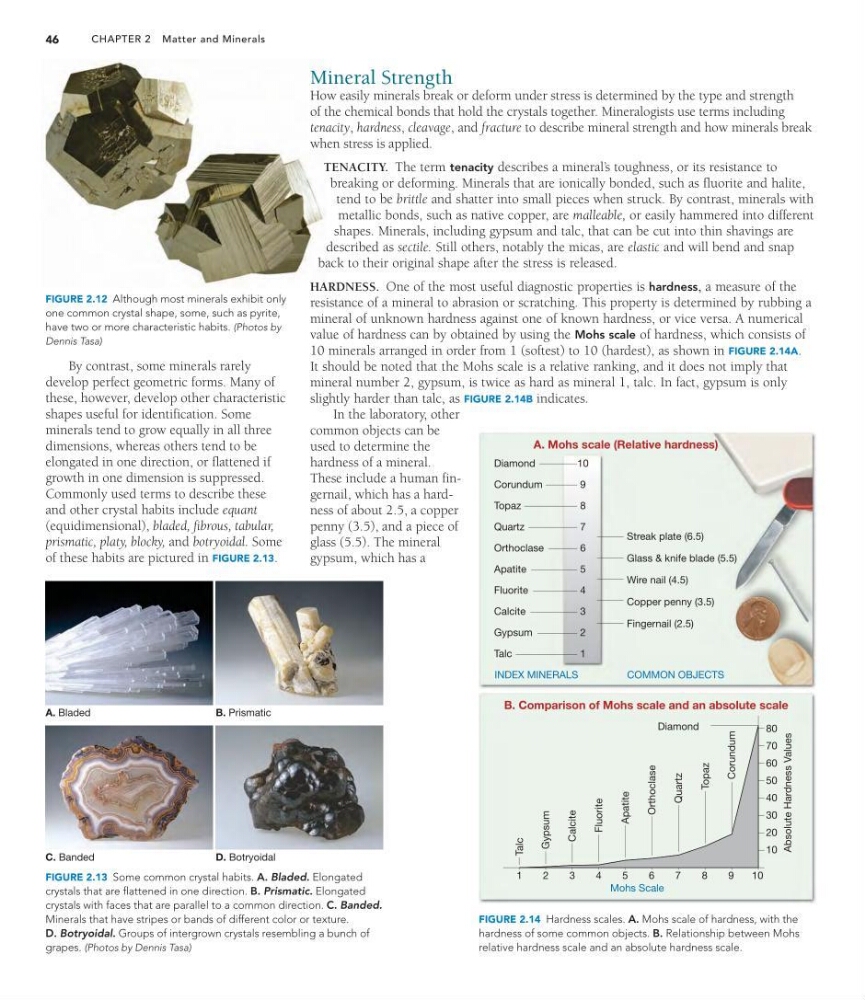
10 minerals arranged in order from 1 (softest) to 10 (hardest), as shown in FIGURE 2.14A.
It should be noted that the Mohs scale is a relative ranking, and it does not imply that
mineral number 2, gypsum, is twice as hard as mineral 1, talc. In fact, gypsum is only
slightly harder than talc, as FIGURE 2.14B indicates.
In the laboratory, other
common objects can be
used to determine the
hardness of a mineral.
These include a human fingernail, which has a hardness of about 2.5, a copper
penny (3.5), and a piece of
glass (5.5). The mineral
gypsum, which has a
CHAPTER 2 Matter and Minerals
46
A. Bladed
B. Prismatic
C. Banded
D. Botryoidal
FIGURE 2.13 Some common crystal habits. A. Bladed. Elongated
crystals that are flattened in one direction. B. Prismatic. Elongated
crystals with faces that are parallel to a common direction. C. Banded.
Minerals that have stripes or bands of different color or texture.
D. Botryoidal. Groups of intergrown crystals resembling a bunch of
grapes. (Photos by Dennis Tasa)
INDEX MINERALS
COMMON OBJECTS
Diamond
10
Corundum
9
Topaz
8
Quartz
7
Orthoclase
6
Apatite
5
Fluorite
4
Calcite
3
Gypsum
2
Talc
Topaz
Talc
1
Glass & knife blade (5.5)
Copper penny (3.5)
Fingernail (2.5)
Streak plate (6.5)
Wire nail (4.5)
Diamond
Corundum
Quartz
Orthoclase
Apatite
Fluorite
Calcite
Gypsum
1
2
3
4
5
6
7
8
9
10
80
70
60
50
40
30
20
10
Mohs Scale
Absolute Hardness Values
A. Mohs scale (Relative hardness)
B. Comparison of Mohs scale and an absolute scale
FIGURE 2.14 Hardness scales. A. Mohs scale of hardness, with the
hardness of some common objects. B. Relationship between Mohs
relative hardness scale and an absolute hardness scale.
FIGURE 2.12 Although most minerals exhibit only
one common crystal shape, some, such as pyrite,
have two or more characteristic habits. (Photos by
Dennis Tasa)
develop perfect geometric forms. Many of
these, however, develop other characteristic
shapes useful for identification. Some
minerals tend to grow equally in all three
dimensions, whereas others tend to be
elongated in one direction, or flattened if
growth in one dimension is suppressed.
Commonly used terms to describe these
and other crystal habits include equant
(equidimensional), bladed, fibrous, tabular,
prismatic, platy, blocky, and botryoidal. Some
of these habits are pictured in FIGURE 2.13.
Mineral Strength
How easily minerals break or deform under stress is determined by the type and strength
of the chemical bonds that hold the crystals together. Mineralogists use terms including
tenacity, hardness, cleavage, and fracture to describe mineral strength and how minerals break
when stress is applied.
TENACITY. The term tenacity describes a mineral’ s toughness, or its resistance to
breaking or deforming. Minerals that are ionically bonded, such as fluorite and halite,
tend to be brittle and shatter into small pieces when struck. By contrast, minerals with
metallic bonds, such as native copper, are malleable, or easily hammered into different
shapes. Minerals, including gypsum and talc, that can be cut into thin shavings are
described as sectile. Still others, notably the micas, are elastic and will bend and snap
back to their original shape after the stress is released.
HARDNESS. One of the most useful diagnostic properties is hardness, a measure of the
resistance of a mineral to abrasion or scratching. This property is determined by rubbing a
mineral of unknown hardness against one of known hardness, or vice versa. A numerical
value of hardness can by obtained by using the Mohs scale of hardness, which consists of
10 minerals arranged in order from 1 (softest) to 10 (hardest), as shown in FIGURE 2.14A.
It should be noted that the Mohs scale is a relative ranking, and it does not imply that
mineral number 2, gypsum, is twice as hard as mineral 1, talc. In fact, gypsum is only
slightly harder than talc, as FIGURE 2.14B indicates.
In the laboratory, other
common objects can be
used to determine the
hardness of a mineral.
These include a human fingernail, which has a hardness of about 2.5, a copper
penny (3.5), and a piece of
glass (5.5). The mineral
gypsum, which has a
CHAPTER 2 Matter and Minerals
46
A. Bladed
B. Prismatic
C. Banded
D. Botryoidal
FIGURE 2.13 Some common crystal habits. A. Bladed. Elongated
crystals that are flattened in one direction. B. Prismatic. Elongated
crystals with faces that are parallel to a common direction. C. Banded.
Minerals that have stripes or bands of different color or texture.
D. Botryoidal. Groups of intergrown crystals resembling a bunch of
grapes. (Photos by Dennis Tasa)
INDEX MINERALS
COMMON OBJECTS
Diamond
10
Corundum
9
Topaz
8
Quartz
7
Orthoclase
6
Apatite
5
Fluorite
4
Calcite
3
Gypsum
2
Talc
Topaz
Talc
1
Glass & knife blade (5.5)
Copper penny (3.5)
Fingernail (2.5)
Streak plate (6.5)
Wire nail (4.5)
Diamond
Corundum
Quartz
Orthoclase
Apatite
Fluorite
Calcite
Gypsum
1
2
3
4
5
6
7
8
9
10
80
70
60
50
40
30
20
10
Mohs Scale
Absolute Hardness Values
A. Mohs scale (Relative hardness)
B. Comparison of Mohs scale and an absolute scale
FIGURE 2.14 Hardness scales. A. Mohs scale of hardness, with the
hardness of some common objects. B. Relationship between Mohs
relative hardness scale and an absolute hardness scale.
FIGURE 2.12 Although most minerals exhibit only
one common crystal shape, some, such as pyrite,
have two or more characteristic habits. (Photos by
Dennis Tasa)