

Isotopes and
Radioactive Decay
The mass number of an atom is simply the
total number of its protons and neutrons.
All atoms of a particular element have the
same number of protons but they may have
varying numbers of neutrons. Atoms with
the same number of protons but different
numbers of neutrons are isotopes of that
element. Isotopes of the same element are
labeled by placing the mass number after
the element’ s name or symbol. For example,
carbon has three well-known isotopes. One
has a mass number of 12 (carbon-12),
another has a mass number of 13
(carbon-13), and the third, carbon-14, has a
mass number of 14. Carbon-12 must also
have six neutrons to give it a mass number
of 12. Carbon-14, on the other hand, has
six protons plus eight neutrons to give it a
mass number of 14.
In chemical behavior, all isotopes of the
same element are nearly identical. To
distinguish among them is like trying to
differentiate identical twins, with one
weighing slightly more than the other.
Because isotopes of the same element
exhibit the same chemical behavior, they
often become parts of the same mineral.
For example, when the mineral calcite
(CaCO 3 ) forms, some of its carbon atoms
are carbon-12, and some are carbon-14.
The nuclei of most atoms are stable.
However, many elements do have isotopes
in which the nuclei are unstable—
carbon-14 is one example of an unstable
isotope. In this context, unstable means that
the nuclei change through a random
process called radioactive decay. During
radioactive decay, unstable isotopes radiate
energy and emit particles. The rates at
which unstable isotopes decay are measurable. Therefore, certain radioactive atoms are
used to determine the ages of fossils, rocks,
and minerals. A discussion of radioactive
decay and its applications in dating past
geologic events appears in Chapter 18.
C O N C E P T C H E C K 2 . 4
What is an isotope?
1
Physical Properties of Minerals
Matter and Minerals
Physical Properties of Minerals
Minerals have definite crystalline structures and chemical compositions that give them
unique sets of physical and chemical properties shared by all samples of that mineral.
For example, all specimens of halite have the same hardness, the same density, and break
in a similar manner. Because a mineral’ s internal structure and chemical composition are
difficult to determine without the aid of sophisticated tests and equipment, the more easily
recognized physical properties are frequently used in identification.
Optical Properties
Of the many optical properties of minerals, their luster, their ability to transmit light, their
color, and their streak are most frequently used for mineral identification.
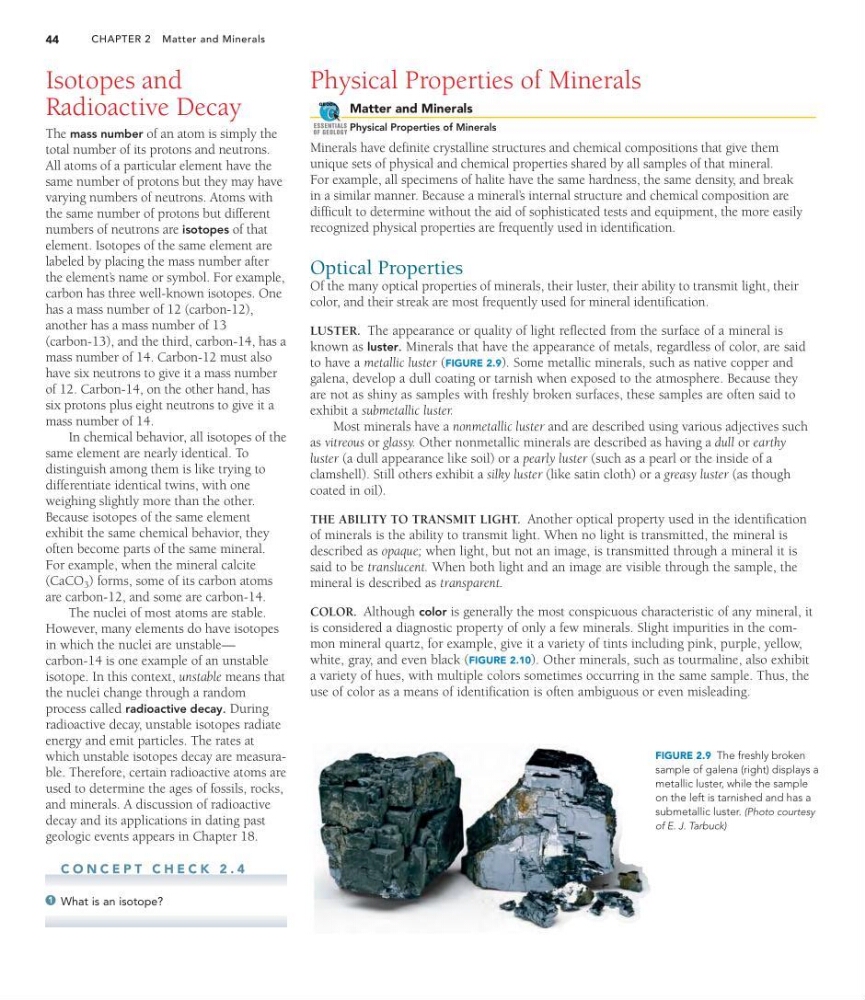
LUSTER. The appearance or quality of light reflected from the surface of a mineral is
known as luster. Minerals that have the appearance of metals, regardless of color, are said
to have a metallic luster (FIGURE 2.9). Some metallic minerals, such as native copper and
galena, develop a dull coating or tarnish when exposed to the atmosphere. Because they
are not as shiny as samples with freshly broken surfaces, these samples are often said to
exhibit a submetallic luster.
Most minerals have a nonmetallic luster and are described using various adjectives such
as vitreous or glassy. Other nonmetallic minerals are described as having a dull or earthy
luster (a dull appearance like soil) or a pearly luster (such as a pearl or the inside of a
clamshell). Still others exhibit a silky luster (like satin cloth) or a greasy luster (as though
coated in oil).
THE ABILITY TO TRANSMIT LIGHT. Another optical property used in the identification
of minerals is the ability to transmit light. When no light is transmitted, the mineral is
described as opaque; when light, but not an image, is transmitted through a mineral it is
said to be translucent. When both light and an image are visible through the sample, the
mineral is described as transparent.
COLOR. Although color is generally the most conspicuous characteristic of any mineral, it
is considered a diagnostic property of only a few minerals. Slight impurities in the common mineral quartz, for example, give it a variety of tints including pink, purple, yellow,
white, gray, and even black (FIGURE 2.10). Other minerals, such as tourmaline, also exhibit
a variety of hues, with multiple colors sometimes occurring in the same sample. Thus, the
use of color as a means of identification is often ambiguous or even misleading.
GEODe
ESSENTIALS
OF GEOLOGY
CHAPTER 2 Matter and Minerals
44
FIGURE 2.9 The freshly broken
sample of galena (right) displays a
metallic luster, while the sample
on the left is tarnished and has a
submetallic luster. (Photo courtesy
of E. J. Tarbuck)
Radioactive Decay
The mass number of an atom is simply the
total number of its protons and neutrons.
All atoms of a particular element have the
same number of protons but they may have
varying numbers of neutrons. Atoms with
the same number of protons but different
numbers of neutrons are isotopes of that
element. Isotopes of the same element are
labeled by placing the mass number after
the element’ s name or symbol. For example,
carbon has three well-known isotopes. One
has a mass number of 12 (carbon-12),
another has a mass number of 13
(carbon-13), and the third, carbon-14, has a
mass number of 14. Carbon-12 must also
have six neutrons to give it a mass number
of 12. Carbon-14, on the other hand, has
six protons plus eight neutrons to give it a
mass number of 14.
In chemical behavior, all isotopes of the
same element are nearly identical. To
distinguish among them is like trying to
differentiate identical twins, with one
weighing slightly more than the other.
Because isotopes of the same element
exhibit the same chemical behavior, they
often become parts of the same mineral.
For example, when the mineral calcite
(CaCO 3 ) forms, some of its carbon atoms
are carbon-12, and some are carbon-14.
The nuclei of most atoms are stable.
However, many elements do have isotopes
in which the nuclei are unstable—
carbon-14 is one example of an unstable
isotope. In this context, unstable means that
the nuclei change through a random
process called radioactive decay. During
radioactive decay, unstable isotopes radiate
energy and emit particles. The rates at
which unstable isotopes decay are measurable. Therefore, certain radioactive atoms are
used to determine the ages of fossils, rocks,
and minerals. A discussion of radioactive
decay and its applications in dating past
geologic events appears in Chapter 18.
C O N C E P T C H E C K 2 . 4
What is an isotope?
1
Physical Properties of Minerals
Matter and Minerals
Physical Properties of Minerals
Minerals have definite crystalline structures and chemical compositions that give them
unique sets of physical and chemical properties shared by all samples of that mineral.
For example, all specimens of halite have the same hardness, the same density, and break
in a similar manner. Because a mineral’ s internal structure and chemical composition are
difficult to determine without the aid of sophisticated tests and equipment, the more easily
recognized physical properties are frequently used in identification.
Optical Properties
Of the many optical properties of minerals, their luster, their ability to transmit light, their
color, and their streak are most frequently used for mineral identification.
LUSTER. The appearance or quality of light reflected from the surface of a mineral is
known as luster. Minerals that have the appearance of metals, regardless of color, are said
to have a metallic luster (FIGURE 2.9). Some metallic minerals, such as native copper and
galena, develop a dull coating or tarnish when exposed to the atmosphere. Because they
are not as shiny as samples with freshly broken surfaces, these samples are often said to
exhibit a submetallic luster.
Most minerals have a nonmetallic luster and are described using various adjectives such
as vitreous or glassy. Other nonmetallic minerals are described as having a dull or earthy
luster (a dull appearance like soil) or a pearly luster (such as a pearl or the inside of a
clamshell). Still others exhibit a silky luster (like satin cloth) or a greasy luster (as though
coated in oil).
THE ABILITY TO TRANSMIT LIGHT. Another optical property used in the identification
of minerals is the ability to transmit light. When no light is transmitted, the mineral is
described as opaque; when light, but not an image, is transmitted through a mineral it is
said to be translucent. When both light and an image are visible through the sample, the
mineral is described as transparent.
COLOR. Although color is generally the most conspicuous characteristic of any mineral, it
is considered a diagnostic property of only a few minerals. Slight impurities in the common mineral quartz, for example, give it a variety of tints including pink, purple, yellow,
white, gray, and even black (FIGURE 2.10). Other minerals, such as tourmaline, also exhibit
a variety of hues, with multiple colors sometimes occurring in the same sample. Thus, the
use of color as a means of identification is often ambiguous or even misleading.
GEODe
ESSENTIALS
OF GEOLOGY
CHAPTER 2 Matter and Minerals
44
FIGURE 2.9 The freshly broken
sample of galena (right) displays a
metallic luster, while the sample
on the left is tarnished and has a
submetallic luster. (Photo courtesy
of E. J. Tarbuck)