

35
Companion Website
mantle (p. 24)
metamorphic rock (p. 20)
nebular theory (p. 20)
negative feedback mechanism
(p. 16)
oceanic (mid-ocean) ridge (p. 27)
open systems (p. 16)
outer core (p. 24)
physical geology (p. 2)
plates (p. 28)
plate tectonics, theory of (p. 28)
positive feedback mechanism
(p. 16)
relative dating (p. 7)
rock cycle (p. 18)
seafloor spreading (p. 29)
seamounts (p. 26)
sediment (p. 20)
sedimentary rock (p. 20)
shields (p. 25)
solar nebula (p. 20)
stable platforms (p. 25)
subduction zone (p. 30)
superposition, law of (p. 7)
system (p. 15)
theory (p. 9)
transform fault boundaries (p. 29)
uniformitarianism (p. 5)
G I V E I T S O M E T H O U G H T
Refer to Figure 1.17. Which of the four main components of the
Earth System (atmosphere, biosphere, geosphere, hydrosphere)
were involved in the natural disaster at Caraballeda, Venezuela?
Describe how each of the components you list contributed to the
event depicted in the photo.
Earth is 4.6 billion years old. This number does not come from
studying Earth rocks since Earth’s oldest rocks only date to about
4 billion years. The number comes from studying lunar rocks and
meteorites. Based on what you know about the formation of our
solar system, how old do you think the other planets are? Why did
you assign this age or these ages?
Why do geologists look to meteorites to tell us about the internal
structure of Earth?
After entering a dark room, you turn on a wall switch but the light
does not come on. Suggest at least three hypotheses that might
explain this observation.
Each of the following statements may either be a hypothesis (H), a
theory (T), or an observation (O). Use one of these letters to identify
each statement. Briefly explain each choice.
a. A scientist proposes that a recently discovered ring-shaped structure is the remains of an ancient meteorite crater.
b. The Redwall Formation in the Grand Canyon is composed primarily of limestone.
c. Earth is composed of several large plates that move and interact
with each other.
d. Since 1885, the terminus of Canada’s Athabasca Glacier has
receded 1.5 kilometers.
Consider the possible results of the following scenario and describe
one positive and one negative feedback. Earth is getting warmer,
consequently evaporation is increasing.
6
5
4
3
2
1
Refer to Figure 1.22. How does the rock cycle diagram, in particular
the process arrows, support the fact that sedimentary rocks are the
most abundant rock type on the surface of Earth?
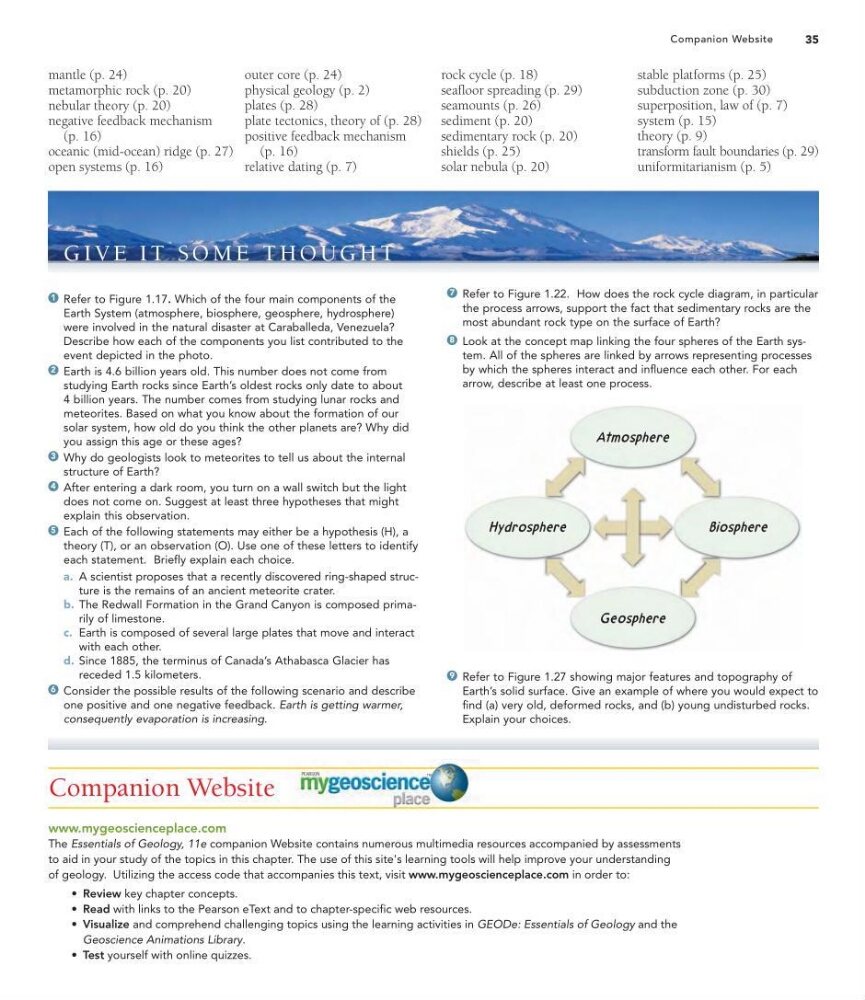
Look at the concept map linking the four spheres of the Earth system. All of the spheres are linked by arrows representing processes
by which the spheres interact and influence each other. For each
arrow, describe at least one process.
8
7
Atmosphere
Hydrosphere
Biosphere
Geosphere
Refer to Figure 1.27 showing major features and topography of
Earth’s solid surface. Give an example of where you would expect to
find (a) very old, deformed rocks, and (b) young undisturbed rocks.
Explain your choices.
9
Companion Website
www.mygeoscienceplace.com
The Essentials of Geology, 11e companion Website contains numerous multimedia resources accompanied by assessments
to aid in your study of the topics in this chapter. The use of this site's learning tools will help improve your understanding
of geology. Utilizing the access code that accompanies this text, visit www.mygeoscienceplace.com in order to:
• Review key chapter concepts.
• Read with links to the Pearson eText and to chapter-specific web resources.
• Visualize and comprehend challenging topics using the learning activities in GEODe: Essentials of Geology and the
Geoscience Animations Library.
• Test yourself with online quizzes.
Companion Website
mantle (p. 24)
metamorphic rock (p. 20)
nebular theory (p. 20)
negative feedback mechanism
(p. 16)
oceanic (mid-ocean) ridge (p. 27)
open systems (p. 16)
outer core (p. 24)
physical geology (p. 2)
plates (p. 28)
plate tectonics, theory of (p. 28)
positive feedback mechanism
(p. 16)
relative dating (p. 7)
rock cycle (p. 18)
seafloor spreading (p. 29)
seamounts (p. 26)
sediment (p. 20)
sedimentary rock (p. 20)
shields (p. 25)
solar nebula (p. 20)
stable platforms (p. 25)
subduction zone (p. 30)
superposition, law of (p. 7)
system (p. 15)
theory (p. 9)
transform fault boundaries (p. 29)
uniformitarianism (p. 5)
G I V E I T S O M E T H O U G H T
Refer to Figure 1.17. Which of the four main components of the
Earth System (atmosphere, biosphere, geosphere, hydrosphere)
were involved in the natural disaster at Caraballeda, Venezuela?
Describe how each of the components you list contributed to the
event depicted in the photo.
Earth is 4.6 billion years old. This number does not come from
studying Earth rocks since Earth’s oldest rocks only date to about
4 billion years. The number comes from studying lunar rocks and
meteorites. Based on what you know about the formation of our
solar system, how old do you think the other planets are? Why did
you assign this age or these ages?
Why do geologists look to meteorites to tell us about the internal
structure of Earth?
After entering a dark room, you turn on a wall switch but the light
does not come on. Suggest at least three hypotheses that might
explain this observation.
Each of the following statements may either be a hypothesis (H), a
theory (T), or an observation (O). Use one of these letters to identify
each statement. Briefly explain each choice.
a. A scientist proposes that a recently discovered ring-shaped structure is the remains of an ancient meteorite crater.
b. The Redwall Formation in the Grand Canyon is composed primarily of limestone.
c. Earth is composed of several large plates that move and interact
with each other.
d. Since 1885, the terminus of Canada’s Athabasca Glacier has
receded 1.5 kilometers.
Consider the possible results of the following scenario and describe
one positive and one negative feedback. Earth is getting warmer,
consequently evaporation is increasing.
6
5
4
3
2
1
Refer to Figure 1.22. How does the rock cycle diagram, in particular
the process arrows, support the fact that sedimentary rocks are the
most abundant rock type on the surface of Earth?
Look at the concept map linking the four spheres of the Earth system. All of the spheres are linked by arrows representing processes
by which the spheres interact and influence each other. For each
arrow, describe at least one process.
8
7
Atmosphere
Hydrosphere
Biosphere
Geosphere
Refer to Figure 1.27 showing major features and topography of
Earth’s solid surface. Give an example of where you would expect to
find (a) very old, deformed rocks, and (b) young undisturbed rocks.
Explain your choices.
9
Companion Website
www.mygeoscienceplace.com
The Essentials of Geology, 11e companion Website contains numerous multimedia resources accompanied by assessments
to aid in your study of the topics in this chapter. The use of this site's learning tools will help improve your understanding
of geology. Utilizing the access code that accompanies this text, visit www.mygeoscienceplace.com in order to:
• Review key chapter concepts.
• Read with links to the Pearson eText and to chapter-specific web resources.
• Visualize and comprehend challenging topics using the learning activities in GEODe: Essentials of Geology and the
Geoscience Animations Library.
• Test yourself with online quizzes.