

asthenosphere, continental lithosphere is
buoyant, which prevents it from being subducted to any great depth. The result is a
collision between the two continental
blocks (Figure 1.32). Such a collision
occurred when the subcontinent of India
“rammed” into Asia and produced the
Himalayas—the most spectacular mountain
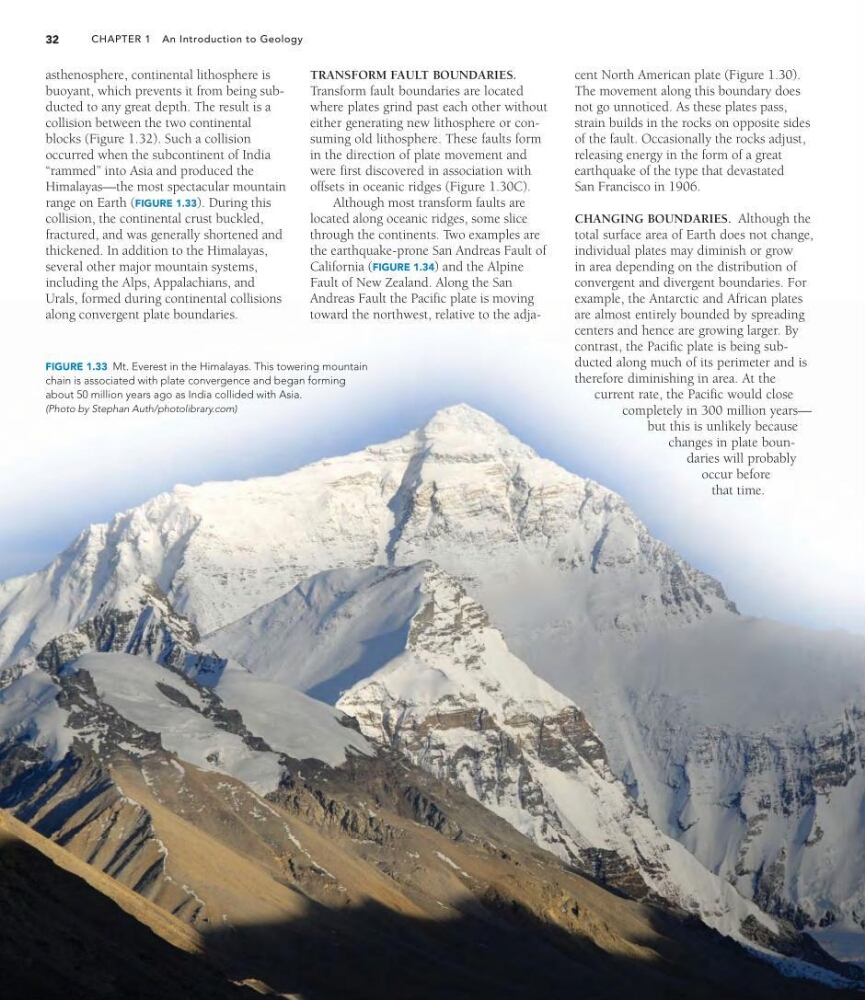
range on Earth (FIGURE 1.33). During this
collision, the continental crust buckled,
fractured, and was generally shortened and
thickened. In addition to the Himalayas,
several other major mountain systems,
including the Alps, Appalachians, and
Urals, formed during continental collisions
along convergent plate boundaries.
CHAPTER 1 An Introduction to Geology
32
FIGURE 1.33 Mt. Everest in the Himalayas. This towering mountain
chain is associated with plate convergence and began forming
about 50 million years ago as India collided with Asia.
(Photo by Stephan Auth/photolibrary.com)
TRANSFORM FAULT BOUNDARIES.
Transform fault boundaries are located
where plates grind past each other without
either generating new lithosphere or consuming old lithosphere. These faults form
in the direction of plate movement and
were first discovered in association with
offsets in oceanic ridges (Figure 1.30C).
Although most transform faults are
located along oceanic ridges, some slice
through the continents. Two examples are
the earthquake-prone San Andreas Fault of
California (FIGURE 1.34) and the Alpine
Fault of New Zealand. Along the San
Andreas Fault the Pacific plate is moving
toward the northwest, relative to the adjacent North American plate (Figure 1.30).
The movement along this boundary does
not go unnoticed. As these plates pass,
strain builds in the rocks on opposite sides
of the fault. Occasionally the rocks adjust,
releasing energy in the form of a great
earthquake of the type that devastated
San Francisco in 1906.
CHANGING BOUNDARIES. Although the
total surface area of Earth does not change,
individual plates may diminish or grow
in area depending on the distribution of
convergent and divergent boundaries. For
example, the Antarctic and African plates
are almost entirely bounded by spreading
centers and hence are growing larger. By
contrast, the Pacific plate is being subducted along much of its perimeter and is
therefore diminishing in area. At the
current rate, the Pacific would close
completely in 300 million years—
but this is unlikely because
changes in plate boundaries will probably
occur before
that time.
buoyant, which prevents it from being subducted to any great depth. The result is a
collision between the two continental
blocks (Figure 1.32). Such a collision
occurred when the subcontinent of India
“rammed” into Asia and produced the
Himalayas—the most spectacular mountain
range on Earth (FIGURE 1.33). During this
collision, the continental crust buckled,
fractured, and was generally shortened and
thickened. In addition to the Himalayas,
several other major mountain systems,
including the Alps, Appalachians, and
Urals, formed during continental collisions
along convergent plate boundaries.
CHAPTER 1 An Introduction to Geology
32
FIGURE 1.33 Mt. Everest in the Himalayas. This towering mountain
chain is associated with plate convergence and began forming
about 50 million years ago as India collided with Asia.
(Photo by Stephan Auth/photolibrary.com)
TRANSFORM FAULT BOUNDARIES.
Transform fault boundaries are located
where plates grind past each other without
either generating new lithosphere or consuming old lithosphere. These faults form
in the direction of plate movement and
were first discovered in association with
offsets in oceanic ridges (Figure 1.30C).
Although most transform faults are
located along oceanic ridges, some slice
through the continents. Two examples are
the earthquake-prone San Andreas Fault of
California (FIGURE 1.34) and the Alpine
Fault of New Zealand. Along the San
Andreas Fault the Pacific plate is moving
toward the northwest, relative to the adjacent North American plate (Figure 1.30).
The movement along this boundary does
not go unnoticed. As these plates pass,
strain builds in the rocks on opposite sides
of the fault. Occasionally the rocks adjust,
releasing energy in the form of a great
earthquake of the type that devastated
San Francisco in 1906.
CHANGING BOUNDARIES. Although the
total surface area of Earth does not change,
individual plates may diminish or grow
in area depending on the distribution of
convergent and divergent boundaries. For
example, the Antarctic and African plates
are almost entirely bounded by spreading
centers and hence are growing larger. By
contrast, the Pacific plate is being subducted along much of its perimeter and is
therefore diminishing in area. At the
current rate, the Pacific would close
completely in 300 million years—
but this is unlikely because
changes in plate boundaries will probably
occur before
that time.