

G I V E I T S O M E T H O U G H T
Describe an environment within Earth in which you might expect
rocks to experience ductile deformation. Suggest a scenario in
which brittle rather than ductile deformation might occur.
Is granite or mica schist more likely to fold or flow rather than
fracture when subjected to differential stress? Explain.
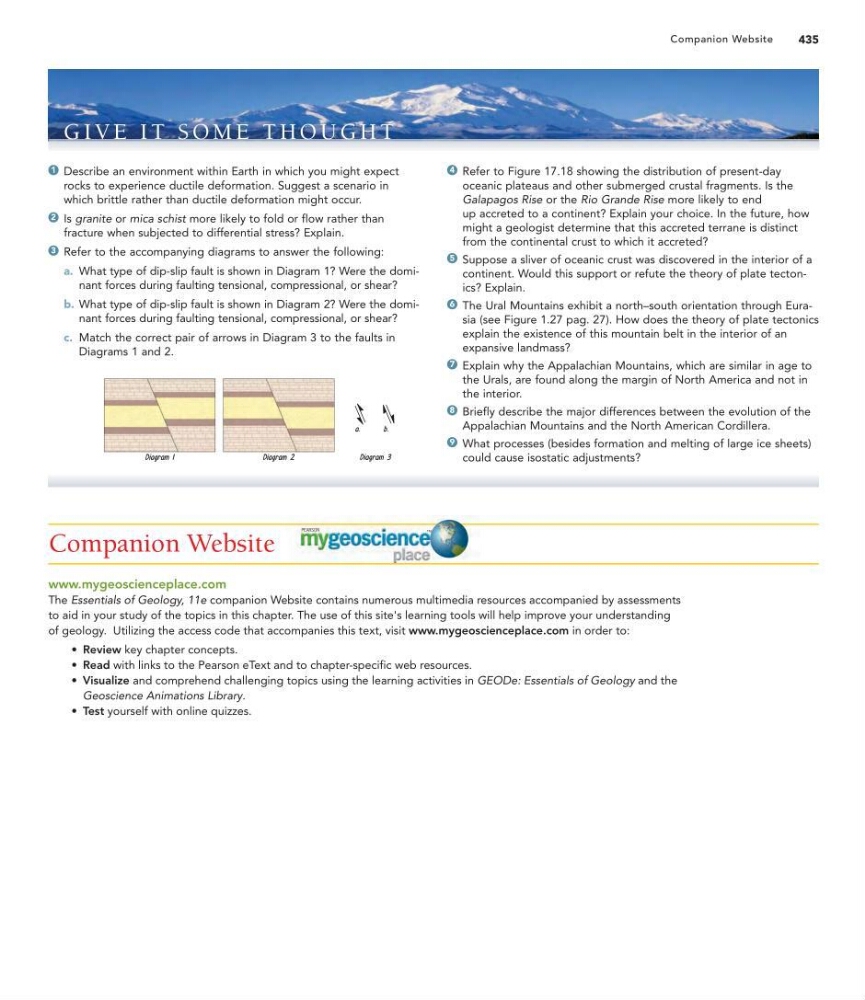
Refer to the accompanying diagrams to answer the following:
a. What type of dip-slip fault is shown in Diagram 1? Were the dominant forces during faulting tensional, compressional, or shear?
b. What type of dip-slip fault is shown in Diagram 2? Were the dominant forces during faulting tensional, compressional, or shear?
c. Match the correct pair of arrows in Diagram 3 to the faults in
Diagrams 1 and 2.
3
2
1
Refer to Figure 17.18 showing the distribution of present-day
oceanic plateaus and other submerged crustal fragments. Is the
Galapagos Rise or the Rio Grande Rise more likely to end
up accreted to a continent? Explain your choice. In the future, how
might a geologist determine that this accreted terrane is distinct
from the continental crust to which it accreted?
Suppose a sliver of oceanic crust was discovered in the interior of a
continent. Would this support or refute the theory of plate tectonics? Explain.
The Ural Mountains exhibit a north–south orientation through Eurasia (see Figure 1.27 pag. 27). How does the theory of plate tectonics
explain the existence of this mountain belt in the interior of an
expansive landmass?
Explain why the Appalachian Mountains, which are similar in age to
the Urals, are found along the margin of North America and not in
the interior.
Briefly describe the major differences between the evolution of the
Appalachian Mountains and the North American Cordillera.
What processes (besides formation and melting of large ice sheets)
could cause isostatic adjustments?
9
8
7
6
5
4
435
Companion Website
Companion Website
www.mygeoscienceplace.com
The Essentials of Geology, 11e companion Website contains numerous multimedia resources accompanied by assessments
to aid in your study of the topics in this chapter. The use of this site's learning tools will help improve your understanding
of geology. Utilizing the access code that accompanies this text, visit www.mygeoscienceplace.com in order to:
• Review key chapter concepts.
• Read with links to the Pearson eText and to chapter-specific web resources.
• Visualize and comprehend challenging topics using the learning activities in GEODe: Essentials of Geology and the
Geoscience Animations Library.
• Test yourself with online quizzes.
Describe an environment within Earth in which you might expect
rocks to experience ductile deformation. Suggest a scenario in
which brittle rather than ductile deformation might occur.
Is granite or mica schist more likely to fold or flow rather than
fracture when subjected to differential stress? Explain.
Refer to the accompanying diagrams to answer the following:
a. What type of dip-slip fault is shown in Diagram 1? Were the dominant forces during faulting tensional, compressional, or shear?
b. What type of dip-slip fault is shown in Diagram 2? Were the dominant forces during faulting tensional, compressional, or shear?
c. Match the correct pair of arrows in Diagram 3 to the faults in
Diagrams 1 and 2.
3
2
1
Refer to Figure 17.18 showing the distribution of present-day
oceanic plateaus and other submerged crustal fragments. Is the
Galapagos Rise or the Rio Grande Rise more likely to end
up accreted to a continent? Explain your choice. In the future, how
might a geologist determine that this accreted terrane is distinct
from the continental crust to which it accreted?
Suppose a sliver of oceanic crust was discovered in the interior of a
continent. Would this support or refute the theory of plate tectonics? Explain.
The Ural Mountains exhibit a north–south orientation through Eurasia (see Figure 1.27 pag. 27). How does the theory of plate tectonics
explain the existence of this mountain belt in the interior of an
expansive landmass?
Explain why the Appalachian Mountains, which are similar in age to
the Urals, are found along the margin of North America and not in
the interior.
Briefly describe the major differences between the evolution of the
Appalachian Mountains and the North American Cordillera.
What processes (besides formation and melting of large ice sheets)
could cause isostatic adjustments?
9
8
7
6
5
4
435
Companion Website
Companion Website
www.mygeoscienceplace.com
The Essentials of Geology, 11e companion Website contains numerous multimedia resources accompanied by assessments
to aid in your study of the topics in this chapter. The use of this site's learning tools will help improve your understanding
of geology. Utilizing the access code that accompanies this text, visit www.mygeoscienceplace.com in order to:
• Review key chapter concepts.
• Read with links to the Pearson eText and to chapter-specific web resources.
• Visualize and comprehend challenging topics using the learning activities in GEODe: Essentials of Geology and the
Geoscience Animations Library.
• Test yourself with online quizzes.