

21
Early Evolution of Earth
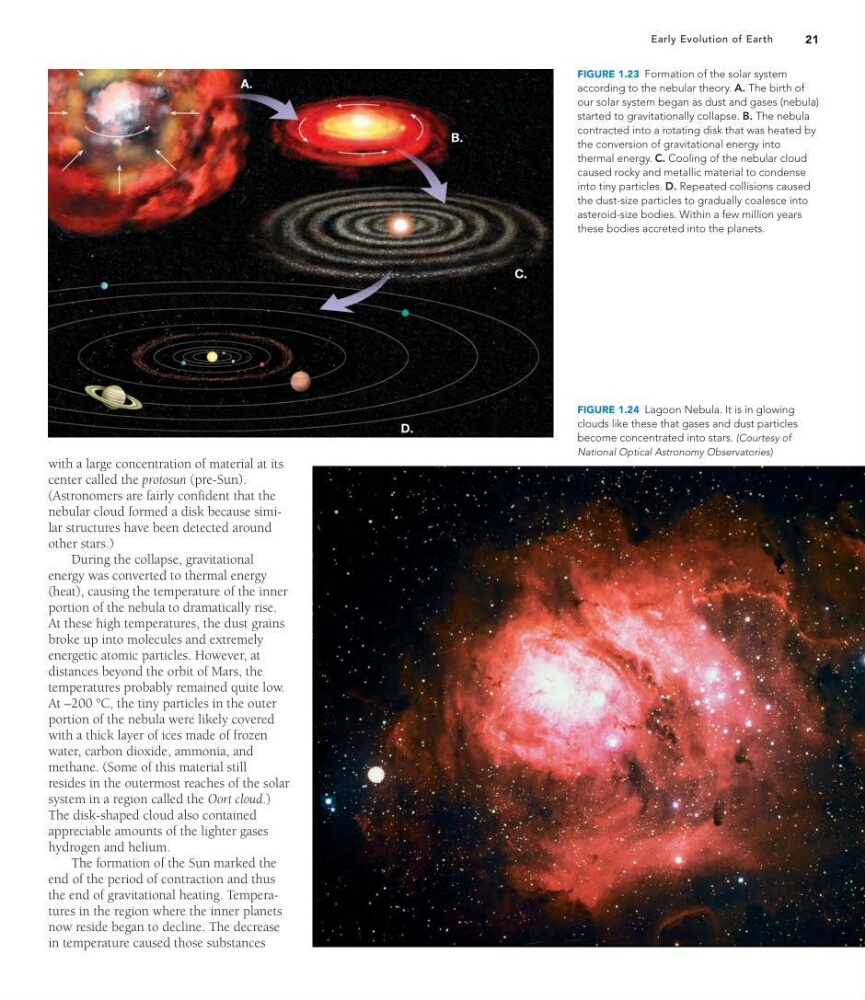
A.
B.
C.
D.
FIGURE 1.23 Formation of the solar system
according to the nebular theory. A. The birth of
our solar system began as dust and gases (nebula)
started to gravitationally collapse. B. The nebula
contracted into a rotating disk that was heated by
the conversion of gravitational energy into
thermal energy. C. Cooling of the nebular cloud
caused rocky and metallic material to condense
into tiny particles. D. Repeated collisions caused
the dust-size particles to gradually coalesce into
asteroid-size bodies. Within a few million years
these bodies accreted into the planets.
FIGURE 1.24 Lagoon Nebula. It is in glowing
clouds like these that gases and dust particles
become concentrated into stars. (Courtesy of
National Optical Astronomy Observatories)
with a large concentration of material at its
center called the protosun (pre-Sun).
(Astronomers are fairly confident that the
nebular cloud formed a disk because similar structures have been detected around
other stars.)
During the collapse, gravitational
energy was converted to thermal energy
(heat), causing the temperature of the inner
portion of the nebula to dramatically rise.
At these high temperatures, the dust grains
broke up into molecules and extremely
energetic atomic particles. However, at
distances beyond the orbit of Mars, the
temperatures probably remained quite low.
At –200 °C, the tiny particles in the outer
portion of the nebula were likely covered
with a thick layer of ices made of frozen
water, carbon dioxide, ammonia, and
methane. (Some of this material still
resides in the outermost reaches of the solar
system in a region called the Oort cloud.)
The disk-shaped cloud also contained
appreciable amounts of the lighter gases
hydrogen and helium.
The formation of the Sun marked the
end of the period of contraction and thus
the end of gravitational heating. Temperatures in the region where the inner planets
now reside began to decline. The decrease
in temperature caused those substances
Early Evolution of Earth
A.
B.
C.
D.
FIGURE 1.23 Formation of the solar system
according to the nebular theory. A. The birth of
our solar system began as dust and gases (nebula)
started to gravitationally collapse. B. The nebula
contracted into a rotating disk that was heated by
the conversion of gravitational energy into
thermal energy. C. Cooling of the nebular cloud
caused rocky and metallic material to condense
into tiny particles. D. Repeated collisions caused
the dust-size particles to gradually coalesce into
asteroid-size bodies. Within a few million years
these bodies accreted into the planets.
FIGURE 1.24 Lagoon Nebula. It is in glowing
clouds like these that gases and dust particles
become concentrated into stars. (Courtesy of
National Optical Astronomy Observatories)
with a large concentration of material at its
center called the protosun (pre-Sun).
(Astronomers are fairly confident that the
nebular cloud formed a disk because similar structures have been detected around
other stars.)
During the collapse, gravitational
energy was converted to thermal energy
(heat), causing the temperature of the inner
portion of the nebula to dramatically rise.
At these high temperatures, the dust grains
broke up into molecules and extremely
energetic atomic particles. However, at
distances beyond the orbit of Mars, the
temperatures probably remained quite low.
At –200 °C, the tiny particles in the outer
portion of the nebula were likely covered
with a thick layer of ices made of frozen
water, carbon dioxide, ammonia, and
methane. (Some of this material still
resides in the outermost reaches of the solar
system in a region called the Oort cloud.)
The disk-shaped cloud also contained
appreciable amounts of the lighter gases
hydrogen and helium.
The formation of the Sun marked the
end of the period of contraction and thus
the end of gravitational heating. Temperatures in the region where the inner planets
now reside began to decline. The decrease
in temperature caused those substances