

413
Companion Website
G I V E I T S O M E T H O U G H T
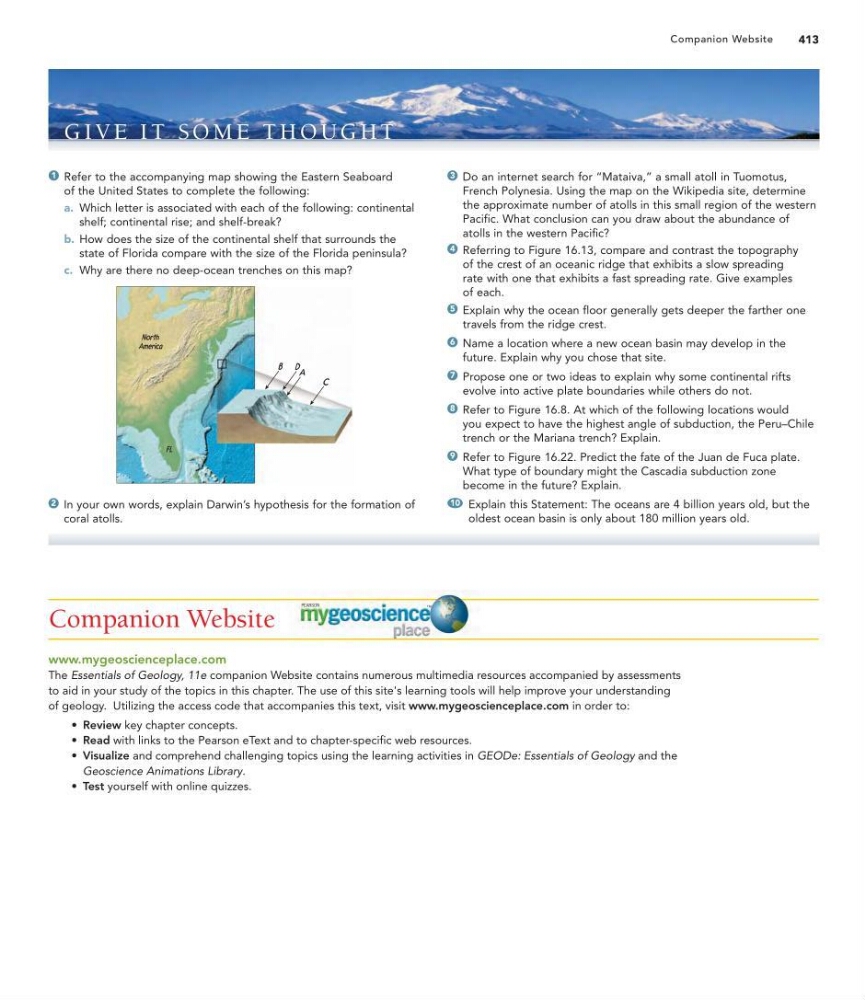
Refer to the accompanying map showing the Eastern Seaboard
of the United States to complete the following:
a. Which letter is associated with each of the following: continental
shelf; continental rise; and shelf-break?
b. How does the size of the continental shelf that surrounds the
state of Florida compare with the size of the Florida peninsula?
c. Why are there no deep-ocean trenches on this map?
1
Do an internet search for “Mataiva,” a small atoll in Tuomotus,
French Polynesia. Using the map on the Wikipedia site, determine
the approximate number of atolls in this small region of the western
Pacific. What conclusion can you draw about the abundance of
atolls in the western Pacific?
Referring to Figure 16.13, compare and contrast the topography
of the crest of an oceanic ridge that exhibits a slow spreading
rate with one that exhibits a fast spreading rate. Give examples
of each.
Explain why the ocean floor generally gets deeper the farther one
travels from the ridge crest.
Name a location where a new ocean basin may develop in the
future. Explain why you chose that site.
Propose one or two ideas to explain why some continental rifts
evolve into active plate boundaries while others do not.
Refer to Figure 16.8. At which of the following locations would
you expect to have the highest angle of subduction, the Peru–Chile
trench or the Mariana trench? Explain.
Refer to Figure 16.22. Predict the fate of the Juan de Fuca plate.
What type of boundary might the Cascadia subduction zone
become in the future? Explain.
Explain this Statement: The oceans are 4 billion years old, but the
oldest ocean basin is only about 180 million years old.
10
9
8
7
6
5
4
3
In your own words, explain Darwin’s hypothesis for the formation of
coral atolls.
2
Companion Website
www.mygeoscienceplace.com
The Essentials of Geology, 11e companion Website contains numerous multimedia resources accompanied by assessments
to aid in your study of the topics in this chapter. The use of this site's learning tools will help improve your understanding
of geology. Utilizing the access code that accompanies this text, visit www.mygeoscienceplace.com in order to:
• Review key chapter concepts.
• Read with links to the Pearson eText and to chapter-specific web resources.
• Visualize and comprehend challenging topics using the learning activities in GEODe: Essentials of Geology and the
Geoscience Animations Library.
• Test yourself with online quizzes.
Companion Website
G I V E I T S O M E T H O U G H T
Refer to the accompanying map showing the Eastern Seaboard
of the United States to complete the following:
a. Which letter is associated with each of the following: continental
shelf; continental rise; and shelf-break?
b. How does the size of the continental shelf that surrounds the
state of Florida compare with the size of the Florida peninsula?
c. Why are there no deep-ocean trenches on this map?
1
Do an internet search for “Mataiva,” a small atoll in Tuomotus,
French Polynesia. Using the map on the Wikipedia site, determine
the approximate number of atolls in this small region of the western
Pacific. What conclusion can you draw about the abundance of
atolls in the western Pacific?
Referring to Figure 16.13, compare and contrast the topography
of the crest of an oceanic ridge that exhibits a slow spreading
rate with one that exhibits a fast spreading rate. Give examples
of each.
Explain why the ocean floor generally gets deeper the farther one
travels from the ridge crest.
Name a location where a new ocean basin may develop in the
future. Explain why you chose that site.
Propose one or two ideas to explain why some continental rifts
evolve into active plate boundaries while others do not.
Refer to Figure 16.8. At which of the following locations would
you expect to have the highest angle of subduction, the Peru–Chile
trench or the Mariana trench? Explain.
Refer to Figure 16.22. Predict the fate of the Juan de Fuca plate.
What type of boundary might the Cascadia subduction zone
become in the future? Explain.
Explain this Statement: The oceans are 4 billion years old, but the
oldest ocean basin is only about 180 million years old.
10
9
8
7
6
5
4
3
In your own words, explain Darwin’s hypothesis for the formation of
coral atolls.
2
Companion Website
www.mygeoscienceplace.com
The Essentials of Geology, 11e companion Website contains numerous multimedia resources accompanied by assessments
to aid in your study of the topics in this chapter. The use of this site's learning tools will help improve your understanding
of geology. Utilizing the access code that accompanies this text, visit www.mygeoscienceplace.com in order to:
• Review key chapter concepts.
• Read with links to the Pearson eText and to chapter-specific web resources.
• Visualize and comprehend challenging topics using the learning activities in GEODe: Essentials of Geology and the
Geoscience Animations Library.
• Test yourself with online quizzes.