

CHAPTER 15 Plate Tectonics: A Scientific Revolution Unfolds
390
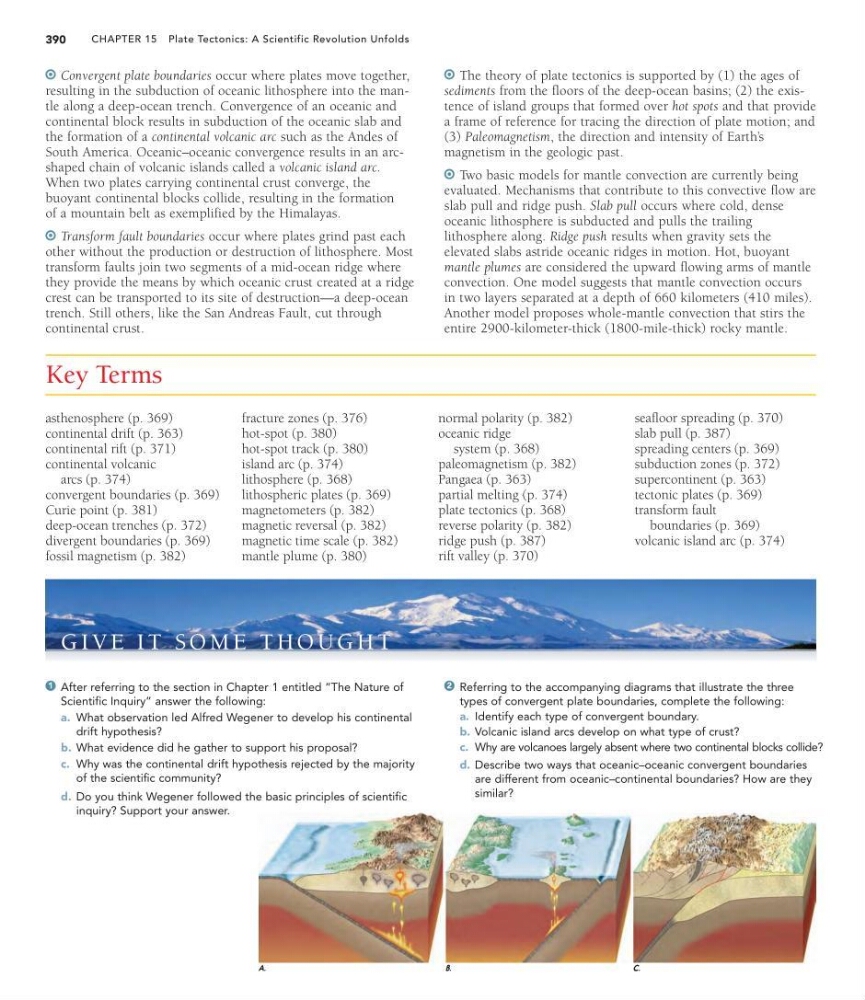
Convergent plate boundaries occur where plates move together,
resulting in the subduction of oceanic lithosphere into the mantle along a deep-ocean trench. Convergence of an oceanic and
continental block results in subduction of the oceanic slab and
the formation of a continental volcanic arc such as the Andes of
South America. Oceanic–oceanic convergence results in an arcshaped chain of volcanic islands called a volcanic island arc.
When two plates carrying continental crust converge, the
buoyant continental blocks collide, resulting in the formation
of a mountain belt as exemplified by the Himalayas.
Transform fault boundaries occur where plates grind past each
other without the production or destruction of lithosphere. Most
transform faults join two segments of a mid-ocean ridge where
they provide the means by which oceanic crust created at a ridge
crest can be transported to its site of destruction—a deep-ocean
trench. Still others, like the San Andreas Fault, cut through
continental crust.
The theory of plate tectonics is supported by (1) the ages of
sediments from the floors of the deep-ocean basins; (2) the existence of island groups that formed over hot spots and that provide
a frame of reference for tracing the direction of plate motion; and
(3) Paleomagnetism, the direction and intensity of Earth’ s
magnetism in the geologic past.
Two basic models for mantle convection are currently being
evaluated. Mechanisms that contribute to this convective flow are
slab pull and ridge push. Slab pull occurs where cold, dense
oceanic lithosphere is subducted and pulls the trailing
lithosphere along. Ridge push results when gravity sets the
elevated slabs astride oceanic ridges in motion. Hot, buoyant
mantle plumes are considered the upward flowing arms of mantle
convection. One model suggests that mantle convection occurs
in two layers separated at a depth of 660 kilometers (410 miles).
Another model proposes whole-mantle convection that stirs the
entire 2900-kilometer-thick (1800-mile-thick) rocky mantle.
Key Terms
asthenosphere (p. 369)
continental drift (p. 363)
continental rift (p. 371)
continental volcanic
arcs (p. 374)
convergent boundaries (p. 369)
Curie point (p. 381)
deep-ocean trenches (p. 372)
divergent boundaries (p. 369)
fossil magnetism (p. 382)
fracture zones (p. 376)
hot-spot (p. 380)
hot-spot track (p. 380)
island arc (p. 374)
lithosphere (p. 368)
lithospheric plates (p. 369)
magnetometers (p. 382)
magnetic reversal (p. 382)
magnetic time scale (p. 382)
mantle plume (p. 380)
normal polarity (p. 382)
oceanic ridge
system (p. 368)
paleomagnetism (p. 382)
Pangaea (p. 363)
partial melting (p. 374)
plate tectonics (p. 368)
reverse polarity (p. 382)
ridge push (p. 387)
rift valley (p. 370)
seafloor spreading (p. 370)
slab pull (p. 387)
spreading centers (p. 369)
subduction zones (p. 372)
supercontinent (p. 363)
tectonic plates (p. 369)
transform fault
boundaries (p. 369)
volcanic island arc (p. 374)
G I V E I T S O M E T H O U G H T
After referring to the section in Chapter 1 entitled “The Nature of
Scientific Inquiry” answer the following:
a. What observation led Alfred Wegener to develop his continental
drift hypothesis?
b. What evidence did he gather to support his proposal?
c. Why was the continental drift hypothesis rejected by the majority
of the scientific community?
d. Do you think Wegener followed the basic principles of scientific
inquiry? Support your answer.
1
Referring to the accompanying diagrams that illustrate the three
types of convergent plate boundaries, complete the following:
a. Identify each type of convergent boundary.
b. Volcanic island arcs develop on what type of crust?
c. Why are volcanoes largely absent where two continental blocks collide?
d. Describe two ways that oceanic–oceanic convergent boundaries
are different from oceanic–continental boundaries? How are they
similar?
2
390
Convergent plate boundaries occur where plates move together,
resulting in the subduction of oceanic lithosphere into the mantle along a deep-ocean trench. Convergence of an oceanic and
continental block results in subduction of the oceanic slab and
the formation of a continental volcanic arc such as the Andes of
South America. Oceanic–oceanic convergence results in an arcshaped chain of volcanic islands called a volcanic island arc.
When two plates carrying continental crust converge, the
buoyant continental blocks collide, resulting in the formation
of a mountain belt as exemplified by the Himalayas.
Transform fault boundaries occur where plates grind past each
other without the production or destruction of lithosphere. Most
transform faults join two segments of a mid-ocean ridge where
they provide the means by which oceanic crust created at a ridge
crest can be transported to its site of destruction—a deep-ocean
trench. Still others, like the San Andreas Fault, cut through
continental crust.
The theory of plate tectonics is supported by (1) the ages of
sediments from the floors of the deep-ocean basins; (2) the existence of island groups that formed over hot spots and that provide
a frame of reference for tracing the direction of plate motion; and
(3) Paleomagnetism, the direction and intensity of Earth’ s
magnetism in the geologic past.
Two basic models for mantle convection are currently being
evaluated. Mechanisms that contribute to this convective flow are
slab pull and ridge push. Slab pull occurs where cold, dense
oceanic lithosphere is subducted and pulls the trailing
lithosphere along. Ridge push results when gravity sets the
elevated slabs astride oceanic ridges in motion. Hot, buoyant
mantle plumes are considered the upward flowing arms of mantle
convection. One model suggests that mantle convection occurs
in two layers separated at a depth of 660 kilometers (410 miles).
Another model proposes whole-mantle convection that stirs the
entire 2900-kilometer-thick (1800-mile-thick) rocky mantle.
Key Terms
asthenosphere (p. 369)
continental drift (p. 363)
continental rift (p. 371)
continental volcanic
arcs (p. 374)
convergent boundaries (p. 369)
Curie point (p. 381)
deep-ocean trenches (p. 372)
divergent boundaries (p. 369)
fossil magnetism (p. 382)
fracture zones (p. 376)
hot-spot (p. 380)
hot-spot track (p. 380)
island arc (p. 374)
lithosphere (p. 368)
lithospheric plates (p. 369)
magnetometers (p. 382)
magnetic reversal (p. 382)
magnetic time scale (p. 382)
mantle plume (p. 380)
normal polarity (p. 382)
oceanic ridge
system (p. 368)
paleomagnetism (p. 382)
Pangaea (p. 363)
partial melting (p. 374)
plate tectonics (p. 368)
reverse polarity (p. 382)
ridge push (p. 387)
rift valley (p. 370)
seafloor spreading (p. 370)
slab pull (p. 387)
spreading centers (p. 369)
subduction zones (p. 372)
supercontinent (p. 363)
tectonic plates (p. 369)
transform fault
boundaries (p. 369)
volcanic island arc (p. 374)
G I V E I T S O M E T H O U G H T
After referring to the section in Chapter 1 entitled “The Nature of
Scientific Inquiry” answer the following:
a. What observation led Alfred Wegener to develop his continental
drift hypothesis?
b. What evidence did he gather to support his proposal?
c. Why was the continental drift hypothesis rejected by the majority
of the scientific community?
d. Do you think Wegener followed the basic principles of scientific
inquiry? Support your answer.
1
Referring to the accompanying diagrams that illustrate the three
types of convergent plate boundaries, complete the following:
a. Identify each type of convergent boundary.
b. Volcanic island arcs develop on what type of crust?
c. Why are volcanoes largely absent where two continental blocks collide?
d. Describe two ways that oceanic–oceanic convergent boundaries
are different from oceanic–continental boundaries? How are they
similar?
2