

17
Earth as a System
THE PARTS ARE LINKED. The parts of
the Earth system are linked so that a
change in one part can produce changes in
any or all of the other parts. For example,
when a volcano erupts, lava from Earth’ s
interior may flow out at the surface and
block a nearby valley. This new obstruction
influences the region’ s drainage system by
creating a lake or causing streams to
change course. The large quantities of
volcanic ash and gases that can be emitted
during an eruption might be blown high
into the atmosphere and influence the
amount of solar energy that can reach
Earth’ s surface. The result could be a
drop in air temperatures over the entire
hemisphere.
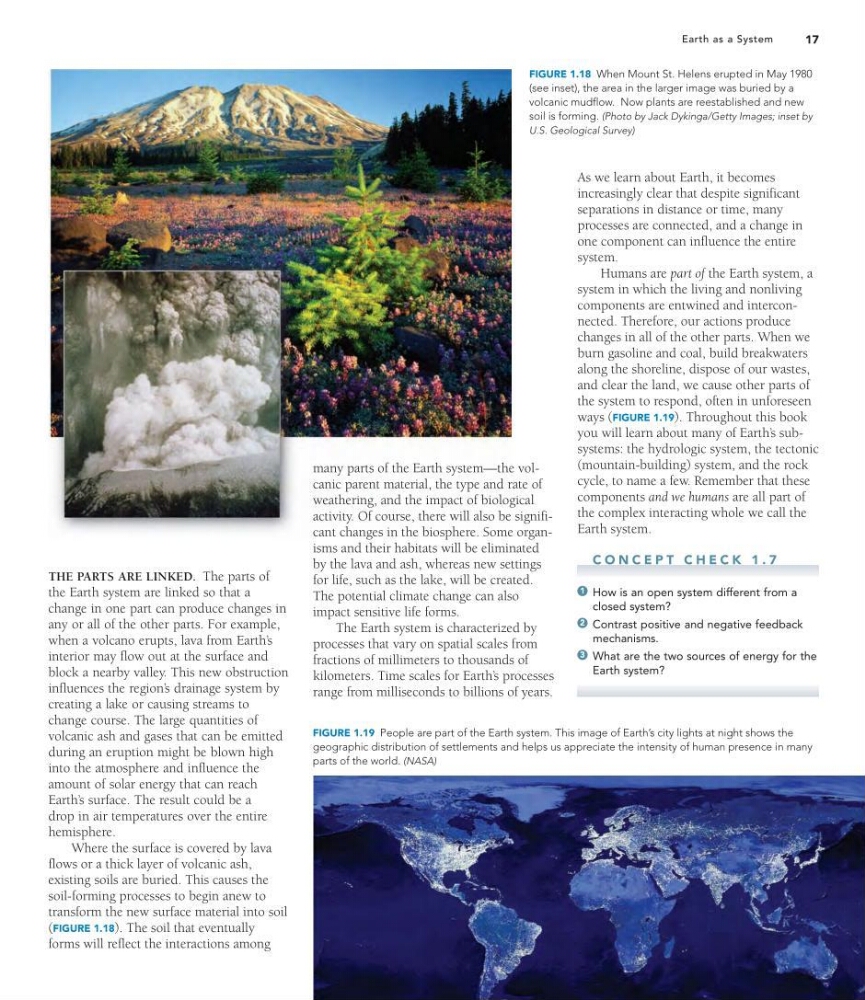
Where the surface is covered by lava
flows or a thick layer of volcanic ash,
existing soils are buried. This causes the
soil-forming processes to begin anew to
transform the new surface material into soil
(FIGURE 1.18). The soil that eventually
forms will reflect the interactions among
FIGURE 1.19 People are part of the Earth system. This image of Earth’s city lights at night shows the
geographic distribution of settlements and helps us appreciate the intensity of human presence in many
parts of the world. (NASA)
FIGURE 1.18 When Mount St. Helens erupted in May 1980
(see inset), the area in the larger image was buried by a
volcanic mudflow. Now plants are reestablished and new
soil is forming. (Photo by Jack Dykinga/Getty Images; inset by
U.S. Geological Survey)
As we learn about Earth, it becomes
increasingly clear that despite significant
separations in distance or time, many
processes are connected, and a change in
one component can influence the entire
system.
Humans are part of the Earth system, a
system in which the living and nonliving
components are entwined and interconnected. Therefore, our actions produce
changes in all of the other parts. When we
burn gasoline and coal, build breakwaters
along the shoreline, dispose of our wastes,
and clear the land, we cause other parts of
the system to respond, often in unforeseen
ways (FIGURE 1.19). Throughout this book
you will learn about many of Earth’ s subsystems: the hydrologic system, the tectonic
(mountain-building) system, and the rock
cycle, to name a few. Remember that these
components and we humans are all part of
the complex interacting whole we call the
Earth system.
C O N C E P T C H E C K 1 . 7
How is an open system different from a
closed system?
Contrast positive and negative feedback
mechanisms.
What are the two sources of energy for the
Earth system?
3
2
1
many parts of the Earth system—the volcanic parent material, the type and rate of
weathering, and the impact of biological
activity. Of course, there will also be significant changes in the biosphere. Some organisms and their habitats will be eliminated
by the lava and ash, whereas new settings
for life, such as the lake, will be created.
The potential climate change can also
impact sensitive life forms.
The Earth system is characterized by
processes that vary on spatial scales from
fractions of millimeters to thousands of
kilometers. Time scales for Earth’ s processes
range from milliseconds to billions of years.
Earth as a System
THE PARTS ARE LINKED. The parts of
the Earth system are linked so that a
change in one part can produce changes in
any or all of the other parts. For example,
when a volcano erupts, lava from Earth’ s
interior may flow out at the surface and
block a nearby valley. This new obstruction
influences the region’ s drainage system by
creating a lake or causing streams to
change course. The large quantities of
volcanic ash and gases that can be emitted
during an eruption might be blown high
into the atmosphere and influence the
amount of solar energy that can reach
Earth’ s surface. The result could be a
drop in air temperatures over the entire
hemisphere.
Where the surface is covered by lava
flows or a thick layer of volcanic ash,
existing soils are buried. This causes the
soil-forming processes to begin anew to
transform the new surface material into soil
(FIGURE 1.18). The soil that eventually
forms will reflect the interactions among
FIGURE 1.19 People are part of the Earth system. This image of Earth’s city lights at night shows the
geographic distribution of settlements and helps us appreciate the intensity of human presence in many
parts of the world. (NASA)
FIGURE 1.18 When Mount St. Helens erupted in May 1980
(see inset), the area in the larger image was buried by a
volcanic mudflow. Now plants are reestablished and new
soil is forming. (Photo by Jack Dykinga/Getty Images; inset by
U.S. Geological Survey)
As we learn about Earth, it becomes
increasingly clear that despite significant
separations in distance or time, many
processes are connected, and a change in
one component can influence the entire
system.
Humans are part of the Earth system, a
system in which the living and nonliving
components are entwined and interconnected. Therefore, our actions produce
changes in all of the other parts. When we
burn gasoline and coal, build breakwaters
along the shoreline, dispose of our wastes,
and clear the land, we cause other parts of
the system to respond, often in unforeseen
ways (FIGURE 1.19). Throughout this book
you will learn about many of Earth’ s subsystems: the hydrologic system, the tectonic
(mountain-building) system, and the rock
cycle, to name a few. Remember that these
components and we humans are all part of
the complex interacting whole we call the
Earth system.
C O N C E P T C H E C K 1 . 7
How is an open system different from a
closed system?
Contrast positive and negative feedback
mechanisms.
What are the two sources of energy for the
Earth system?
3
2
1
many parts of the Earth system—the volcanic parent material, the type and rate of
weathering, and the impact of biological
activity. Of course, there will also be significant changes in the biosphere. Some organisms and their habitats will be eliminated
by the lava and ash, whereas new settings
for life, such as the lake, will be created.
The potential climate change can also
impact sensitive life forms.
The Earth system is characterized by
processes that vary on spatial scales from
fractions of millimeters to thousands of
kilometers. Time scales for Earth’ s processes
range from milliseconds to billions of years.