

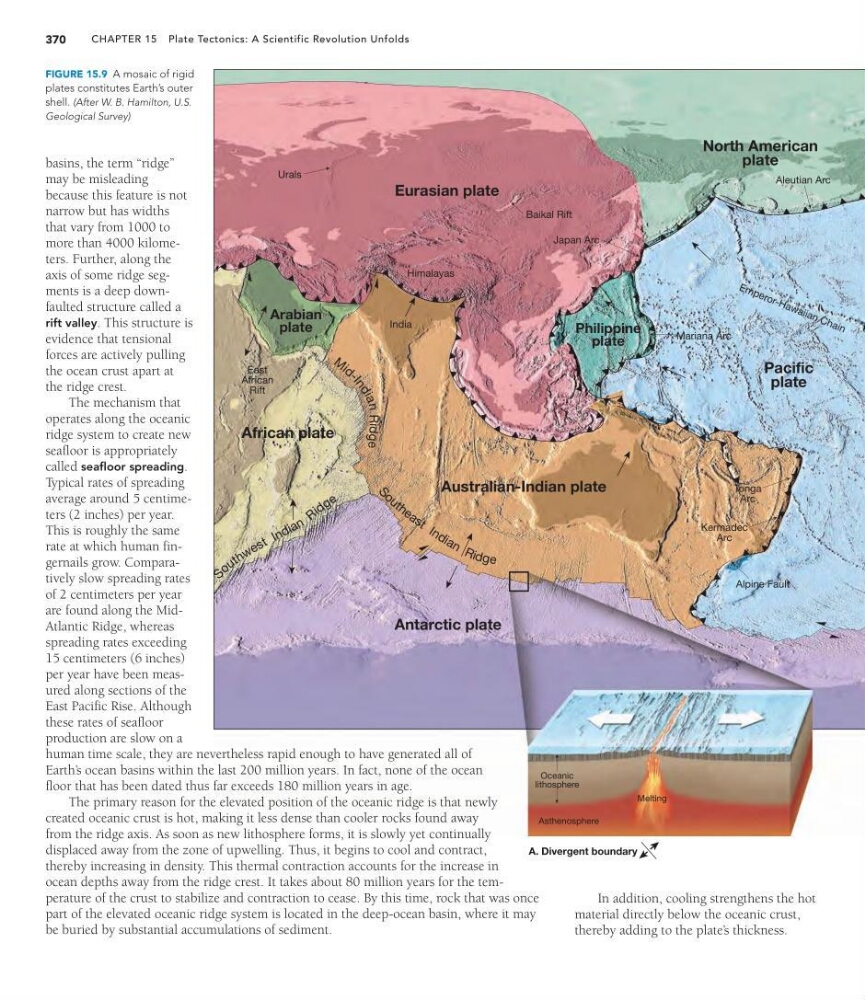
FIGURE 15.9 A mosaic of rigid
plates constitutes Earth’s outer
shell. (After W. B. Hamilton, U.S.
Geological Survey)
Eurasian plate
Philippine
plate
Australian-Indian plate
Pacific
plate
North American
plate
African plate
Antarctic plate
Urals
Kermadec
Arc
Baikal Rift
India
Arabian
plate
Himalayas
East
African
Rift
Alpine Fault
Japan Arc
Mariana Arc
Aleutian Arc
E m p e ro r- H a w a ii a n C h a in
Tonga
Arc
M
i d
-
I
n
d
i
a
n
Ridge
S
o u t h e a s t I n d i a n R id g e
S
o u t h w e s t I n d i a n
R i d g e
A. Divergent boundary
Asthenosphere
Oceanic
lithosphere
Melting
CHAPTER 15 Plate Tectonics: A Scientific Revolution Unfolds
370
basins, the term “ridge”
may be misleading
because this feature is not
narrow but has widths
that vary from 1000 to
more than 4000 kilometers. Further, along the
axis of some ridge segments is a deep downfaulted structure called a
rift valley. This structure is
evidence that tensional
forces are actively pulling
the ocean crust apart at
the ridge crest.
The mechanism that
operates along the oceanic
ridge system to create new
seafloor is appropriately
called seafloor spreading.
Typical rates of spreading
average around 5 centimeters (2 inches) per year.
This is roughly the same
rate at which human fingernails grow. Comparatively slow spreading rates
of 2 centimeters per year
are found along the MidAtlantic Ridge, whereas
spreading rates exceeding
15 centimeters (6 inches)
per year have been measured along sections of the
East Pacific Rise. Although
these rates of seafloor
production are slow on a
human time scale, they are nevertheless rapid enough to have generated all of
Earth’ s ocean basins within the last 200 million years. In fact, none of the ocean
floor that has been dated thus far exceeds 180 million years in age.
The primary reason for the elevated position of the oceanic ridge is that newly
created oceanic crust is hot, making it less dense than cooler rocks found away
from the ridge axis. As soon as new lithosphere forms, it is slowly yet continually
displaced away from the zone of upwelling. Thus, it begins to cool and contract,
thereby increasing in density. This thermal contraction accounts for the increase in
ocean depths away from the ridge crest. It takes about 80 million years for the temperature of the crust to stabilize and contraction to cease. By this time, rock that was once
part of the elevated oceanic ridge system is located in the deep-ocean basin, where it may
be buried by substantial accumulations of sediment.
In addition, cooling strengthens the hot
material directly below the oceanic crust,
thereby adding to the plate’ s thickness.
plates constitutes Earth’s outer
shell. (After W. B. Hamilton, U.S.
Geological Survey)
Eurasian plate
Philippine
plate
Australian-Indian plate
Pacific
plate
North American
plate
African plate
Antarctic plate
Urals
Kermadec
Arc
Baikal Rift
India
Arabian
plate
Himalayas
East
African
Rift
Alpine Fault
Japan Arc
Mariana Arc
Aleutian Arc
E m p e ro r- H a w a ii a n C h a in
Tonga
Arc
M
i d
-
I
n
d
i
a
n
Ridge
S
o u t h e a s t I n d i a n R id g e
S
o u t h w e s t I n d i a n
R i d g e
A. Divergent boundary
Asthenosphere
Oceanic
lithosphere
Melting
CHAPTER 15 Plate Tectonics: A Scientific Revolution Unfolds
370
basins, the term “ridge”
may be misleading
because this feature is not
narrow but has widths
that vary from 1000 to
more than 4000 kilometers. Further, along the
axis of some ridge segments is a deep downfaulted structure called a
rift valley. This structure is
evidence that tensional
forces are actively pulling
the ocean crust apart at
the ridge crest.
The mechanism that
operates along the oceanic
ridge system to create new
seafloor is appropriately
called seafloor spreading.
Typical rates of spreading
average around 5 centimeters (2 inches) per year.
This is roughly the same
rate at which human fingernails grow. Comparatively slow spreading rates
of 2 centimeters per year
are found along the MidAtlantic Ridge, whereas
spreading rates exceeding
15 centimeters (6 inches)
per year have been measured along sections of the
East Pacific Rise. Although
these rates of seafloor
production are slow on a
human time scale, they are nevertheless rapid enough to have generated all of
Earth’ s ocean basins within the last 200 million years. In fact, none of the ocean
floor that has been dated thus far exceeds 180 million years in age.
The primary reason for the elevated position of the oceanic ridge is that newly
created oceanic crust is hot, making it less dense than cooler rocks found away
from the ridge axis. As soon as new lithosphere forms, it is slowly yet continually
displaced away from the zone of upwelling. Thus, it begins to cool and contract,
thereby increasing in density. This thermal contraction accounts for the increase in
ocean depths away from the ridge crest. It takes about 80 million years for the temperature of the crust to stabilize and contraction to cease. By this time, rock that was once
part of the elevated oceanic ridge system is located in the deep-ocean basin, where it may
be buried by substantial accumulations of sediment.
In addition, cooling strengthens the hot
material directly below the oceanic crust,
thereby adding to the plate’ s thickness.