

305
Companion Website
G I V E I T S O M E T H O U G H T
Albuquerque, New Mexico, receives an average of 20.7 centimeters
(8.07 inches) of rainfall annually. Albuquerque is considered a
desert when the commonly used Köppen climate classification is
applied. The Russian city of Verkhoyansk is located near the Arctic
Circle in Siberia. The yearly precipitation at Verkhoyansk averages
15.5 centimeters (6.05 inches), about 5 centimeters less than
Albuquerque, yet it is classified as a humid climate. Explain how
this can occur.
Compare and contrast the sediment deposited by a stream, the
wind, and a glacier. Which deposit should have the most uniform
grain size? Which one would exhibit the poorest sorting? Explain
your choices.
Is either of the following statements true? Are they both true?
Explain your answer.
a. Wind is more effective as an agent of erosion in dry places than
in humid places.
b. Wind is the most important agent of erosion in deserts.
Examine the photo on p. 302 of sand dunes encroaching on
irrigated fields. What type of dunes are these? From what direction
(left or right) is the prevailing wind? How were you able to determine the wind direction?
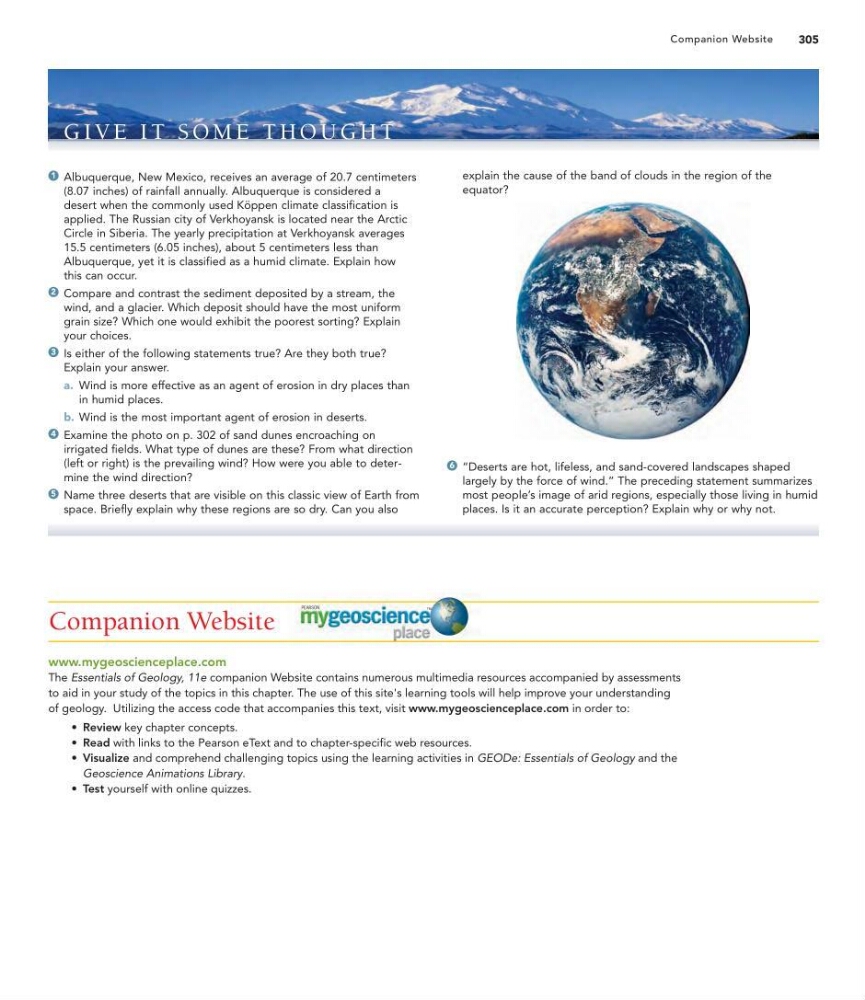
Name three deserts that are visible on this classic view of Earth from
space. Briefly explain why these regions are so dry. Can you also
5
4
3
2
1
explain the cause of the band of clouds in the region of the
equator?
“Deserts are hot, lifeless, and sand-covered landscapes shaped
largely by the force of wind.” The preceding statement summarizes
most people’s image of arid regions, especially those living in humid
places. Is it an accurate perception? Explain why or why not.
6
Companion Website
www.mygeoscienceplace.com
The Essentials of Geology, 11e companion Website contains numerous multimedia resources accompanied by assessments
to aid in your study of the topics in this chapter. The use of this site's learning tools will help improve your understanding
of geology. Utilizing the access code that accompanies this text, visit www.mygeoscienceplace.com in order to:
• Review key chapter concepts.
• Read with links to the Pearson eText and to chapter-specific web resources.
• Visualize and comprehend challenging topics using the learning activities in GEODe: Essentials of Geology and the
Geoscience Animations Library.
• Test yourself with online quizzes.
Companion Website
G I V E I T S O M E T H O U G H T
Albuquerque, New Mexico, receives an average of 20.7 centimeters
(8.07 inches) of rainfall annually. Albuquerque is considered a
desert when the commonly used Köppen climate classification is
applied. The Russian city of Verkhoyansk is located near the Arctic
Circle in Siberia. The yearly precipitation at Verkhoyansk averages
15.5 centimeters (6.05 inches), about 5 centimeters less than
Albuquerque, yet it is classified as a humid climate. Explain how
this can occur.
Compare and contrast the sediment deposited by a stream, the
wind, and a glacier. Which deposit should have the most uniform
grain size? Which one would exhibit the poorest sorting? Explain
your choices.
Is either of the following statements true? Are they both true?
Explain your answer.
a. Wind is more effective as an agent of erosion in dry places than
in humid places.
b. Wind is the most important agent of erosion in deserts.
Examine the photo on p. 302 of sand dunes encroaching on
irrigated fields. What type of dunes are these? From what direction
(left or right) is the prevailing wind? How were you able to determine the wind direction?
Name three deserts that are visible on this classic view of Earth from
space. Briefly explain why these regions are so dry. Can you also
5
4
3
2
1
explain the cause of the band of clouds in the region of the
equator?
“Deserts are hot, lifeless, and sand-covered landscapes shaped
largely by the force of wind.” The preceding statement summarizes
most people’s image of arid regions, especially those living in humid
places. Is it an accurate perception? Explain why or why not.
6
Companion Website
www.mygeoscienceplace.com
The Essentials of Geology, 11e companion Website contains numerous multimedia resources accompanied by assessments
to aid in your study of the topics in this chapter. The use of this site's learning tools will help improve your understanding
of geology. Utilizing the access code that accompanies this text, visit www.mygeoscienceplace.com in order to:
• Review key chapter concepts.
• Read with links to the Pearson eText and to chapter-specific web resources.
• Visualize and comprehend challenging topics using the learning activities in GEODe: Essentials of Geology and the
Geoscience Animations Library.
• Test yourself with online quizzes.