

285
Companion Website
G I V E I T S O M E T H O U G H T
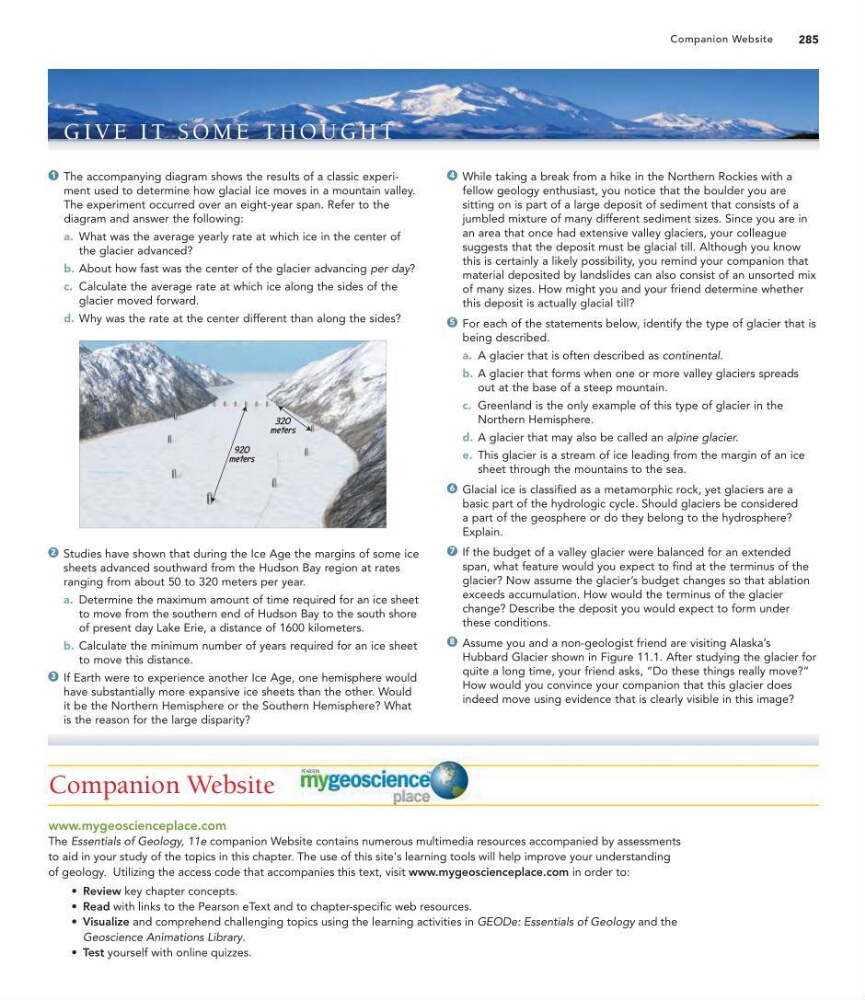
The accompanying diagram shows the results of a classic experiment used to determine how glacial ice moves in a mountain valley.
The experiment occurred over an eight-year span. Refer to the
diagram and answer the following:
a. What was the average yearly rate at which ice in the center of
the glacier advanced?
b. About how fast was the center of the glacier advancing per day?
c. Calculate the average rate at which ice along the sides of the
glacier moved forward.
d. Why was the rate at the center different than along the sides?
1
While taking a break from a hike in the Northern Rockies with a
fellow geology enthusiast, you notice that the boulder you are
sitting on is part of a large deposit of sediment that consists of a
jumbled mixture of many different sediment sizes. Since you are in
an area that once had extensive valley glaciers, your colleague
suggests that the deposit must be glacial till. Although you know
this is certainly a likely possibility, you remind your companion that
material deposited by landslides can also consist of an unsorted mix
of many sizes. How might you and your friend determine whether
this deposit is actually glacial till?
For each of the statements below, identify the type of glacier that is
being described.
a. A glacier that is often described as continental.
b. A glacier that forms when one or more valley glaciers spreads
out at the base of a steep mountain.
c. Greenland is the only example of this type of glacier in the
Northern Hemisphere.
d. A glacier that may also be called an alpine glacier.
e. This glacier is a stream of ice leading from the margin of an ice
sheet through the mountains to the sea.
Glacial ice is classified as a metamorphic rock, yet glaciers are a
basic part of the hydrologic cycle. Should glaciers be considered
a part of the geosphere or do they belong to the hydrosphere?
Explain.
If the budget of a valley glacier were balanced for an extended
span, what feature would you expect to find at the terminus of the
glacier? Now assume the glacier’s budget changes so that ablation
exceeds accumulation. How would the terminus of the glacier
change? Describe the deposit you would expect to form under
these conditions.
Assume you and a non-geologist friend are visiting Alaska’s
Hubbard Glacier shown in Figure 11.1. After studying the glacier for
quite a long time, your friend asks, “Do these things really move?”
How would you convince your companion that this glacier does
indeed move using evidence that is clearly visible in this image?
8
7
6
5
4
Studies have shown that during the Ice Age the margins of some ice
sheets advanced southward from the Hudson Bay region at rates
ranging from about 50 to 320 meters per year.
a. Determine the maximum amount of time required for an ice sheet
to move from the southern end of Hudson Bay to the south shore
of present day Lake Erie, a distance of 1600 kilometers.
b. Calculate the minimum number of years required for an ice sheet
to move this distance.
If Earth were to experience another Ice Age, one hemisphere would
have substantially more expansive ice sheets than the other. Would
it be the Northern Hemisphere or the Southern Hemisphere? What
is the reason for the large disparity?
3
2
Companion Website
www.mygeoscienceplace.com
The Essentials of Geology, 11e companion Website contains numerous multimedia resources accompanied by assessments
to aid in your study of the topics in this chapter. The use of this site's learning tools will help improve your understanding
of geology. Utilizing the access code that accompanies this text, visit www.mygeoscienceplace.com in order to:
• Review key chapter concepts.
• Read with links to the Pearson eText and to chapter-specific web resources.
• Visualize and comprehend challenging topics using the learning activities in GEODe: Essentials of Geology and the
Geoscience Animations Library.
• Test yourself with online quizzes.
Companion Website
G I V E I T S O M E T H O U G H T
The accompanying diagram shows the results of a classic experiment used to determine how glacial ice moves in a mountain valley.
The experiment occurred over an eight-year span. Refer to the
diagram and answer the following:
a. What was the average yearly rate at which ice in the center of
the glacier advanced?
b. About how fast was the center of the glacier advancing per day?
c. Calculate the average rate at which ice along the sides of the
glacier moved forward.
d. Why was the rate at the center different than along the sides?
1
While taking a break from a hike in the Northern Rockies with a
fellow geology enthusiast, you notice that the boulder you are
sitting on is part of a large deposit of sediment that consists of a
jumbled mixture of many different sediment sizes. Since you are in
an area that once had extensive valley glaciers, your colleague
suggests that the deposit must be glacial till. Although you know
this is certainly a likely possibility, you remind your companion that
material deposited by landslides can also consist of an unsorted mix
of many sizes. How might you and your friend determine whether
this deposit is actually glacial till?
For each of the statements below, identify the type of glacier that is
being described.
a. A glacier that is often described as continental.
b. A glacier that forms when one or more valley glaciers spreads
out at the base of a steep mountain.
c. Greenland is the only example of this type of glacier in the
Northern Hemisphere.
d. A glacier that may also be called an alpine glacier.
e. This glacier is a stream of ice leading from the margin of an ice
sheet through the mountains to the sea.
Glacial ice is classified as a metamorphic rock, yet glaciers are a
basic part of the hydrologic cycle. Should glaciers be considered
a part of the geosphere or do they belong to the hydrosphere?
Explain.
If the budget of a valley glacier were balanced for an extended
span, what feature would you expect to find at the terminus of the
glacier? Now assume the glacier’s budget changes so that ablation
exceeds accumulation. How would the terminus of the glacier
change? Describe the deposit you would expect to form under
these conditions.
Assume you and a non-geologist friend are visiting Alaska’s
Hubbard Glacier shown in Figure 11.1. After studying the glacier for
quite a long time, your friend asks, “Do these things really move?”
How would you convince your companion that this glacier does
indeed move using evidence that is clearly visible in this image?
8
7
6
5
4
Studies have shown that during the Ice Age the margins of some ice
sheets advanced southward from the Hudson Bay region at rates
ranging from about 50 to 320 meters per year.
a. Determine the maximum amount of time required for an ice sheet
to move from the southern end of Hudson Bay to the south shore
of present day Lake Erie, a distance of 1600 kilometers.
b. Calculate the minimum number of years required for an ice sheet
to move this distance.
If Earth were to experience another Ice Age, one hemisphere would
have substantially more expansive ice sheets than the other. Would
it be the Northern Hemisphere or the Southern Hemisphere? What
is the reason for the large disparity?
3
2
Companion Website
www.mygeoscienceplace.com
The Essentials of Geology, 11e companion Website contains numerous multimedia resources accompanied by assessments
to aid in your study of the topics in this chapter. The use of this site's learning tools will help improve your understanding
of geology. Utilizing the access code that accompanies this text, visit www.mygeoscienceplace.com in order to:
• Review key chapter concepts.
• Read with links to the Pearson eText and to chapter-specific web resources.
• Visualize and comprehend challenging topics using the learning activities in GEODe: Essentials of Geology and the
Geoscience Animations Library.
• Test yourself with online quizzes.