

T
HE SPECTACULAR
ERUPTION OF A
VOLCANO, THE TERROR
brought by an earthquake, the
magnificent scenery of a mountain
valley, and the destruction created
by a landslide all are subjects for
the geologist.
The study of geology deals with many
fascinating and practical questions about our
physical environment. Will there soon be
another great earthquake in California?
What was the Ice Age like? Will there be
another? Will oil be found if a well is drilled
at this location?
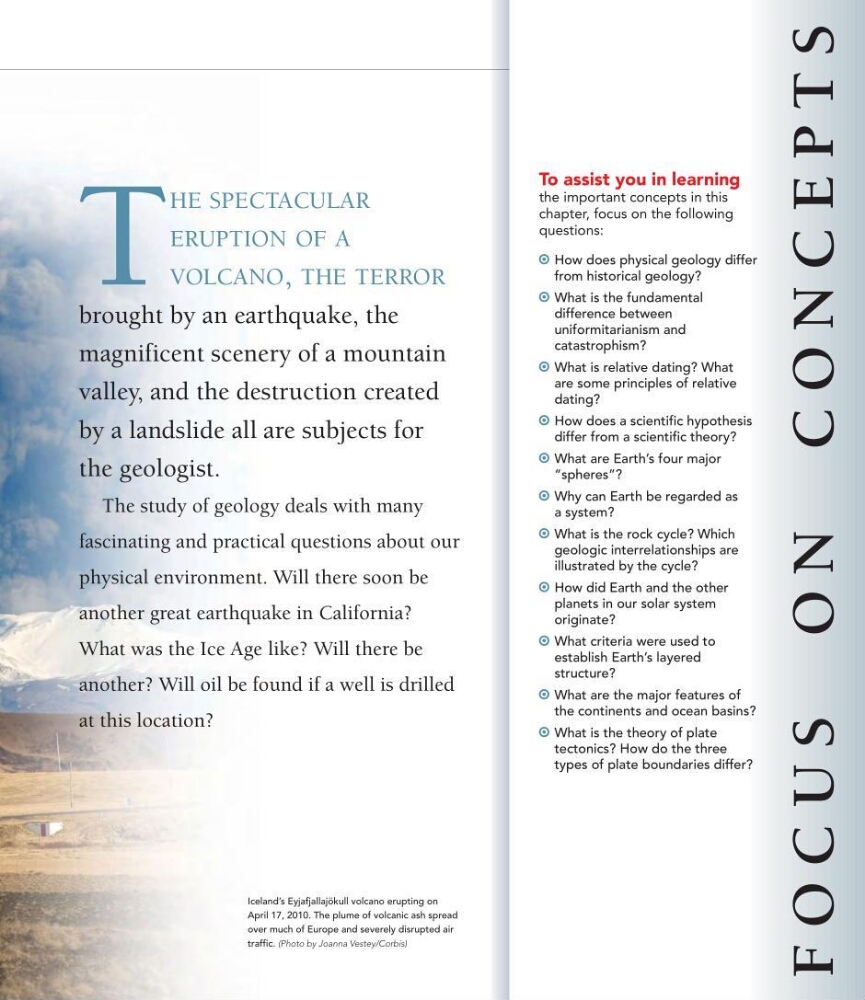
Iceland’s Eyjafjallajökull volcano erupting on
April 17, 2010. The plume of volcanic ash spread
over much of Europe and severely disrupted air
traffic. (Photo by Joanna Vestey/Corbis)
F O C U S O N C O N C E P T S
To assist you in learning
the important concepts in this
chapter, focus on the following
questions:
How does physical geology differ
from historical geology?
What is the fundamental
difference between
uniformitarianism and
catastrophism?
What is relative dating? What
are some principles of relative
dating?
How does a scientific hypothesis
differ from a scientific theory?
What are Earth’s four major
“spheres”?
Why can Earth be regarded as
a system?
What is the rock cycle? Which
geologic interrelationships are
illustrated by the cycle?
How did Earth and the other
planets in our solar system
originate?
What criteria were used to
establish Earth’s layered
structure?
What are the major features of
the continents and ocean basins?
What is the theory of plate
tectonics? How do the three
types of plate boundaries differ?
HE SPECTACULAR
ERUPTION OF A
VOLCANO, THE TERROR
brought by an earthquake, the
magnificent scenery of a mountain
valley, and the destruction created
by a landslide all are subjects for
the geologist.
The study of geology deals with many
fascinating and practical questions about our
physical environment. Will there soon be
another great earthquake in California?
What was the Ice Age like? Will there be
another? Will oil be found if a well is drilled
at this location?
Iceland’s Eyjafjallajökull volcano erupting on
April 17, 2010. The plume of volcanic ash spread
over much of Europe and severely disrupted air
traffic. (Photo by Joanna Vestey/Corbis)
F O C U S O N C O N C E P T S
To assist you in learning
the important concepts in this
chapter, focus on the following
questions:
How does physical geology differ
from historical geology?
What is the fundamental
difference between
uniformitarianism and
catastrophism?
What is relative dating? What
are some principles of relative
dating?
How does a scientific hypothesis
differ from a scientific theory?
What are Earth’s four major
“spheres”?
Why can Earth be regarded as
a system?
What is the rock cycle? Which
geologic interrelationships are
illustrated by the cycle?
How did Earth and the other
planets in our solar system
originate?
What criteria were used to
establish Earth’s layered
structure?
What are the major features of
the continents and ocean basins?
What is the theory of plate
tectonics? How do the three
types of plate boundaries differ?