

A.
B.
rockfall
CHAPTER 8 Mass Wasting: The Work of Gravity
198
Landslides
as Natural Disasters
Even in areas with steep slopes,
catastrophic landslides are relatively rare
occurrences. As a result people living in
susceptible areas often do not appreciate
the risk of living where they do. However,
media reports remind us that such events
occur with some regularity around the
world. The three examples described here
occurred during a span of just four months.
On October 5, 2005, torrential rains
from Hurricane Stan triggered mudflows in
Guatemala. A slurry of mud 1 kilometer
wide and up to 12 meters (40 feet) deep
buried the village of Panabaj. Death toll
estimates for the area approached 1400
people. Flows such as this can travel at
speeds of 50 kilometers (30 miles) per hour
down rugged mountain slopes.
Just three days later, on October 8,
2005, a magnitude 7.6 earthquake struck
the Kashmir region between India and Pakistan. Compounding the tragic effects
caused directly by the severe ground shaking were hundreds of landslides triggered
by the quake and its many aftershocks.
Rockfalls and debris slides thundered down
steep mountain slopes and were focused
into narrow valleys where many people
made their homes. The landslides also
blocked roads and trails,
delaying attempts to reach
those in need (FIGURE 8.1A).
On February 17, 2006,
only a few months after
the tragedies in Kashmir
and Central America, a lethal
mudflow triggered by
extraordinary rains buried a
small town on the Philippine
island of Leyte (Figure 8.1B).
A mass of mud engulfed this
remote coastal area to depths
as great as 10 meters (30
feet). Although an accurate
count of fatalities was difficult, as many as 1800 people
perished. This region is prone
to such events due in part to
the fact that deforestation has denuded the
nearby mountain slopes. In the pages that
follow you will take a closer look at rapid
mass-wasting events in an attempt to better
understand their causes and effects.
C O N C E P T C H E C K 8 . 1
What events triggered the landslides
shown in Figure 8.1?
1
This home in Pacific
Palisades, California, was
destroyed by a landslide
triggered by the January
1994 Northridge
earthquake. (Photo by
Chromo Sohm/Corbis/The
Stock Market)
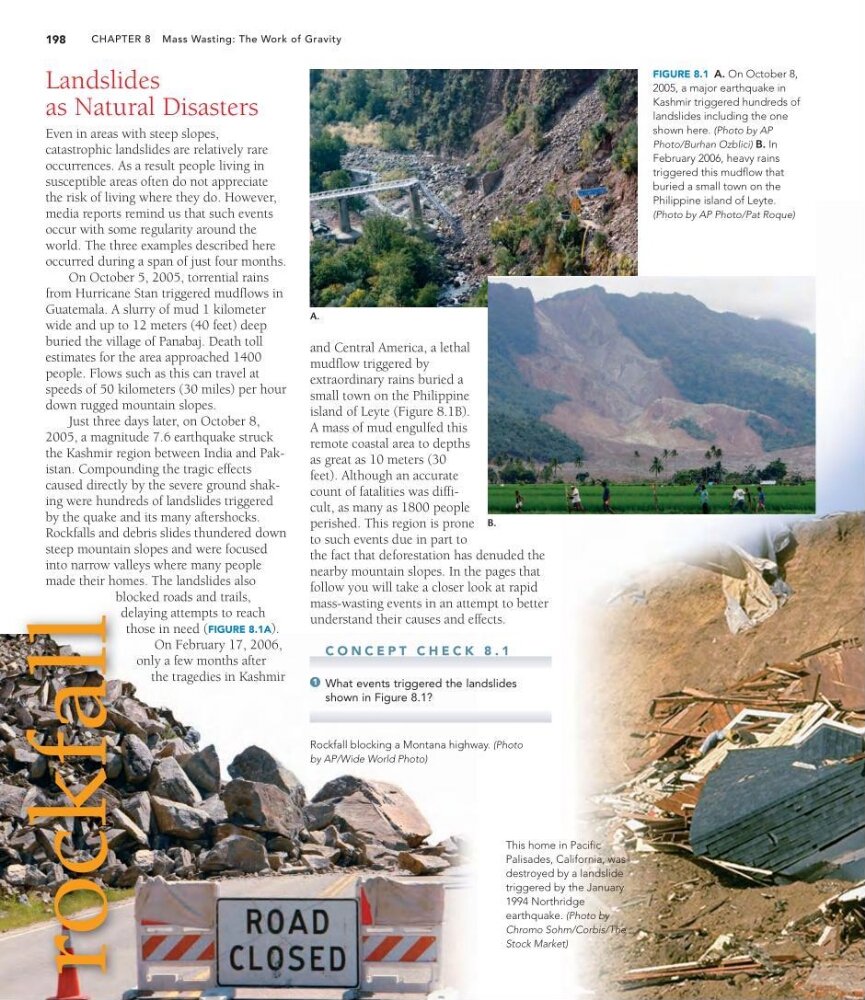
FIGURE 8.1 A. On October 8,
2005, a major earthquake in
Kashmir triggered hundreds of
landslides including the one
shown here. (Photo by AP
Photo/Burhan Ozblici) B. In
February 2006, heavy rains
triggered this mudflow that
buried a small town on the
Philippine island of Leyte.
(Photo by AP Photo/Pat Roque)
Rockfall blocking a Montana highway. (Photo
by AP/Wide World Photo)
B.
rockfall
CHAPTER 8 Mass Wasting: The Work of Gravity
198
Landslides
as Natural Disasters
Even in areas with steep slopes,
catastrophic landslides are relatively rare
occurrences. As a result people living in
susceptible areas often do not appreciate
the risk of living where they do. However,
media reports remind us that such events
occur with some regularity around the
world. The three examples described here
occurred during a span of just four months.
On October 5, 2005, torrential rains
from Hurricane Stan triggered mudflows in
Guatemala. A slurry of mud 1 kilometer
wide and up to 12 meters (40 feet) deep
buried the village of Panabaj. Death toll
estimates for the area approached 1400
people. Flows such as this can travel at
speeds of 50 kilometers (30 miles) per hour
down rugged mountain slopes.
Just three days later, on October 8,
2005, a magnitude 7.6 earthquake struck
the Kashmir region between India and Pakistan. Compounding the tragic effects
caused directly by the severe ground shaking were hundreds of landslides triggered
by the quake and its many aftershocks.
Rockfalls and debris slides thundered down
steep mountain slopes and were focused
into narrow valleys where many people
made their homes. The landslides also
blocked roads and trails,
delaying attempts to reach
those in need (FIGURE 8.1A).
On February 17, 2006,
only a few months after
the tragedies in Kashmir
and Central America, a lethal
mudflow triggered by
extraordinary rains buried a
small town on the Philippine
island of Leyte (Figure 8.1B).
A mass of mud engulfed this
remote coastal area to depths
as great as 10 meters (30
feet). Although an accurate
count of fatalities was difficult, as many as 1800 people
perished. This region is prone
to such events due in part to
the fact that deforestation has denuded the
nearby mountain slopes. In the pages that
follow you will take a closer look at rapid
mass-wasting events in an attempt to better
understand their causes and effects.
C O N C E P T C H E C K 8 . 1
What events triggered the landslides
shown in Figure 8.1?
1
This home in Pacific
Palisades, California, was
destroyed by a landslide
triggered by the January
1994 Northridge
earthquake. (Photo by
Chromo Sohm/Corbis/The
Stock Market)
FIGURE 8.1 A. On October 8,
2005, a major earthquake in
Kashmir triggered hundreds of
landslides including the one
shown here. (Photo by AP
Photo/Burhan Ozblici) B. In
February 2006, heavy rains
triggered this mudflow that
buried a small town on the
Philippine island of Leyte.
(Photo by AP Photo/Pat Roque)
Rockfall blocking a Montana highway. (Photo
by AP/Wide World Photo)