

P R E F A C E
xvii
In addition to being informative and upto-date, a major goal of Essentials of Geology
is to meet the need of beginning students
for a readable and user-friendly text, a book
that is a highly usable tool for learning the
basic principles and concepts of geology.
New Active Learning Approach
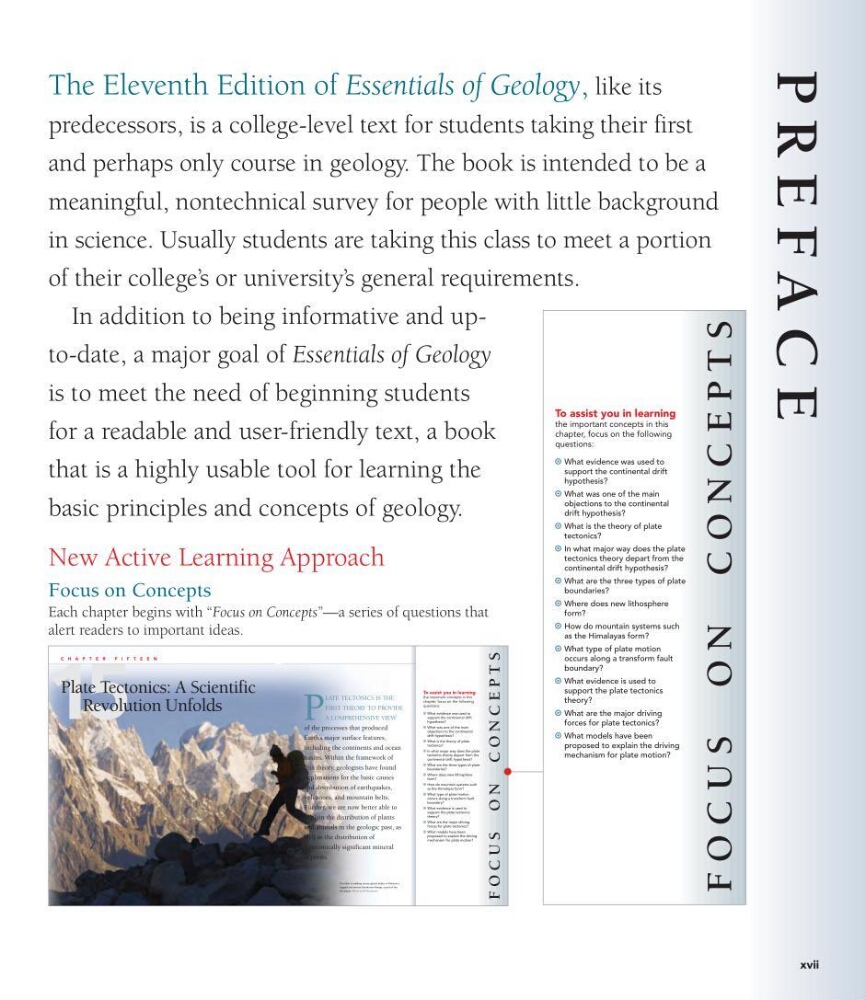
Focus on Concepts
Each chapter begins with “Focus on Concepts”—a series of questions that
alert readers to important ideas.
The Eleventh Edition of Essentials of Geology, like its
predecessors, is a college-level text for students taking their first
and perhaps only course in geology. The book is intended to be a
meaningful, nontechnical survey for people with little background
in science. Usually students are taking this class to meet a portion
of their college’ s or university’ s general requirements.
P
LATE TECTONICS IS THE
FIRST THEORY TO PROVIDE
A COMPREHENSIVE VIEW
of the processes that produced
Earth’ s major surface features,
including the continents and ocean
basins. Within the framework of
this theory, geologists have found
explanations for the basic causes
and distribution of earthquakes,
volcanoes, and mountain belts.
Further, we are now better able to
explain the distribution of plants
and animals in the geologic past, as
well as the distribution of
economically significant mineral
deposits.
F O C U S O N C O N C E P T S
To assist you in learning
the important concepts in this
chapter, focus on the following
questions:
What evidence was used to
support the continental drift
hypothesis?
What was one of the main
objections to the continental
drift hypothesis?
What is the theory of plate
tectonics?
In what major way does the plate
tectonics theory depart from the
continental drift hypothesis?
What are the three types of plate
boundaries?
Where does new lithosphere
form?
How do mountain systems such
as the Himalayas form?
What type of plate motion
occurs along a transform fault
boundary?
What evidence is used to
support the plate tectonics
theory?
What are the major driving
forces for plate tectonics?
What models have been
proposed to explain the driving
mechanism for plate motion?
C H A P T E R
F I F T E E N
15
Plate Tectonics: A Scientific
Revolution Unfolds
This hiker is walking across glacial debris in Pakistan’s
rugged and remote Karakoram Range, a part of the
Himalayas. (Photo by Bill Stevenson)
F O C U S O N C O N C E P T S
To assist you in learning
the important concepts in this
chapter, focus on the following
questions:
What evidence was used to
support the continental drift
hypothesis?
What was one of the main
objections to the continental
drift hypothesis?
What is the theory of plate
tectonics?
In what major way does the plate
tectonics theory depart from the
continental drift hypothesis?
What are the three types of plate
boundaries?
Where does new lithosphere
form?
How do mountain systems such
as the Himalayas form?
What type of plate motion
occurs along a transform fault
boundary?
What evidence is used to
support the plate tectonics
theory?
What are the major driving
forces for plate tectonics?
What models have been
proposed to explain the driving
mechanism for plate motion?
xvii
In addition to being informative and upto-date, a major goal of Essentials of Geology
is to meet the need of beginning students
for a readable and user-friendly text, a book
that is a highly usable tool for learning the
basic principles and concepts of geology.
New Active Learning Approach
Focus on Concepts
Each chapter begins with “Focus on Concepts”—a series of questions that
alert readers to important ideas.
The Eleventh Edition of Essentials of Geology, like its
predecessors, is a college-level text for students taking their first
and perhaps only course in geology. The book is intended to be a
meaningful, nontechnical survey for people with little background
in science. Usually students are taking this class to meet a portion
of their college’ s or university’ s general requirements.
P
LATE TECTONICS IS THE
FIRST THEORY TO PROVIDE
A COMPREHENSIVE VIEW
of the processes that produced
Earth’ s major surface features,
including the continents and ocean
basins. Within the framework of
this theory, geologists have found
explanations for the basic causes
and distribution of earthquakes,
volcanoes, and mountain belts.
Further, we are now better able to
explain the distribution of plants
and animals in the geologic past, as
well as the distribution of
economically significant mineral
deposits.
F O C U S O N C O N C E P T S
To assist you in learning
the important concepts in this
chapter, focus on the following
questions:
What evidence was used to
support the continental drift
hypothesis?
What was one of the main
objections to the continental
drift hypothesis?
What is the theory of plate
tectonics?
In what major way does the plate
tectonics theory depart from the
continental drift hypothesis?
What are the three types of plate
boundaries?
Where does new lithosphere
form?
How do mountain systems such
as the Himalayas form?
What type of plate motion
occurs along a transform fault
boundary?
What evidence is used to
support the plate tectonics
theory?
What are the major driving
forces for plate tectonics?
What models have been
proposed to explain the driving
mechanism for plate motion?
C H A P T E R
F I F T E E N
15
Plate Tectonics: A Scientific
Revolution Unfolds
This hiker is walking across glacial debris in Pakistan’s
rugged and remote Karakoram Range, a part of the
Himalayas. (Photo by Bill Stevenson)
F O C U S O N C O N C E P T S
To assist you in learning
the important concepts in this
chapter, focus on the following
questions:
What evidence was used to
support the continental drift
hypothesis?
What was one of the main
objections to the continental
drift hypothesis?
What is the theory of plate
tectonics?
In what major way does the plate
tectonics theory depart from the
continental drift hypothesis?
What are the three types of plate
boundaries?
Where does new lithosphere
form?
How do mountain systems such
as the Himalayas form?
What type of plate motion
occurs along a transform fault
boundary?
What evidence is used to
support the plate tectonics
theory?
What are the major driving
forces for plate tectonics?
What models have been
proposed to explain the driving
mechanism for plate motion?