

147
Companion Website
G I V E I T S O M E T H O U G H T
Imagine you are a geologist who was hired to study the geology
of a small mountainous island in the tropics. When you arrive at
the shore of the island to begin your study, you find that transportation to the island’s interior will not be available until the
next day. Rather than lose a day of investigation, how might you
begin your study of the island’s geology having access only to
the beach?
Describe how plants promote mechanical and chemical weathering
but inhibit erosion.
Granite and basalt are exposed at Earth’s surface in a hot, wet
region. Will mechanical weathering or chemical weathering
predominate? Which rock will weather most rapidly? Why?
The level of carbon dioxide (CO 2 ) in the atmosphere has been
increasing for more than a century. Do you think this increase
tends to accelerate or slow down the rate of chemical weathering
of Earth’s surface rocks? Explain your conclusion.
When you studied Chapter 3, you learned that feldspars are very
common minerals in igneous rocks. When you learn about the
common minerals that compose sedimentary rocks in Chapter 6,
you will find that feldspars are relatively rare. Applying what
you have learned about chemical weathering, explain why this is
true. Based on this explanation, what mineral might you expect
to be common in sedimentary rocks that is not found in
igneous rocks?
If a historic monument or building were particularly valuable to
your community, how would you determine how rapidly the structure might deteriorate and whether it needed protection?
6
5
4
3
2
1
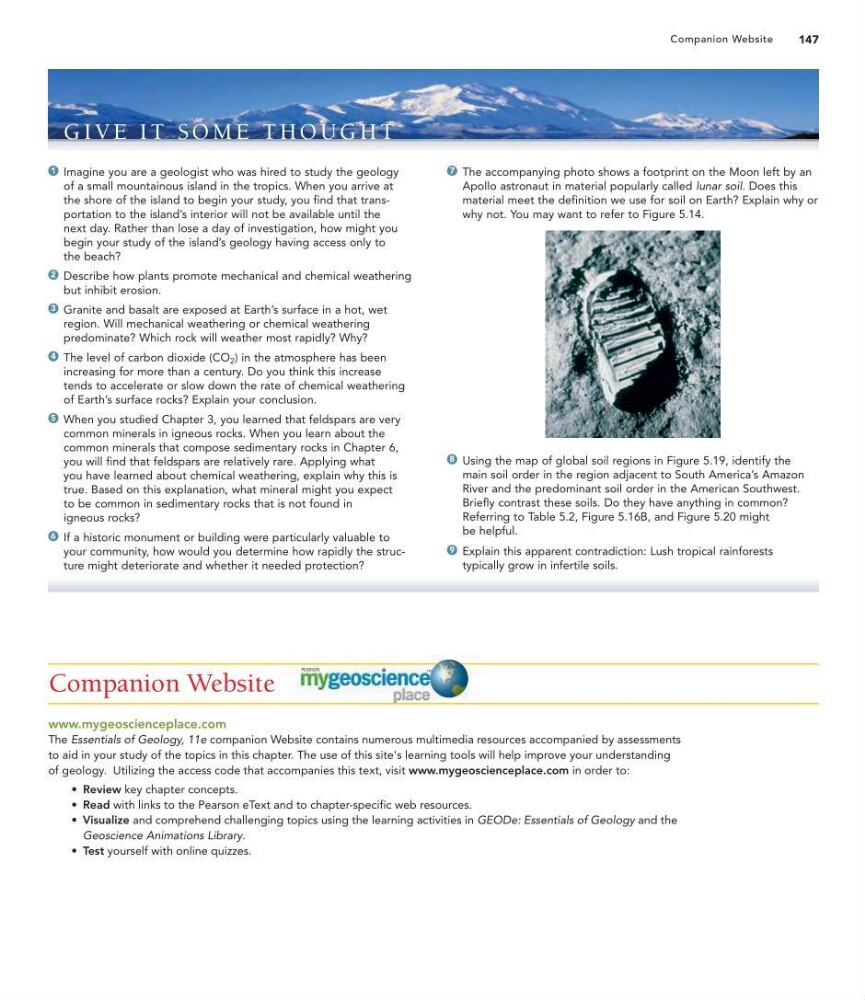
The accompanying photo shows a footprint on the Moon left by an
Apollo astronaut in material popularly called lunar soil. Does this
material meet the definition we use for soil on Earth? Explain why or
why not. You may want to refer to Figure 5.14.
Using the map of global soil regions in Figure 5.19, identify the
main soil order in the region adjacent to South America’s Amazon
River and the predominant soil order in the American Southwest.
Briefly contrast these soils. Do they have anything in common?
Referring to Table 5.2, Figure 5.16B, and Figure 5.20 might
be helpful.
Explain this apparent contradiction: Lush tropical rainforests
typically grow in infertile soils.
9
8
7
Companion Website
www.mygeoscienceplace.com
The Essentials of Geology, 11e companion Website contains numerous multimedia resources accompanied by assessments
to aid in your study of the topics in this chapter. The use of this site's learning tools will help improve your understanding
of geology. Utilizing the access code that accompanies this text, visit www.mygeoscienceplace.com in order to:
• Review key chapter concepts.
• Read with links to the Pearson eText and to chapter-specific web resources.
• Visualize and comprehend challenging topics using the learning activities in GEODe: Essentials of Geology and the
Geoscience Animations Library.
• Test yourself with online quizzes.
Companion Website
G I V E I T S O M E T H O U G H T
Imagine you are a geologist who was hired to study the geology
of a small mountainous island in the tropics. When you arrive at
the shore of the island to begin your study, you find that transportation to the island’s interior will not be available until the
next day. Rather than lose a day of investigation, how might you
begin your study of the island’s geology having access only to
the beach?
Describe how plants promote mechanical and chemical weathering
but inhibit erosion.
Granite and basalt are exposed at Earth’s surface in a hot, wet
region. Will mechanical weathering or chemical weathering
predominate? Which rock will weather most rapidly? Why?
The level of carbon dioxide (CO 2 ) in the atmosphere has been
increasing for more than a century. Do you think this increase
tends to accelerate or slow down the rate of chemical weathering
of Earth’s surface rocks? Explain your conclusion.
When you studied Chapter 3, you learned that feldspars are very
common minerals in igneous rocks. When you learn about the
common minerals that compose sedimentary rocks in Chapter 6,
you will find that feldspars are relatively rare. Applying what
you have learned about chemical weathering, explain why this is
true. Based on this explanation, what mineral might you expect
to be common in sedimentary rocks that is not found in
igneous rocks?
If a historic monument or building were particularly valuable to
your community, how would you determine how rapidly the structure might deteriorate and whether it needed protection?
6
5
4
3
2
1
The accompanying photo shows a footprint on the Moon left by an
Apollo astronaut in material popularly called lunar soil. Does this
material meet the definition we use for soil on Earth? Explain why or
why not. You may want to refer to Figure 5.14.
Using the map of global soil regions in Figure 5.19, identify the
main soil order in the region adjacent to South America’s Amazon
River and the predominant soil order in the American Southwest.
Briefly contrast these soils. Do they have anything in common?
Referring to Table 5.2, Figure 5.16B, and Figure 5.20 might
be helpful.
Explain this apparent contradiction: Lush tropical rainforests
typically grow in infertile soils.
9
8
7
Companion Website
www.mygeoscienceplace.com
The Essentials of Geology, 11e companion Website contains numerous multimedia resources accompanied by assessments
to aid in your study of the topics in this chapter. The use of this site's learning tools will help improve your understanding
of geology. Utilizing the access code that accompanies this text, visit www.mygeoscienceplace.com in order to:
• Review key chapter concepts.
• Read with links to the Pearson eText and to chapter-specific web resources.
• Visualize and comprehend challenging topics using the learning activities in GEODe: Essentials of Geology and the
Geoscience Animations Library.
• Test yourself with online quizzes.