

Cinder
cones
Composite
cones
Fissure
eruption
Magma
chamber
A.
Laccolith
Volcanic
necks
Dike
B.
Batholith
Batholith
C.
Intrusions
Sills
Sills
Dikes
Dike
Dike
Dike
Pipe
Laccolith
Dikes
T
I
M
E
Sill
Emplacement of magma
and related igneous
structures
Crystallization of magma
to form intrusions.
Erosion exposes some
intrusions at the surface.
Extensive uplift
and erosion exposes
batholith
Invariably, some of
the magma will not
reach the surface but
will instead crystallize
or “freeze” at depth where
it becomes an intrusive
igneous rock. Much of what
is known about intrusive
igneous activity has come from
the study of old, now solid,
magma bodies exhumed by
erosion.
Nature of Intrusive Bodies
The structures that result from the
emplacement of magma into preexisting
rocks are called intrusions or plutons.
Because all intrusions form out of view
beneath Earth’ s surface, they are studied
primarily after uplifting and erosion have
exposed them. The challenge lies in reconstructing the events that generated these
structures millions or even hundreds of
millions of years ago.
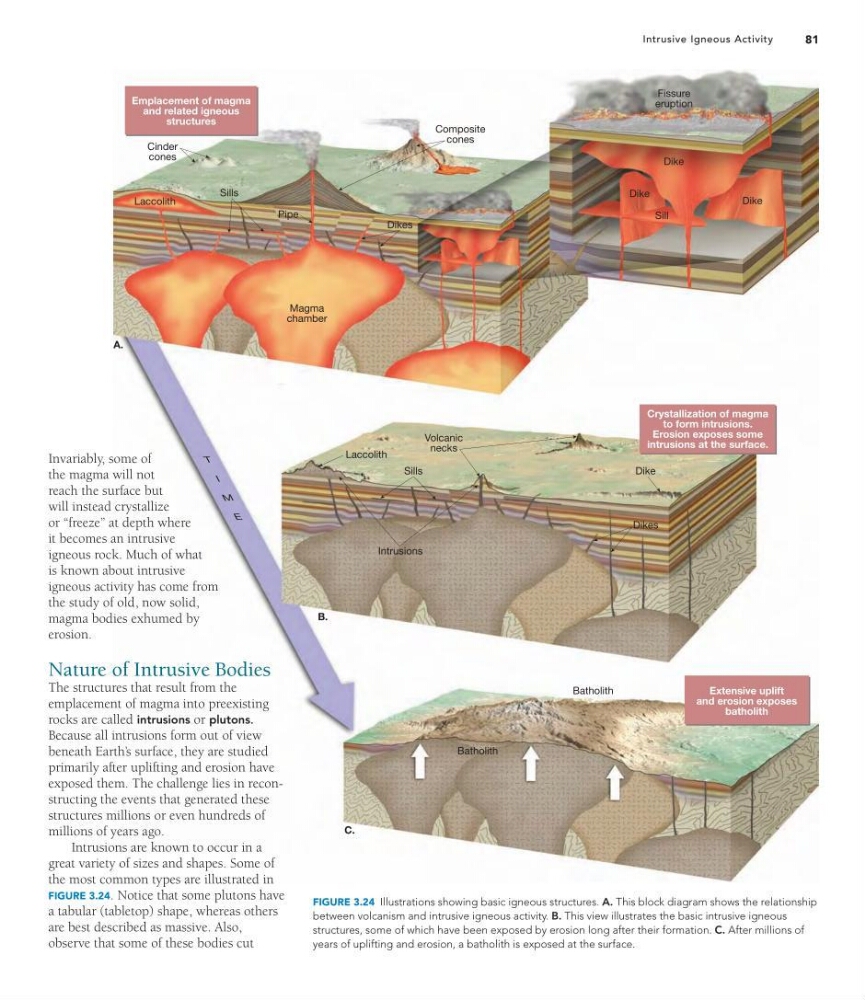
Intrusions are known to occur in a
great variety of sizes and shapes. Some of
the most common types are illustrated in
FIGURE 3.24. Notice that some plutons have
a tabular (tabletop) shape, whereas others
are best described as massive. Also,
observe that some of these bodies cut
81
Intrusive Igneous Activity
FIGURE 3.24 Illustrations showing basic igneous structures. A. This block diagram shows the relationship
between volcanism and intrusive igneous activity. B. This view illustrates the basic intrusive igneous
structures, some of which have been exposed by erosion long after their formation. C. After millions of
years of uplifting and erosion, a batholith is exposed at the surface.
cones
Composite
cones
Fissure
eruption
Magma
chamber
A.
Laccolith
Volcanic
necks
Dike
B.
Batholith
Batholith
C.
Intrusions
Sills
Sills
Dikes
Dike
Dike
Dike
Pipe
Laccolith
Dikes
T
I
M
E
Sill
Emplacement of magma
and related igneous
structures
Crystallization of magma
to form intrusions.
Erosion exposes some
intrusions at the surface.
Extensive uplift
and erosion exposes
batholith
Invariably, some of
the magma will not
reach the surface but
will instead crystallize
or “freeze” at depth where
it becomes an intrusive
igneous rock. Much of what
is known about intrusive
igneous activity has come from
the study of old, now solid,
magma bodies exhumed by
erosion.
Nature of Intrusive Bodies
The structures that result from the
emplacement of magma into preexisting
rocks are called intrusions or plutons.
Because all intrusions form out of view
beneath Earth’ s surface, they are studied
primarily after uplifting and erosion have
exposed them. The challenge lies in reconstructing the events that generated these
structures millions or even hundreds of
millions of years ago.
Intrusions are known to occur in a
great variety of sizes and shapes. Some of
the most common types are illustrated in
FIGURE 3.24. Notice that some plutons have
a tabular (tabletop) shape, whereas others
are best described as massive. Also,
observe that some of these bodies cut
81
Intrusive Igneous Activity
FIGURE 3.24 Illustrations showing basic igneous structures. A. This block diagram shows the relationship
between volcanism and intrusive igneous activity. B. This view illustrates the basic intrusive igneous
structures, some of which have been exposed by erosion long after their formation. C. After millions of
years of uplifting and erosion, a batholith is exposed at the surface.