

Host
rock
Host rock is
dislodged, melts
and is incorporated
into a magma body
Earliest-formed
minerals settle,
changing the composition
of the remaining melt
Younger magma body
intrudes and mixes
with older one
A. Assimilation of host rock
C. Magma mixing
B. Crystallization and settling
Host
rock
Magma
body
A.
B.
C.
Crystallization
and settling
Crystallization
and settling
T
I
M
E
Igneous activity
produces rocks having
the composition of the
initial magma
Magmatic differentiation
(crystallization and settling)
changes the composition
of the remaining melt
Further magmatic
differentiation results
in more highly
evolved melts
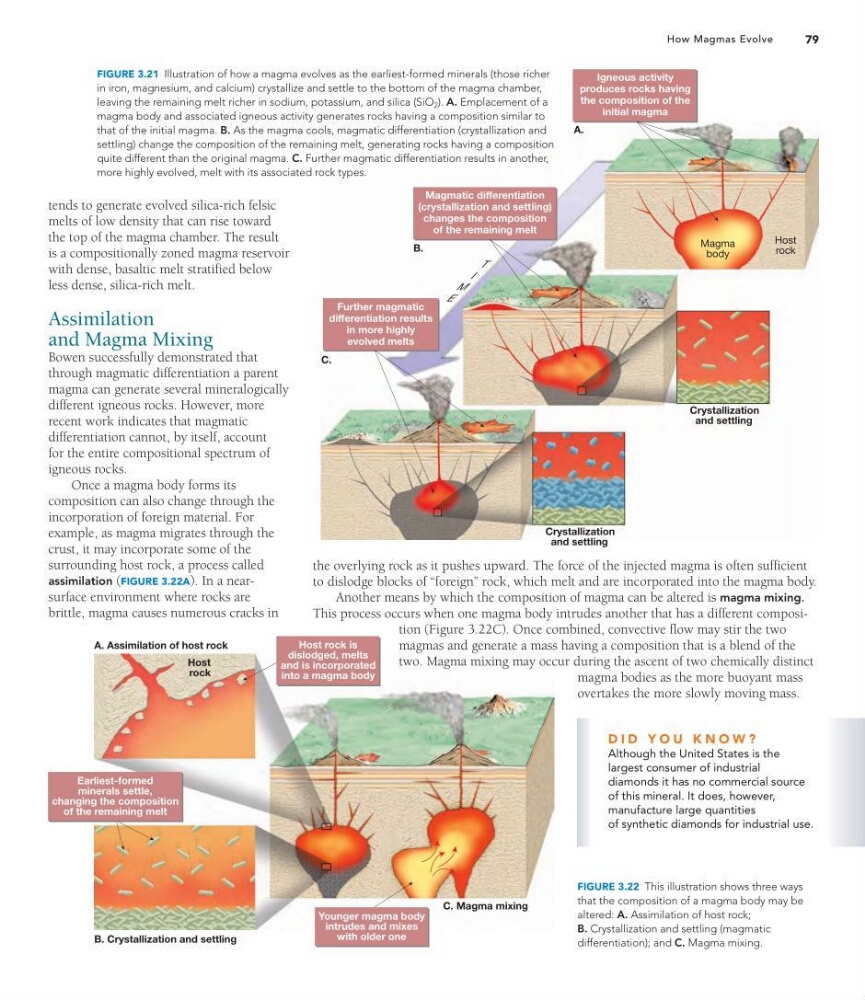
the overlying rock as it pushes upward. The force of the injected magma is often sufficient
to dislodge blocks of “foreign” rock, which melt and are incorporated into the magma body.
Another means by which the composition of magma can be altered is magma mixing.
This process occurs when one magma body intrudes another that has a different composition (Figure 3.22C). Once combined, convective flow may stir the two
magmas and generate a mass having a composition that is a blend of the
two. Magma mixing may occur during the ascent of two chemically distinct
magma bodies as the more buoyant mass
overtakes the more slowly moving mass.
tends to generate evolved silica-rich felsic
melts of low density that can rise toward
the top of the magma chamber. The result
is a compositionally zoned magma reservoir
with dense, basaltic melt stratified below
less dense, silica-rich melt.
Assimilation
and Magma Mixing
Bowen successfully demonstrated that
through magmatic differentiation a parent
magma can generate several mineralogically
different igneous rocks. However, more
recent work indicates that magmatic
differentiation cannot, by itself, account
for the entire compositional spectrum of
igneous rocks.
Once a magma body forms its
composition can also change through the
incorporation of foreign material. For
example, as magma migrates through the
crust, it may incorporate some of the
surrounding host rock, a process called
assimilation (FIGURE 3.22A). In a nearsurface environment where rocks are
brittle, magma causes numerous cracks in
FIGURE 3.21 Illustration of how a magma evolves as the earliest-formed minerals (those richer
in iron, magnesium, and calcium) crystallize and settle to the bottom of the magma chamber,
leaving the remaining melt richer in sodium, potassium, and silica (SiO 2 ). A. Emplacement of a
magma body and associated igneous activity generates rocks having a composition similar to
that of the initial magma. B. As the magma cools, magmatic differentiation (crystallization and
settling) change the composition of the remaining melt, generating rocks having a composition
quite different than the original magma. C. Further magmatic differentiation results in another,
more highly evolved, melt with its associated rock types.
D I D Y O U K N O W ?
Although the United States is the
largest consumer of industrial
diamonds it has no commercial source
of this mineral. It does, however,
manufacture large quantities
of synthetic diamonds for industrial use.
FIGURE 3.22 This illustration shows three ways
that the composition of a magma body may be
altered: A. Assimilation of host rock;
B. Crystallization and settling (magmatic
differentiation); and C. Magma mixing.
79
How Magmas Evolve
rock
Host rock is
dislodged, melts
and is incorporated
into a magma body
Earliest-formed
minerals settle,
changing the composition
of the remaining melt
Younger magma body
intrudes and mixes
with older one
A. Assimilation of host rock
C. Magma mixing
B. Crystallization and settling
Host
rock
Magma
body
A.
B.
C.
Crystallization
and settling
Crystallization
and settling
T
I
M
E
Igneous activity
produces rocks having
the composition of the
initial magma
Magmatic differentiation
(crystallization and settling)
changes the composition
of the remaining melt
Further magmatic
differentiation results
in more highly
evolved melts
the overlying rock as it pushes upward. The force of the injected magma is often sufficient
to dislodge blocks of “foreign” rock, which melt and are incorporated into the magma body.
Another means by which the composition of magma can be altered is magma mixing.
This process occurs when one magma body intrudes another that has a different composition (Figure 3.22C). Once combined, convective flow may stir the two
magmas and generate a mass having a composition that is a blend of the
two. Magma mixing may occur during the ascent of two chemically distinct
magma bodies as the more buoyant mass
overtakes the more slowly moving mass.
tends to generate evolved silica-rich felsic
melts of low density that can rise toward
the top of the magma chamber. The result
is a compositionally zoned magma reservoir
with dense, basaltic melt stratified below
less dense, silica-rich melt.
Assimilation
and Magma Mixing
Bowen successfully demonstrated that
through magmatic differentiation a parent
magma can generate several mineralogically
different igneous rocks. However, more
recent work indicates that magmatic
differentiation cannot, by itself, account
for the entire compositional spectrum of
igneous rocks.
Once a magma body forms its
composition can also change through the
incorporation of foreign material. For
example, as magma migrates through the
crust, it may incorporate some of the
surrounding host rock, a process called
assimilation (FIGURE 3.22A). In a nearsurface environment where rocks are
brittle, magma causes numerous cracks in
FIGURE 3.21 Illustration of how a magma evolves as the earliest-formed minerals (those richer
in iron, magnesium, and calcium) crystallize and settle to the bottom of the magma chamber,
leaving the remaining melt richer in sodium, potassium, and silica (SiO 2 ). A. Emplacement of a
magma body and associated igneous activity generates rocks having a composition similar to
that of the initial magma. B. As the magma cools, magmatic differentiation (crystallization and
settling) change the composition of the remaining melt, generating rocks having a composition
quite different than the original magma. C. Further magmatic differentiation results in another,
more highly evolved, melt with its associated rock types.
D I D Y O U K N O W ?
Although the United States is the
largest consumer of industrial
diamonds it has no commercial source
of this mineral. It does, however,
manufacture large quantities
of synthetic diamonds for industrial use.
FIGURE 3.22 This illustration shows three ways
that the composition of a magma body may be
altered: A. Assimilation of host rock;
B. Crystallization and settling (magmatic
differentiation); and C. Magma mixing.
79
How Magmas Evolve