

3.2 POROSITY AND PERMEABILITY
79
GRAIN SIZE:
%
.r-I nl Ill mini
0 10 20 30 40 50 60 0 10 20 30 40 50 60
I
l
l
n
I
I
l
I
l
I
I
I
l
I
~o-~--t
20 ~go
30
o ~176 ~ ~ ~ o...~ ~,~' 0
~j~2~ i o.tID 9 ~ ~o""o 9
40
- "e 9 9 9 9 e.o.e - -
2. ,o..o~ a ~o 9 9 ...
50
a 9 9 9 e. o.~~9 _
e..eo o~o e..9
-" "O OO qJ.o-o"o 9
i
oo9
i.~
0 LL9 o 9 9 o'o,..
)0 4. 9 9 9
9 ee 9 e"~ot
I
9 9 e~e"o.P 9 9 "
00000000
~ ~l
0000001)
t
'0"+',, oooooooo
I-.J"-,...00000000 ""
t
--o..oo 9 9 9 oo9
I/
o'~, ~o.o oo9
30 5. o o'lbe t o ~Oo 95~1
o o 9 9 9 o"o"o ...
OOOOO:__O
//
OOOOOOOO
t
oe~" 4"[
oooooooo
)0
ooooo
oooooooo
I r'". jooooooo
)0
oooooooo
l-I
o"O 9 q.o 9 o 9
oo.ooo.o l] o.oo.-.-...
l0 ~..ooooooo
n-I
ooooooo
"
'0
"
"'''14
ooo9149149
ii 9 1
--,/.1
j
SET 21
EROSIVE BOUNDARY
SET 22
.
3O
50
90110
2600
2O
4o
60
8O
loo
""""~~
120
,
,
,
"~
' adoo 9 a oo' 3 oo
9oo
2aoo 2 oo ' a 'oo
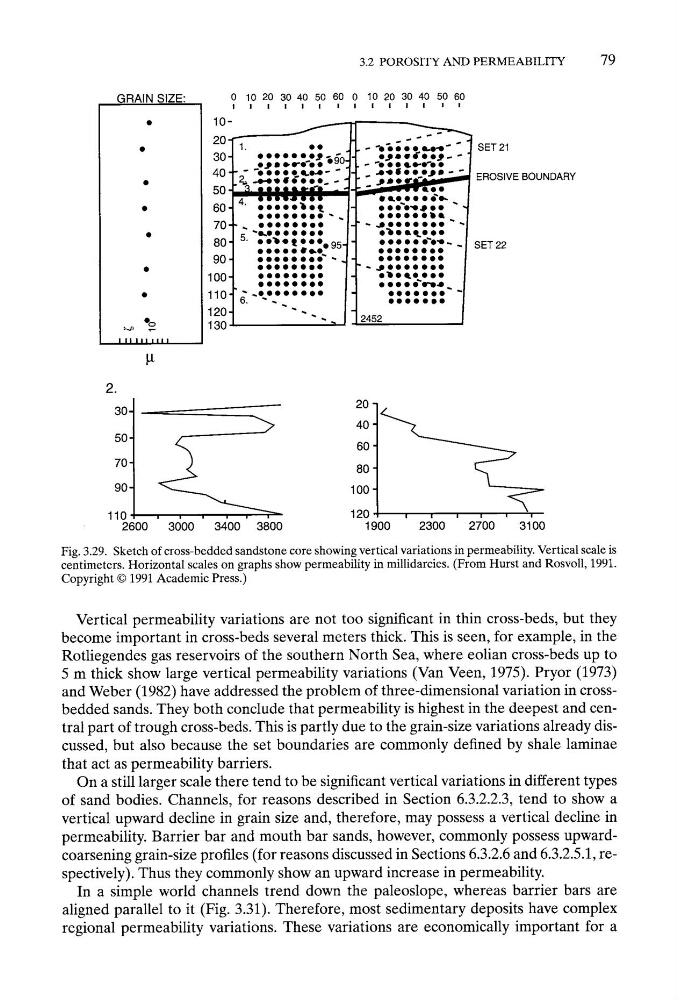
Fig. 3.29. Sketch of cross-bedded sandstone core showing vertical variations in permeability. Vertical scale is
centimeters. Horizontal scales on graphs show permeability in millidarcies. (From Hurst and Rosvoll, 1991.
Copyright 9 1991 Academic Press.)
Vertical permeability variations are not too significant in thin cross-beds, but they
become important in cross-beds several meters thick. This is seen, for example, in the
Rotliegendes gas reservoirs of the southern North Sea, where eolian cross-beds up to
5 m thick show large vertical permeability variations (Van Veen, 1975). Pryor (1973)
and Weber (1982) have addressed the problem of three-dimensional variation in crossbedded sands. They both conclude that permeability is highest in the deepest and central part of trough cross-beds. This is partly due to the grain-size variations already discussed, but also because the set boundaries are commonly defined by shale laminae
that act as permeability barriers.
On a still larger scale there tend to be significant vertical variations in different types
of sand bodies. Channels, for reasons described in Section 6.3.2.2.3, tend to show a
vertical upward decline in grain size and, therefore, may possess a vertical decline in
permeability. Barrier bar and mouth bar sands, however, commonly possess upwardcoarsening grain-size profiles (for reasons discussed in Sections 6.3.2.6 and 6.3.2.5.1, respectively). Thus they commonly show an upward increase in permeability.
In a simple world channels trend down the palee 9
whereas barrier bars are
aligned parallel to it (Fig. 3.31). Therefore, most sedimentary deposits have complex
regional permeability variations. These variations are economically important for a
79
GRAIN SIZE:
%
.r-I nl Ill mini
0 10 20 30 40 50 60 0 10 20 30 40 50 60
I
l
l
n
I
I
l
I
l
I
I
I
l
I
~o-~--t
20 ~go
30
o ~176 ~ ~ ~ o...~ ~,~' 0
~j~2~ i o.tID 9 ~ ~o""o 9
40
- "e 9 9 9 9 e.o.e - -
2. ,o..o~ a ~o 9 9 ...
50
a 9 9 9 e. o.~~9 _
e..eo o~o e..9
-" "O OO qJ.o-o"o 9
i
oo9
i.~
0 LL9 o 9 9 o'o,..
)0 4. 9 9 9
9 ee 9 e"~ot
I
9 9 e~e"o.P 9 9 "
00000000
~ ~l
0000001)
t
'0"+',, oooooooo
I-.J"-,...00000000 ""
t
--o..oo 9 9 9 oo9
I/
o'~, ~o.o oo9
30 5. o o'lbe t o ~Oo 95~1
o o 9 9 9 o"o"o ...
OOOOO:__O
//
OOOOOOOO
t
oe~" 4"[
oooooooo
)0
ooooo
oooooooo
I r'". jooooooo
)0
oooooooo
l-I
o"O 9 q.o 9 o 9
oo.ooo.o l] o.oo.-.-...
l0 ~..ooooooo
n-I
ooooooo
"
'0
"
"'''14
ooo9149149
ii 9 1
--,/.1
j
SET 21
EROSIVE BOUNDARY
SET 22
.
3O
50
90110
2600
2O
4o
60
8O
loo
""""~~
120
,
,
,
"~
' adoo 9 a oo' 3 oo
9oo
2aoo 2 oo ' a 'oo
Fig. 3.29. Sketch of cross-bedded sandstone core showing vertical variations in permeability. Vertical scale is
centimeters. Horizontal scales on graphs show permeability in millidarcies. (From Hurst and Rosvoll, 1991.
Copyright 9 1991 Academic Press.)
Vertical permeability variations are not too significant in thin cross-beds, but they
become important in cross-beds several meters thick. This is seen, for example, in the
Rotliegendes gas reservoirs of the southern North Sea, where eolian cross-beds up to
5 m thick show large vertical permeability variations (Van Veen, 1975). Pryor (1973)
and Weber (1982) have addressed the problem of three-dimensional variation in crossbedded sands. They both conclude that permeability is highest in the deepest and central part of trough cross-beds. This is partly due to the grain-size variations already discussed, but also because the set boundaries are commonly defined by shale laminae
that act as permeability barriers.
On a still larger scale there tend to be significant vertical variations in different types
of sand bodies. Channels, for reasons described in Section 6.3.2.2.3, tend to show a
vertical upward decline in grain size and, therefore, may possess a vertical decline in
permeability. Barrier bar and mouth bar sands, however, commonly possess upwardcoarsening grain-size profiles (for reasons discussed in Sections 6.3.2.6 and 6.3.2.5.1, respectively). Thus they commonly show an upward increase in permeability.
In a simple world channels trend down the palee 9
whereas barrier bars are
aligned parallel to it (Fig. 3.31). Therefore, most sedimentary deposits have complex
regional permeability variations. These variations are economically important for a