

3.2 POROSITY AND PERMEABILITY
73
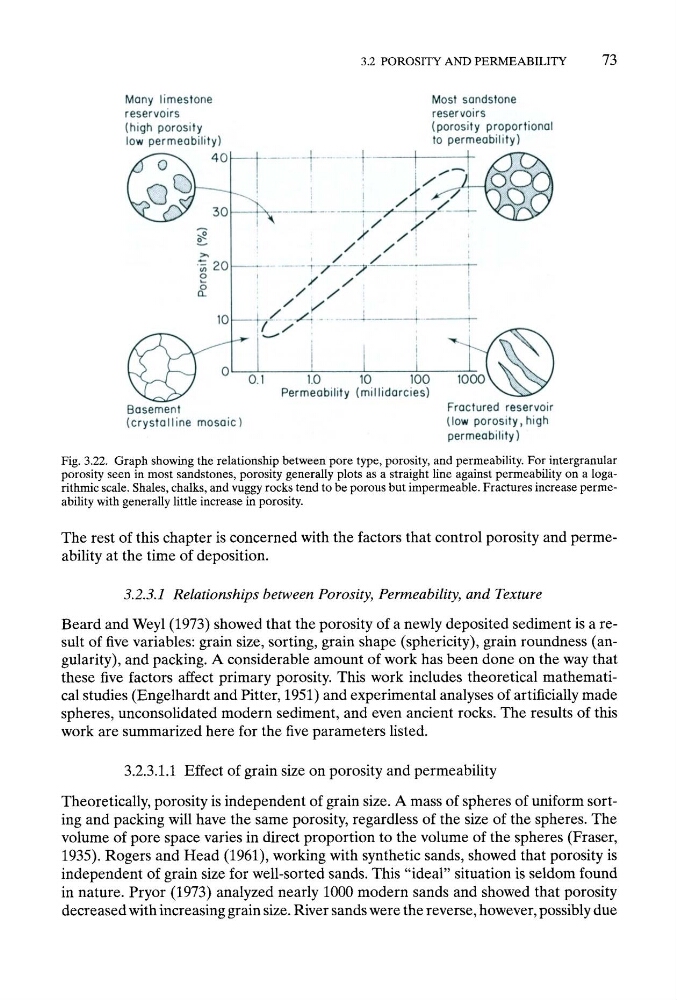
Fig. 3.22. Graph showing the relationship between pore type, porosity, and permeability. For intergranular
porosity seen in most sandstones, porosity generally plots as a straight line against permeability on a logarithmic scale. Shales, chalks, and vuggy rocks tend to be porous but impermeable. Fractures increase permeability with generally little increase in porosity.
The rest of this chapter is concerned with the factors that control porosity and permeability at the time of deposition.
3.2.3.1 Relationships between Porosity, Permeability, and Texture
Beard and Weyl (1973) showed that the porosity of a newly deposited sediment is a result of five variables: grain size, sorting, grain shape (sphericity), grain roundness (angularity), and packing. A considerable amount of work has been done on the way that
these five factors affect primary porosity. This work includes theoretical mathematical studies (Engelhardt and Pitter, 1951) and experimental analyses of artificially made
spheres, unconsolidated modern sediment, and even ancient rocks. The results of this
work are summarized here for the five parameters listed.
3.2.3.1.1 Effect of grain size on porosity and permeability
Theoretically, porosity is independent of grain size. A mass of spheres of uniform sorting and packing will have the same porosity, regardless of the size of the spheres. The
volume of pore space varies in direct proportion to the volume of the spheres (Fraser,
1935). Rogers and Head (1961), working with synthetic sands, showed that porosity is
independent of grain size for well-sorted sands. This "ideal" situation is seldom found
in nature. Pryor (1973) analyzed nearly 1000 modern sands and showed that porosity
decreased with increasing grain size. River sands were the reverse, however, possibly due
73
Fig. 3.22. Graph showing the relationship between pore type, porosity, and permeability. For intergranular
porosity seen in most sandstones, porosity generally plots as a straight line against permeability on a logarithmic scale. Shales, chalks, and vuggy rocks tend to be porous but impermeable. Fractures increase permeability with generally little increase in porosity.
The rest of this chapter is concerned with the factors that control porosity and permeability at the time of deposition.
3.2.3.1 Relationships between Porosity, Permeability, and Texture
Beard and Weyl (1973) showed that the porosity of a newly deposited sediment is a result of five variables: grain size, sorting, grain shape (sphericity), grain roundness (angularity), and packing. A considerable amount of work has been done on the way that
these five factors affect primary porosity. This work includes theoretical mathematical studies (Engelhardt and Pitter, 1951) and experimental analyses of artificially made
spheres, unconsolidated modern sediment, and even ancient rocks. The results of this
work are summarized here for the five parameters listed.
3.2.3.1.1 Effect of grain size on porosity and permeability
Theoretically, porosity is independent of grain size. A mass of spheres of uniform sorting and packing will have the same porosity, regardless of the size of the spheres. The
volume of pore space varies in direct proportion to the volume of the spheres (Fraser,
1935). Rogers and Head (1961), working with synthetic sands, showed that porosity is
independent of grain size for well-sorted sands. This "ideal" situation is seldom found
in nature. Pryor (1973) analyzed nearly 1000 modern sands and showed that porosity
decreased with increasing grain size. River sands were the reverse, however, possibly due