

3.2 POROSITY AND PERMEABILITY
71
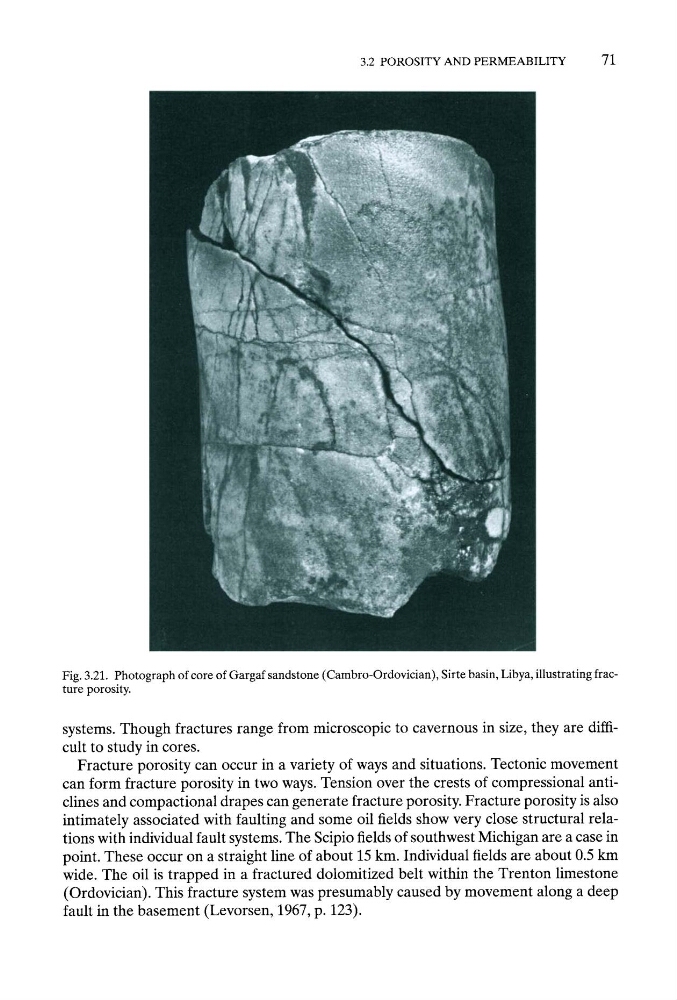
Fig. 3.21. Photograph of core of Gargaf sandstone (Cambro-Ordovician), Sirte basin, Libya, illustrating fracture porosity.
systems. Though fractures range from microscopic to cavernous in size, they are difficult to study in cores.
Fracture porosity can occur in a variety of ways and situations. Tectonic movement
can form fracture porosity in two ways. Tension over the crests of compressional anticlines and compactional drapes can generate fracture porosity. Fracture porosity is also
intimately associated with faulting and some oil fields show very close structural relations with individual fault systems. The Scipio fields of southwest Michigan are a case in
point. These occur on a straight line of about 15 km. Individual fields are about 0.5 km
wide. The oil is trapped in a fractured dolomitized belt within the Trenton limestone
(Ordovician). This fracture system was presumably caused by movement along a deep
fault in the basement (Levorsen, 1967, p. 123).
71
Fig. 3.21. Photograph of core of Gargaf sandstone (Cambro-Ordovician), Sirte basin, Libya, illustrating fracture porosity.
systems. Though fractures range from microscopic to cavernous in size, they are difficult to study in cores.
Fracture porosity can occur in a variety of ways and situations. Tectonic movement
can form fracture porosity in two ways. Tension over the crests of compressional anticlines and compactional drapes can generate fracture porosity. Fracture porosity is also
intimately associated with faulting and some oil fields show very close structural relations with individual fault systems. The Scipio fields of southwest Michigan are a case in
point. These occur on a straight line of about 15 km. Individual fields are about 0.5 km
wide. The oil is trapped in a fractured dolomitized belt within the Trenton limestone
(Ordovician). This fracture system was presumably caused by movement along a deep
fault in the basement (Levorsen, 1967, p. 123).