

66
3 PARTICLES, PORES, AND PERMEABILITY
Table 3.4
Classification of Porosity Types
Type
Origin
I. Primary or
depositional
II. Secondary or
postdepositional
(a) Intergranular or }
interparticle
(b) Intragranular or
intraparticle
(c) Intercrystalline }
(d) Fenestral
(e) Moldic }
(f) Vuggy
(g) Fracture
Sedimentation
Cementation
Solution
Tectonic movement,
compaction or dehydration
petrography of the host rock (e.g., Robinson, 1966). The classification shown in Table 3.4
divides porosity into two commonly recognized main varieties (e.g., Murray, 1960).
These are primary porosity fabrics, which were present immediately after the rock had
been deposited, and secondary or postdepositional fabrics, which formed after sedimentation by a variety of causes. The main porosity types are now described and illustrated (see Plate 1).
3.2.2.2 Primary or Depositional Porosity
Primary or depositional porosity is that which, by definition, forms when a sediment is
first laid down. Two main types of primary porosity are recognized: intergranular, or
interparticle, and intragranular, or intraparticle.
3.2.2.2.1 Intergranular or interparticle porosity
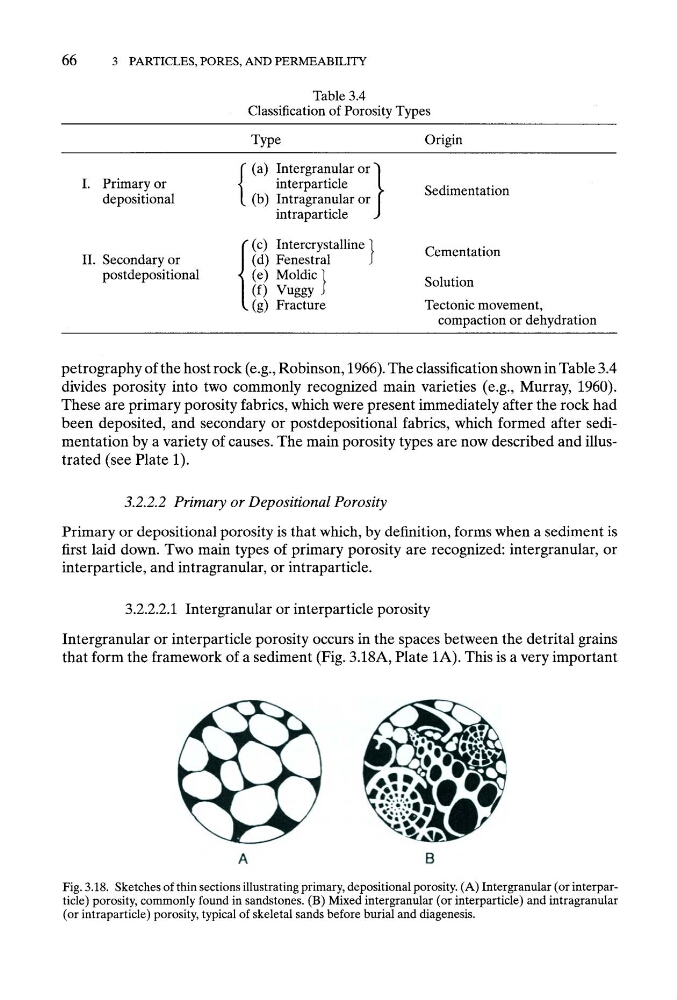
Intergranular or interparticle porosity occurs in the spaces between the detrital grains
that form the framework of a sediment (Fig. 3.18A, Plate 1A). This is a very important
Fig. 3.18. Sketches of thin sections illustrating primary, depositional porosity. (A) Intergranular (or interparticle) porosity, commonly found in sandstones. (B) Mixed intergranular (or interparticle) and intragranular
(or intraparticle) porosity, typical of skeletal sands before burial and diagenesis.
3 PARTICLES, PORES, AND PERMEABILITY
Table 3.4
Classification of Porosity Types
Type
Origin
I. Primary or
depositional
II. Secondary or
postdepositional
(a) Intergranular or }
interparticle
(b) Intragranular or
intraparticle
(c) Intercrystalline }
(d) Fenestral
(e) Moldic }
(f) Vuggy
(g) Fracture
Sedimentation
Cementation
Solution
Tectonic movement,
compaction or dehydration
petrography of the host rock (e.g., Robinson, 1966). The classification shown in Table 3.4
divides porosity into two commonly recognized main varieties (e.g., Murray, 1960).
These are primary porosity fabrics, which were present immediately after the rock had
been deposited, and secondary or postdepositional fabrics, which formed after sedimentation by a variety of causes. The main porosity types are now described and illustrated (see Plate 1).
3.2.2.2 Primary or Depositional Porosity
Primary or depositional porosity is that which, by definition, forms when a sediment is
first laid down. Two main types of primary porosity are recognized: intergranular, or
interparticle, and intragranular, or intraparticle.
3.2.2.2.1 Intergranular or interparticle porosity
Intergranular or interparticle porosity occurs in the spaces between the detrital grains
that form the framework of a sediment (Fig. 3.18A, Plate 1A). This is a very important
Fig. 3.18. Sketches of thin sections illustrating primary, depositional porosity. (A) Intergranular (or interparticle) porosity, commonly found in sandstones. (B) Mixed intergranular (or interparticle) and intragranular
(or intraparticle) porosity, typical of skeletal sands before burial and diagenesis.