

64
3 PARTICLES, PORES, AND PERMEABILITY
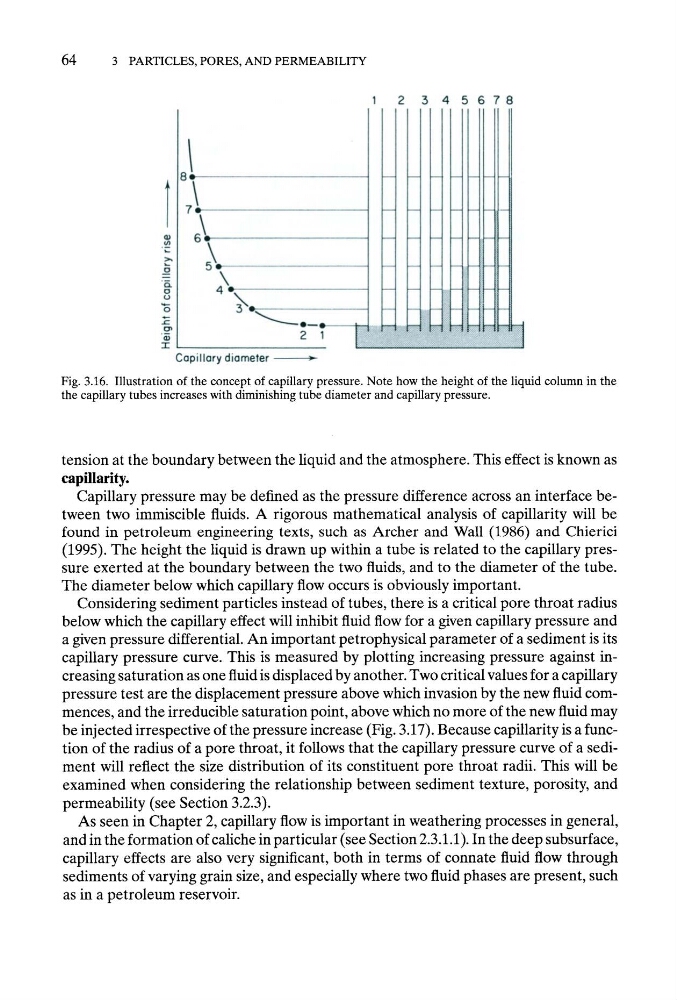
Fig. 3.16. Illustration of the concept of capillary pressure. Note how the height of the liquid column in the
the capillary tubes increases with diminishing tube diameter and capillary pressure.
tension at the boundary between the liquid and the atmosphere. This effect is known as
capillarity.
Capillary pressure may be defined as the pressure difference across an interface between two immiscible fluids. A rigorous mathematical analysis of capillarity will be
found in petroleum engineering texts, such as Archer and Wall (1986) and Chierici
(1995). The height the liquid is drawn up within a tube is related to the capillary pressure exerted at the boundary between the two fluids, and to the diameter of the tube.
The diameter below which capillary flow occurs is obviously important.
Considering sediment particles instead of tubes, there is a critical pore throat radius
below which the capillary effect will inhibit fluid flow for a given capillary pressure and
a given pressure differential. An important petrophysical parameter of a sediment is its
capillary pressure curve. This is measured by plotting increasing pressure against increasing saturation as one fluid is displaced by another. Two critical values for a capillary
pressure test are the displacement pressure above which invasion by the new fluid commences, and the irreducible saturation point, above which no more of the new fluid may
be injected irrespective of the pressure increase (Fig. 3.17). Because capillarity is a function of the radius of a pore throat, it follows that the capillary pressure curve of a sediment will reflect the size distribution of its constituent pore throat radii. This will be
examined when considering the relationship between sediment texture, porosity, and
permeability (see Section 3.2.3).
As seen in Chapter 2, capillary flow is important in weathering processes in general,
and in the formation of caliche in particular (see Section 2.3.1.1). In the deep subsurface,
capillary effects are also very significant, both in terms of connate fluid flow through
sediments of varying grain size, and especially where two fluid phases are present, such
as in a petroleum reservoir.
3 PARTICLES, PORES, AND PERMEABILITY
Fig. 3.16. Illustration of the concept of capillary pressure. Note how the height of the liquid column in the
the capillary tubes increases with diminishing tube diameter and capillary pressure.
tension at the boundary between the liquid and the atmosphere. This effect is known as
capillarity.
Capillary pressure may be defined as the pressure difference across an interface between two immiscible fluids. A rigorous mathematical analysis of capillarity will be
found in petroleum engineering texts, such as Archer and Wall (1986) and Chierici
(1995). The height the liquid is drawn up within a tube is related to the capillary pressure exerted at the boundary between the two fluids, and to the diameter of the tube.
The diameter below which capillary flow occurs is obviously important.
Considering sediment particles instead of tubes, there is a critical pore throat radius
below which the capillary effect will inhibit fluid flow for a given capillary pressure and
a given pressure differential. An important petrophysical parameter of a sediment is its
capillary pressure curve. This is measured by plotting increasing pressure against increasing saturation as one fluid is displaced by another. Two critical values for a capillary
pressure test are the displacement pressure above which invasion by the new fluid commences, and the irreducible saturation point, above which no more of the new fluid may
be injected irrespective of the pressure increase (Fig. 3.17). Because capillarity is a function of the radius of a pore throat, it follows that the capillary pressure curve of a sediment will reflect the size distribution of its constituent pore throat radii. This will be
examined when considering the relationship between sediment texture, porosity, and
permeability (see Section 3.2.3).
As seen in Chapter 2, capillary flow is important in weathering processes in general,
and in the formation of caliche in particular (see Section 2.3.1.1). In the deep subsurface,
capillary effects are also very significant, both in terms of connate fluid flow through
sediments of varying grain size, and especially where two fluid phases are present, such
as in a petroleum reservoir.