

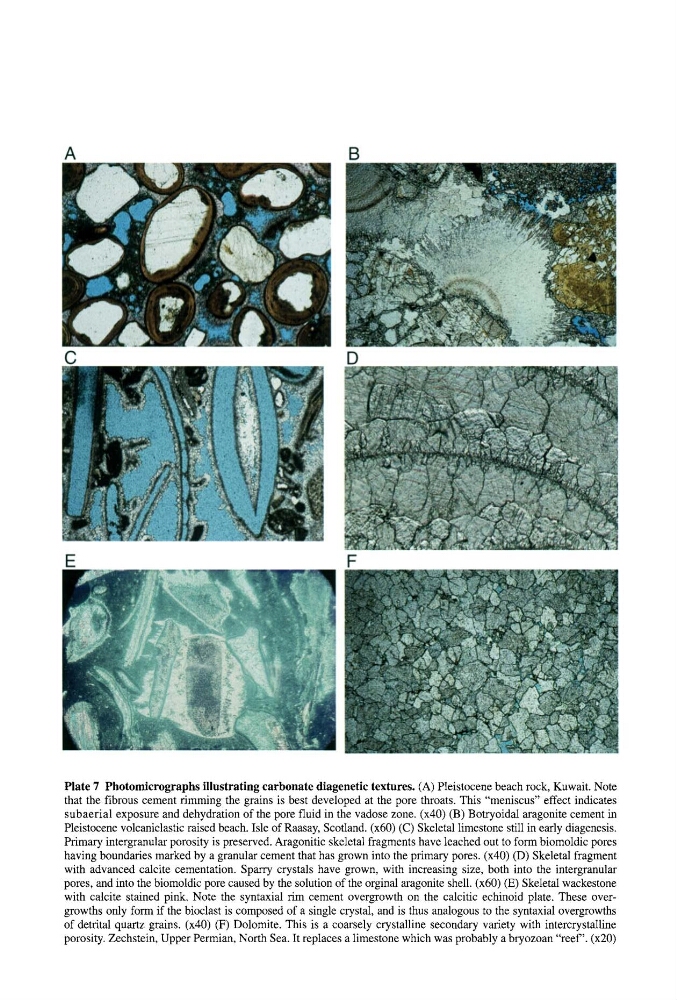
Plate 7 Photomicrographs illustrating carbonate diagenetic textures. (A) Pleistocene beach rock, Kuwait. Note
that the fibrous cement rimming the grains is best developed at the pore throats. This "meniscus" effect indicates
subaerial exposure and dehydration of the pore fluid in the vadose zone. (x40) (B) Botryoidal aragonite cement in
Pleistocene volcaniclastic raised beach. Isle of Raasay, Scotland. (x60) (C) Skeletal limestone still in early diagenesis.
Primary intergranular porosity is preserved. Aragonitic skeletal fragments have leached out to form biomoldic pores
having boundaries marked by a granular cement that has grown into the primary pores. (x40) (D) Skeletal fragment
with advanced calcite cementation. Sparry crystals have grown, with increasing size, both into the intergranular
pores, and into the biomoldic pore caused by the solution of the orginal aragonite shell. (x60) (E) Skeletal wackestone
with calcite stained pink. Note the syntaxial rim cement overgrowth on the calcitic echinoid plate. These overgrowths only form if the bioclast is composed of a single crystal, and is thus analogous to the syntaxial overgrowths
of detrital quartz grains. (x40) (F) Dolomite. This is a coarsely crystalline secondary variety with intercrystalline
porosity. Zechstein, Upper Permian, North Sea. It replaces a limestone which was probably a bryozoan "reef". (x20)
that the fibrous cement rimming the grains is best developed at the pore throats. This "meniscus" effect indicates
subaerial exposure and dehydration of the pore fluid in the vadose zone. (x40) (B) Botryoidal aragonite cement in
Pleistocene volcaniclastic raised beach. Isle of Raasay, Scotland. (x60) (C) Skeletal limestone still in early diagenesis.
Primary intergranular porosity is preserved. Aragonitic skeletal fragments have leached out to form biomoldic pores
having boundaries marked by a granular cement that has grown into the primary pores. (x40) (D) Skeletal fragment
with advanced calcite cementation. Sparry crystals have grown, with increasing size, both into the intergranular
pores, and into the biomoldic pore caused by the solution of the orginal aragonite shell. (x60) (E) Skeletal wackestone
with calcite stained pink. Note the syntaxial rim cement overgrowth on the calcitic echinoid plate. These overgrowths only form if the bioclast is composed of a single crystal, and is thus analogous to the syntaxial overgrowths
of detrital quartz grains. (x40) (F) Dolomite. This is a coarsely crystalline secondary variety with intercrystalline
porosity. Zechstein, Upper Permian, North Sea. It replaces a limestone which was probably a bryozoan "reef". (x20)