

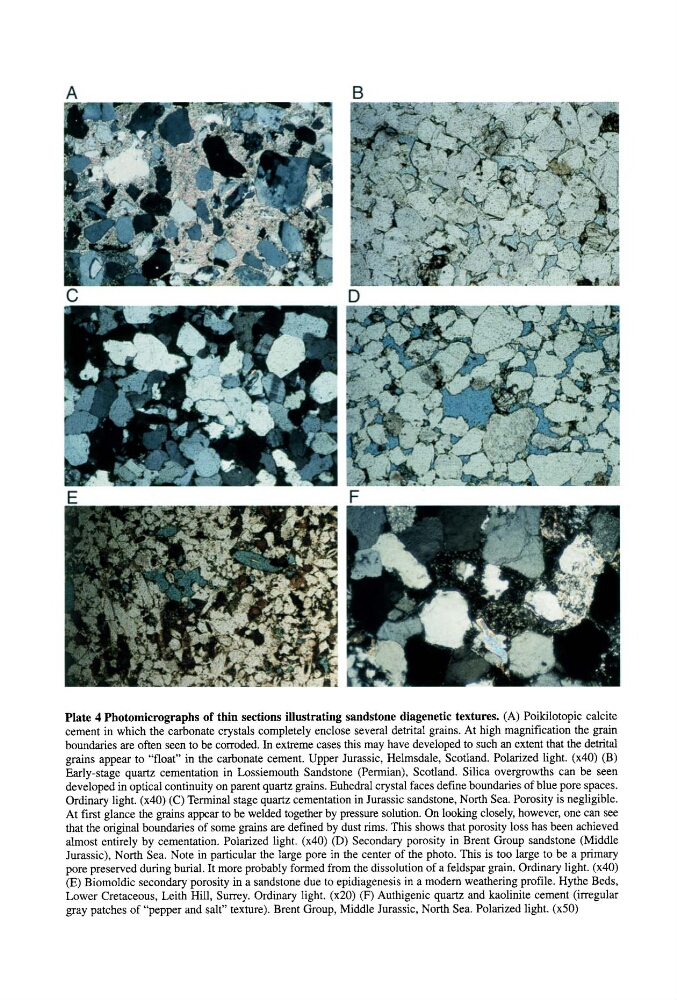
Plate 4 Photomicrographs of thin sections illustrating sandstone diagenetic textures. (A) Poikilotopic calcite
cement in which the carbonate crystals completely enclose several detrital grains. At high magnification the grain
boundaries are often seen to be corroded. In extreme cases this may have developed to such an extent that the detrital
grains appear to "float" in the carbonate cement. Upper Jurassic, Helmsdale, Scotland. Polarized light. (x40) (B)
Early-stage quartz cementation in Lossiemouth Sandstone (Permian), Scotland. Silica overgrowths can be seen
developed in optical continuity on parent quartz grains. Euhedral crystal faces define boundaries of blue pore spaces.
Ordinary light. (x40) (C) Terminal stage quartz cementation in Jurassic sandstone, North Sea. Porosity is negligible.
At first glance the grains appear to be welded together by pressure solution. On looking closely, however, one can see
that the original boundaries of some grains are defined by dust rims. This shows that porosity loss has been achieved
almost entirely by cementation. Polarized light. (x40) (D) Secondary porosity in Brent Group sandstone (Middle
Jurassic), North Sea. Note in particular the large pore in the center of the photo. This is too large to be a primary
pore preserved during burial. It more probably formed from the dissolution of a feldspar grain. Ordinary light. (x40)
(E) Biomoldic secondary porosity in a sandstone due to epidiagenesis in a modem weathering profile. Hythe Beds,
Lower Cretaceous, Leith Hill, Surrey. Ordinary light. (x20) (F) Authigenic quartz and kaolinite cement (irregular
gray patches of "pepper and salt" texture). Brent Group, Middle Jurassic, North Sea. Polarized light. (x50)
cement in which the carbonate crystals completely enclose several detrital grains. At high magnification the grain
boundaries are often seen to be corroded. In extreme cases this may have developed to such an extent that the detrital
grains appear to "float" in the carbonate cement. Upper Jurassic, Helmsdale, Scotland. Polarized light. (x40) (B)
Early-stage quartz cementation in Lossiemouth Sandstone (Permian), Scotland. Silica overgrowths can be seen
developed in optical continuity on parent quartz grains. Euhedral crystal faces define boundaries of blue pore spaces.
Ordinary light. (x40) (C) Terminal stage quartz cementation in Jurassic sandstone, North Sea. Porosity is negligible.
At first glance the grains appear to be welded together by pressure solution. On looking closely, however, one can see
that the original boundaries of some grains are defined by dust rims. This shows that porosity loss has been achieved
almost entirely by cementation. Polarized light. (x40) (D) Secondary porosity in Brent Group sandstone (Middle
Jurassic), North Sea. Note in particular the large pore in the center of the photo. This is too large to be a primary
pore preserved during burial. It more probably formed from the dissolution of a feldspar grain. Ordinary light. (x40)
(E) Biomoldic secondary porosity in a sandstone due to epidiagenesis in a modem weathering profile. Hythe Beds,
Lower Cretaceous, Leith Hill, Surrey. Ordinary light. (x20) (F) Authigenic quartz and kaolinite cement (irregular
gray patches of "pepper and salt" texture). Brent Group, Middle Jurassic, North Sea. Polarized light. (x50)