

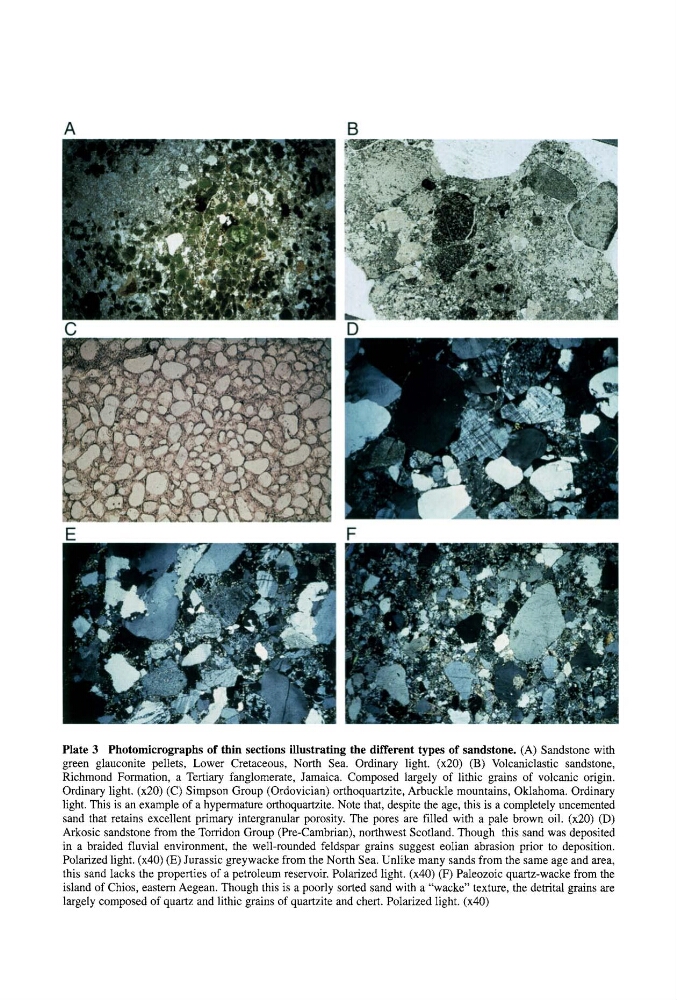
Plate 3 Photomicrographs of thin sections illustrating the different types of sandstone. (A) Sandstone with
green glauconite pellets, Lower Cretaceous, North Sea. Ordinary light. (x20) (B) Volcaniclastic sandstone,
Richmond Formation, a Tertiary fanglomerate, Jamaica. Composed largely of lithic grains of volcanic origin.
Ordinary light. (x20) (C) Simpson Group (Ordovician) orthoquartzite, Arbuckle mountains, Oklahoma. Ordinary
light. This is an example of a hypermature orthoquartzite. Note that, despite the age, this is a completely uncemented
sand that retains excellent primary intergranular porosity. The pores are filled with a pale brown oil. (x20) (D)
Arkosic sandstone from the Torridon Group (Pre-Cambrian), northwest Scotland. Though this sand was deposited
in a braided fluvial environment, the well-rounded feldspar grains suggest eolian abrasion prior to deposition.
Polarized light. (x40) (E) Jurassic greywacke from the North Sea. Unlike many sands from the same age and area,
this sand lacks the properties of a petroleum reservoir. Polarized light. (x40) (F) Paleozoic quartz-wacke from the
island of Chios, eastern Aegean. Though this is a poorly sorted sand with a "wacke" texture, the detrital grains are
largely composed of quartz and lithic grains of quartzite and chert. Polarized light. (x40)
green glauconite pellets, Lower Cretaceous, North Sea. Ordinary light. (x20) (B) Volcaniclastic sandstone,
Richmond Formation, a Tertiary fanglomerate, Jamaica. Composed largely of lithic grains of volcanic origin.
Ordinary light. (x20) (C) Simpson Group (Ordovician) orthoquartzite, Arbuckle mountains, Oklahoma. Ordinary
light. This is an example of a hypermature orthoquartzite. Note that, despite the age, this is a completely uncemented
sand that retains excellent primary intergranular porosity. The pores are filled with a pale brown oil. (x20) (D)
Arkosic sandstone from the Torridon Group (Pre-Cambrian), northwest Scotland. Though this sand was deposited
in a braided fluvial environment, the well-rounded feldspar grains suggest eolian abrasion prior to deposition.
Polarized light. (x40) (E) Jurassic greywacke from the North Sea. Unlike many sands from the same age and area,
this sand lacks the properties of a petroleum reservoir. Polarized light. (x40) (F) Paleozoic quartz-wacke from the
island of Chios, eastern Aegean. Though this is a poorly sorted sand with a "wacke" texture, the detrital grains are
largely composed of quartz and lithic grains of quartzite and chert. Polarized light. (x40)