

498
10 S E D I M E N T A R Y BASINS
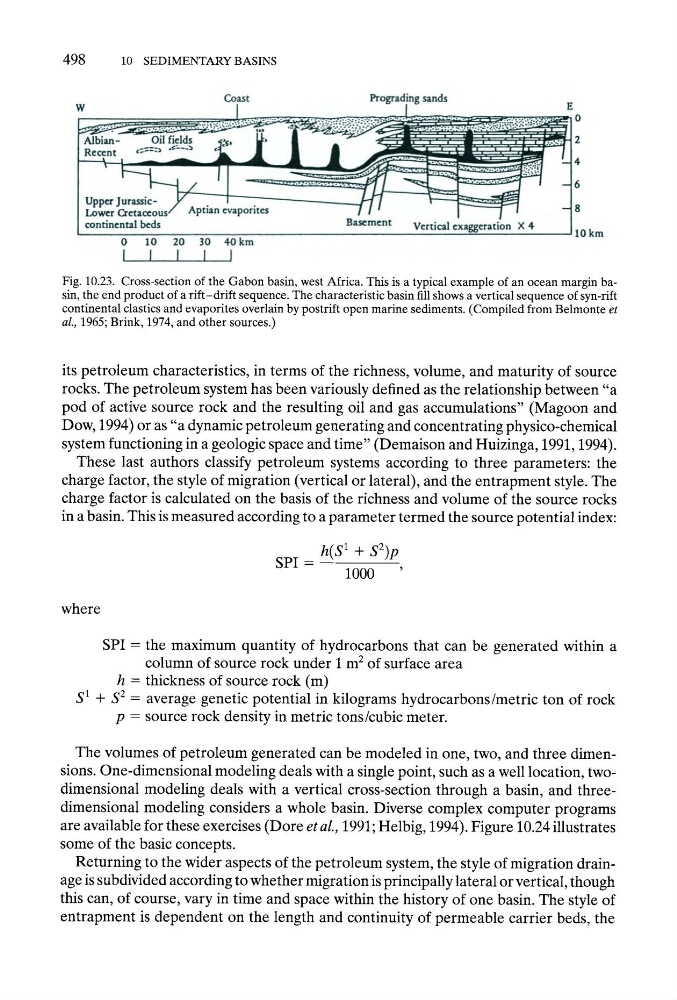
Fig. 10.23. Cross-section of the Gabon basin, west Africa. This is a typical example of an ocean margin basin, the end product of a rift-drift sequence. The characteristic basin fill shows a vertical sequence of syn-rift
continental clastics and evaporites overlain by postrift open marine sediments. (Compiled from Belmonte et
al., 1965; Brink, 1974, and other sources.)
its petroleum characteristics, in terms of the richness, volume, and maturity of source
rocks. The petroleum system has been variously defined as the relationship between "a
pod of active source rock and the resulting oil and gas accumulations" (Magoon and
Dow, 1994) or as "a dynamic petroleum generating and concentrating physico-chemical
system functioning in a geologic space and time" (Demaison and Huizinga, 1991, 1994).
These last authors classify petroleum systems according to three parameters: the
charge factor, the style of migration (vertical or lateral), and the entrapment style. The
charge factor is calculated on the basis of the richness and volume of the source rocks
in a basin. This is measured according to a parameter termed the source potential index:
SPI =
h(S 1 + S2)p
1000
'
where
SPI = the maximum quantity of hydrocarbons that can be generated within a
column of source rock under 1 m 2 of surface area
h - thickness of source rock (m)
S 1 + S 2 - average genetic potential in kilograms hydrocarbons/metric ton of rock
p - source rock density in metric tons/cubic meter.
The volumes of petroleum generated can be modeled in one, two, and three dimensions. One-dimensional modeling deals with a single point, such as a well location, twodimensional modeling deals with a vertical cross-section through a basin, and threedimensional modeling considers a whole basin. Diverse complex computer programs
are available for these exercises (Dore et al., 1991; Helbig, 1994). Figure 10.24 illustrates
some of the basic concepts.
Returning to the wider aspects of the petroleum system, the style of migration drainage is subdivided according to whether migration is principally lateral or vertical, though
this can, of course, vary in time and space within the history of one basin. The style of
entrapment is dependent on the length and continuity of permeable carrier beds, the
10 S E D I M E N T A R Y BASINS
Fig. 10.23. Cross-section of the Gabon basin, west Africa. This is a typical example of an ocean margin basin, the end product of a rift-drift sequence. The characteristic basin fill shows a vertical sequence of syn-rift
continental clastics and evaporites overlain by postrift open marine sediments. (Compiled from Belmonte et
al., 1965; Brink, 1974, and other sources.)
its petroleum characteristics, in terms of the richness, volume, and maturity of source
rocks. The petroleum system has been variously defined as the relationship between "a
pod of active source rock and the resulting oil and gas accumulations" (Magoon and
Dow, 1994) or as "a dynamic petroleum generating and concentrating physico-chemical
system functioning in a geologic space and time" (Demaison and Huizinga, 1991, 1994).
These last authors classify petroleum systems according to three parameters: the
charge factor, the style of migration (vertical or lateral), and the entrapment style. The
charge factor is calculated on the basis of the richness and volume of the source rocks
in a basin. This is measured according to a parameter termed the source potential index:
SPI =
h(S 1 + S2)p
1000
'
where
SPI = the maximum quantity of hydrocarbons that can be generated within a
column of source rock under 1 m 2 of surface area
h - thickness of source rock (m)
S 1 + S 2 - average genetic potential in kilograms hydrocarbons/metric ton of rock
p - source rock density in metric tons/cubic meter.
The volumes of petroleum generated can be modeled in one, two, and three dimensions. One-dimensional modeling deals with a single point, such as a well location, twodimensional modeling deals with a vertical cross-section through a basin, and threedimensional modeling considers a whole basin. Diverse complex computer programs
are available for these exercises (Dore et al., 1991; Helbig, 1994). Figure 10.24 illustrates
some of the basic concepts.
Returning to the wider aspects of the petroleum system, the style of migration drainage is subdivided according to whether migration is principally lateral or vertical, though
this can, of course, vary in time and space within the history of one basin. The style of
entrapment is dependent on the length and continuity of permeable carrier beds, the