

496
10 SEDIMENTARY BASINS
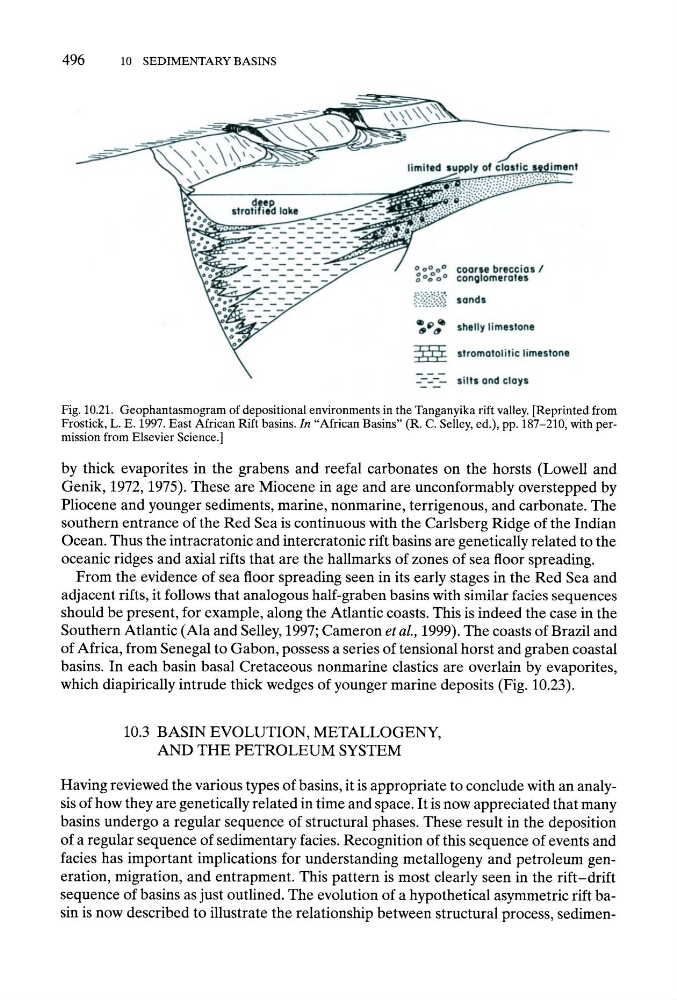
Fig. 10.21. Geophantasmogram of depositional environments in the Tanganyika rift valley. [Reprinted from
Frostick, L. E. 1997. East African Rift basins. In "African Basins" (R. C. Selley, ed.), pp. 187-210, with permission from Elsevier Science.]
by thick evaporites in the grabens and reefal carbonates on the horsts (Lowell and
Genik, 1972, 1975). These are Miocene in age and are unconformably overstepped by
Pliocene and younger sediments, marine, nonmarine, terrigenous, and carbonate. The
southern entrance of the Red Sea is continuous with the Carlsberg Ridge of the Indian
Ocean. Thus the intracratonic and intercratonic rift basins are genetically related to the
oceanic ridges and axial rifts that are the hallmarks of zones of sea floor spreading.
From the evidence of sea floor spreading seen in its early stages in the Red Sea and
adjacent rifts, it follows that analogous half-graben basins with similar facies sequences
should be present, for example, along the Atlantic coasts. This is indeed the case in the
Southern Atlantic (Ala and Selley, 1997; Cameron et aL, 1999). The coasts of Brazil and
of Africa, from Senegal to Gabon, possess a series of tensional horst and graben coastal
basins. In each basin basal Cretaceous nonmarine clastics are overlain by evaporites,
which diapirically intrude thick wedges of younger marine deposits (Fig. 10.23).
10.3 BASIN EVOLUTION, METALLOGENY,
AND THE PETROLEUM SYSTEM
Having reviewed the various types of basins, it is appropriate to conclude with an analysis of how they are genetically related in time and space. It is now appreciated that many
basins undergo a regular sequence of structural phases. These result in the deposition
of a regular sequence of sedimentary facies. Recognition of this sequence of events and
facies has important implications for understanding metallogeny and petroleum generation, migration, and entrapment. This pattern is most clearly seen in the rift-drift
sequence of basins as just outlined. The evolution of a hypothetical asymmetric rift basin is now described to illustrate the relationship between structural process, sedimen-
10 SEDIMENTARY BASINS
Fig. 10.21. Geophantasmogram of depositional environments in the Tanganyika rift valley. [Reprinted from
Frostick, L. E. 1997. East African Rift basins. In "African Basins" (R. C. Selley, ed.), pp. 187-210, with permission from Elsevier Science.]
by thick evaporites in the grabens and reefal carbonates on the horsts (Lowell and
Genik, 1972, 1975). These are Miocene in age and are unconformably overstepped by
Pliocene and younger sediments, marine, nonmarine, terrigenous, and carbonate. The
southern entrance of the Red Sea is continuous with the Carlsberg Ridge of the Indian
Ocean. Thus the intracratonic and intercratonic rift basins are genetically related to the
oceanic ridges and axial rifts that are the hallmarks of zones of sea floor spreading.
From the evidence of sea floor spreading seen in its early stages in the Red Sea and
adjacent rifts, it follows that analogous half-graben basins with similar facies sequences
should be present, for example, along the Atlantic coasts. This is indeed the case in the
Southern Atlantic (Ala and Selley, 1997; Cameron et aL, 1999). The coasts of Brazil and
of Africa, from Senegal to Gabon, possess a series of tensional horst and graben coastal
basins. In each basin basal Cretaceous nonmarine clastics are overlain by evaporites,
which diapirically intrude thick wedges of younger marine deposits (Fig. 10.23).
10.3 BASIN EVOLUTION, METALLOGENY,
AND THE PETROLEUM SYSTEM
Having reviewed the various types of basins, it is appropriate to conclude with an analysis of how they are genetically related in time and space. It is now appreciated that many
basins undergo a regular sequence of structural phases. These result in the deposition
of a regular sequence of sedimentary facies. Recognition of this sequence of events and
facies has important implications for understanding metallogeny and petroleum generation, migration, and entrapment. This pattern is most clearly seen in the rift-drift
sequence of basins as just outlined. The evolution of a hypothetical asymmetric rift basin is now described to illustrate the relationship between structural process, sedimen-