

Pa,aeocurrents I
, ,~o~5 t:~e~'t
The Mediterranean
~" KEY
f
Hoggar
Post-mid-Cretaceous
massif
post-Carboniferousmid-Cretaceous
Palaeozoic
0
Pre-Cambri an massifs
Polignac
basin
Garga~
The Gulf of Sirte
\
~c~
Sirte
basin
\
\
\
I
I
/
9
,
(
'''
i
l O00km
9
9
9
0
dv~
9
9
0
0
9
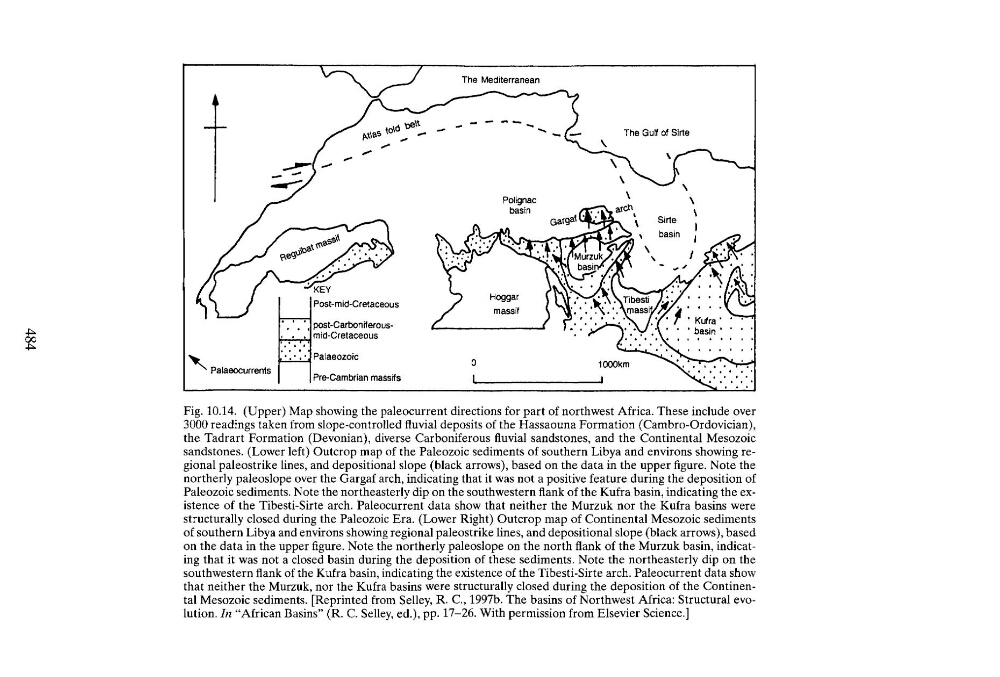
Fig. 10.14. (Upper) Map showing the paleocurrent directions for part of northwest Africa. These include over
3000 readings taken from slope-controlled fluvial deposits of the Hassaouna Formation (Cambro-Ordovician),
the Tadrart Formation (Devonian), diverse Carboniferous fluvial sandstones, and the Continental Mesozoic
sandstones. (Lower left) Outcrop map of the Paleozoic sediments of southern Libya and environs showing regional paleostrike lines, and depositional slope (black arrows), based on the data in the upper figure. Note the
northerly paleoslope over the Gargaf arch, indicating that it was not a positive feature during the deposition of
Paleozoic sediments. Note the northeasterly dip on the southwestern flank of the Kufra basin, indicating the existence of the Tibesti-Sirte arch. Paleocurrent data show that neither the Murzuk nor the Kufra basins were
structurally closed during the Paleozoic Era. (Lower Right) Outcrop map of Continental Mesozoic sediments
of southern Libya and environs showing regional paleostrike lines, and depositional slope (black arrows), based
on the data in the upper figure. Note the northerly paleoslope on the north flank of the Murzuk basin, indicating that it was not a closed basin during the deposition of these sediments. Note the northeasterly dip on the
southwestern flank of the Kufra basin, indicating the existence of the Tibesti-Sirte arch. Paleocurrent data show
that neither the Murzuk, nor the Kufra basins were structurally closed during the deposition of the Continental Mesozoic sediments. [Reprinted from Selley, R. C., 1997b. The basins of Northwest Africa: Structural evolution. In "African Basins" (R. C. Selley, ed.), pp. 17-26. With permission from Elsevier Science.]
, ,~o~5 t:~e~'t
The Mediterranean
~" KEY
f
Hoggar
Post-mid-Cretaceous
massif
post-Carboniferousmid-Cretaceous
Palaeozoic
0
Pre-Cambri an massifs
Polignac
basin
Garga~
The Gulf of Sirte
\
~c~
Sirte
basin
\
\
\
I
I
/
9
,
(
'''
i
l O00km
9
9
9
0
dv~
9
9
0
0
9
Fig. 10.14. (Upper) Map showing the paleocurrent directions for part of northwest Africa. These include over
3000 readings taken from slope-controlled fluvial deposits of the Hassaouna Formation (Cambro-Ordovician),
the Tadrart Formation (Devonian), diverse Carboniferous fluvial sandstones, and the Continental Mesozoic
sandstones. (Lower left) Outcrop map of the Paleozoic sediments of southern Libya and environs showing regional paleostrike lines, and depositional slope (black arrows), based on the data in the upper figure. Note the
northerly paleoslope over the Gargaf arch, indicating that it was not a positive feature during the deposition of
Paleozoic sediments. Note the northeasterly dip on the southwestern flank of the Kufra basin, indicating the existence of the Tibesti-Sirte arch. Paleocurrent data show that neither the Murzuk nor the Kufra basins were
structurally closed during the Paleozoic Era. (Lower Right) Outcrop map of Continental Mesozoic sediments
of southern Libya and environs showing regional paleostrike lines, and depositional slope (black arrows), based
on the data in the upper figure. Note the northerly paleoslope on the north flank of the Murzuk basin, indicating that it was not a closed basin during the deposition of these sediments. Note the northeasterly dip on the
southwestern flank of the Kufra basin, indicating the existence of the Tibesti-Sirte arch. Paleocurrent data show
that neither the Murzuk, nor the Kufra basins were structurally closed during the deposition of the Continental Mesozoic sediments. [Reprinted from Selley, R. C., 1997b. The basins of Northwest Africa: Structural evolution. In "African Basins" (R. C. Selley, ed.), pp. 17-26. With permission from Elsevier Science.]