

458
9 AUTOCHTHONOUS SEDIMENTS
(in Folk and McBride, 1976) argue for a bathyal depth, while Folk (1973; and in Folk
and McBride, 1976) argues for an intertidal origin.
Bedded cherts are also known from lacustrine deposits. For example, silicified limestones with the freshwater gastropod Hydrobia occur in the Continental Mesozoic beds
of the Kufra basin, Libya.
Bedded cherts of uncertain origin occur interbedded with Pre-Cambrian ironstones,
as previously illustrated in Fig. 9.25, and whose environment of deposition was discussed
in Section 9.4.2.
It has often been remarked that cherts tend to be associated with contemporaneous volcanic activity. It has been argued that vulcanism releases large amounts of silica
into the environment. This encourages "blooms" of silica-secreting organisms, such as
radiolaria, diatoms, and sponges, and thus generates chert formation (e.g., Wenk, 1949;
Khvorova, 1968).
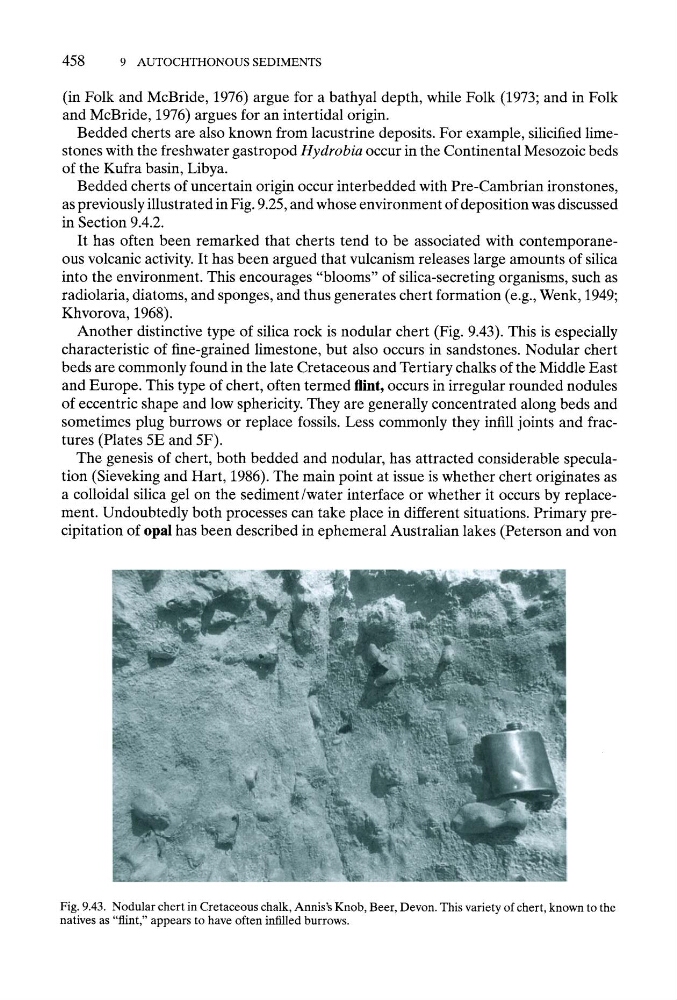
Another distinctive type of silica rock is nodular chert (Fig. 9.43). This is especially
characteristic of fine-grained limestone, but also occurs in sandstones. Nodular chert
beds are commonly found in the late Cretaceous and Tertiary chalks of the Middle East
and Europe. This type of chert, often termed flint, occurs in irregular rounded nodules
of eccentric shape and low sphericity. They are generally concentrated along beds and
sometimes plug burrows or replace fossils. Less commonly they infill joints and fractures (Plates 5E and 5F).
The genesis of chert, both bedded and nodular, has attracted considerable speculation (Sieveking and Hart, 1986). The main point at issue is whether chert originates as
a colloidal silica gel on the sediment/water interface or whether it occurs by replacement. Undoubtedly both processes can take place in different situations. Primary precipitation of opal has been described in ephemeral Australian lakes (Peterson and von
Fig. 9.43. Nodular chert in Cretaceous chalk, Annis's Knob, Beer, Devon. This variety of chert, known to the
natives as "flint," appears to have often infilled burrows.
9 AUTOCHTHONOUS SEDIMENTS
(in Folk and McBride, 1976) argue for a bathyal depth, while Folk (1973; and in Folk
and McBride, 1976) argues for an intertidal origin.
Bedded cherts are also known from lacustrine deposits. For example, silicified limestones with the freshwater gastropod Hydrobia occur in the Continental Mesozoic beds
of the Kufra basin, Libya.
Bedded cherts of uncertain origin occur interbedded with Pre-Cambrian ironstones,
as previously illustrated in Fig. 9.25, and whose environment of deposition was discussed
in Section 9.4.2.
It has often been remarked that cherts tend to be associated with contemporaneous volcanic activity. It has been argued that vulcanism releases large amounts of silica
into the environment. This encourages "blooms" of silica-secreting organisms, such as
radiolaria, diatoms, and sponges, and thus generates chert formation (e.g., Wenk, 1949;
Khvorova, 1968).
Another distinctive type of silica rock is nodular chert (Fig. 9.43). This is especially
characteristic of fine-grained limestone, but also occurs in sandstones. Nodular chert
beds are commonly found in the late Cretaceous and Tertiary chalks of the Middle East
and Europe. This type of chert, often termed flint, occurs in irregular rounded nodules
of eccentric shape and low sphericity. They are generally concentrated along beds and
sometimes plug burrows or replace fossils. Less commonly they infill joints and fractures (Plates 5E and 5F).
The genesis of chert, both bedded and nodular, has attracted considerable speculation (Sieveking and Hart, 1986). The main point at issue is whether chert originates as
a colloidal silica gel on the sediment/water interface or whether it occurs by replacement. Undoubtedly both processes can take place in different situations. Primary precipitation of opal has been described in ephemeral Australian lakes (Peterson and von
Fig. 9.43. Nodular chert in Cretaceous chalk, Annis's Knob, Beer, Devon. This variety of chert, known to the
natives as "flint," appears to have often infilled burrows.