

456
9 AUTOCHTHONOUS SEDIMENTS
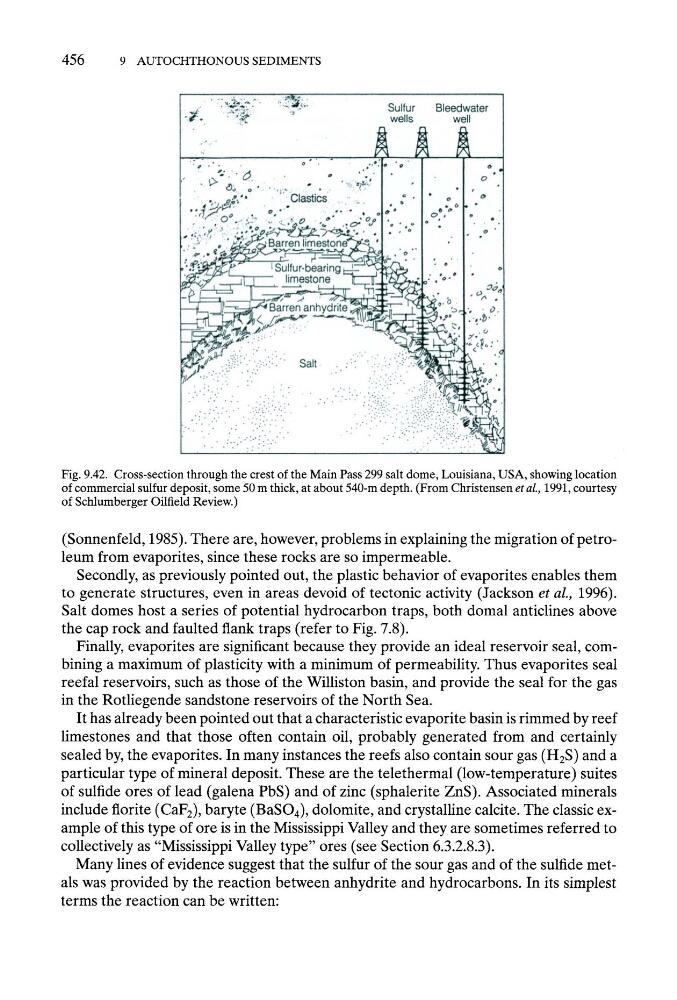
Fig. 9.42. Cross-section through the crest of the Main Pass 299 salt dome, Louisiana, USA, showing location
of commercial sulfur deposit, some 50 m thick, at about 540-m depth. (From Christensen et al., 1991, courtesy
of Schlumberger Oilfield Review.)
(Sonnenfeld, 1985). There are, however, problems in explaining the migration of petroleum from evaporites, since these rocks are so impermeable.
Secondly, as previously pointed out, the plastic behavior of evaporites enables them
to generate structures, even in areas devoid of tectonic activity (Jackson et al., 1996).
Salt domes host a series of potential hydrocarbon traps, both domal anticlines above
the cap rock and faulted flank traps (refer to Fig. 7.8).
Finally, evaporites are significant because they provide an ideal reservoir seal, combining a maximum of plasticity with a minimum of permeability. Thus evaporites seal
reefal reservoirs, such as those of the Williston basin, and provide the seal for the gas
in the Rotliegende sandstone reservoirs of the North Sea.
It has already been pointed out that a characteristic evaporite basin is rimmed by reef
limestones and that those often contain oil, probably generated from and certainly
sealed by, the evaporites. In many instances the reefs also contain sour gas (H2S) and a
particular type of mineral deposit. These are the telethermal (low-temperature) suites
of sulfide ores of lead (galena PbS) and of zinc (sphalerite ZnS). Associated minerals
include florite (CaF2), baryte (BaSO4), dolomite, and crystalline calcite. The classic example of this type of ore is in the Mississippi Valley and they are sometimes referred to
collectively as "Mississippi Valley type" ores (see Section 6.3.2.8.3).
Many lines of evidence suggest that the sulfur of the sour gas and of the sulfide metals was provided by the reaction between anhydrite and hydrocarbons. In its simplest
terms the reaction can be written:
9 AUTOCHTHONOUS SEDIMENTS
Fig. 9.42. Cross-section through the crest of the Main Pass 299 salt dome, Louisiana, USA, showing location
of commercial sulfur deposit, some 50 m thick, at about 540-m depth. (From Christensen et al., 1991, courtesy
of Schlumberger Oilfield Review.)
(Sonnenfeld, 1985). There are, however, problems in explaining the migration of petroleum from evaporites, since these rocks are so impermeable.
Secondly, as previously pointed out, the plastic behavior of evaporites enables them
to generate structures, even in areas devoid of tectonic activity (Jackson et al., 1996).
Salt domes host a series of potential hydrocarbon traps, both domal anticlines above
the cap rock and faulted flank traps (refer to Fig. 7.8).
Finally, evaporites are significant because they provide an ideal reservoir seal, combining a maximum of plasticity with a minimum of permeability. Thus evaporites seal
reefal reservoirs, such as those of the Williston basin, and provide the seal for the gas
in the Rotliegende sandstone reservoirs of the North Sea.
It has already been pointed out that a characteristic evaporite basin is rimmed by reef
limestones and that those often contain oil, probably generated from and certainly
sealed by, the evaporites. In many instances the reefs also contain sour gas (H2S) and a
particular type of mineral deposit. These are the telethermal (low-temperature) suites
of sulfide ores of lead (galena PbS) and of zinc (sphalerite ZnS). Associated minerals
include florite (CaF2), baryte (BaSO4), dolomite, and crystalline calcite. The classic example of this type of ore is in the Mississippi Valley and they are sometimes referred to
collectively as "Mississippi Valley type" ores (see Section 6.3.2.8.3).
Many lines of evidence suggest that the sulfur of the sour gas and of the sulfide metals was provided by the reaction between anhydrite and hydrocarbons. In its simplest
terms the reaction can be written: