

9.6 EVAPORITES
451
Within the lagoonal waters calcium ions are removed by the organic precipitation of
aragonite skeletal debris. Thus the water becomes progressively enriched in ions of magnesium, potassium, and sulfates. Simultaneously salinity increases due to the high rate
of evaporation. Thus, although the background sediment is basically carbonate, evaporite minerals occur in abundance in the sediments of the intertidal and supratidal facies.
Gypsum and dolomite are present in the sediments of the present intertidal and low
supratidal zones, and they are also found in earlier buried intertidal sediments, while
nodules of anhydrite are locally abundant in the sediments of the supratidal facies. In
all essential respects this present-day nodular anhydrite is strictly comparable with that
found in anhydrite units of the ancient carbonate-anhydrite cycles. It is evident in the
field that the nodules grew within the host carbonate sediment by displacement, and that
features such as enterolithic folds are growth structures that resulted from the demand
for space as more and more anhydrite crystals grew within layers of coalesced nodules.
The groundwaters of the coastal sabkha are marine derived, and due to heat and aridity
they have become concentrated by capillarity and evaporation to the point where they
are now highly concentrated brines. It is from these interstitial brines that the evaporite minerals are formed.
Prior to the discovery of this presently forming anhydrite of the UAE, it had been
thought that the nodular anhydrite of the ancient carbonate-anhydrite cycles may have
been formed in shallow, highly saline coastal lagoons. A supratidal origin now appears
more likely; the carbonate-anhydrite cycles are desert zone carbonate-shoreline regressive cycles of sedimentation in which evaporites were emplaced in the intertidal and
supratidal sediments by penecontemporaneous diagenesis.
Vertical repetition of the cycles, and the total thickness of the succession, is the expression of the diastropic background of relative subsidence. It is convenient to refer to
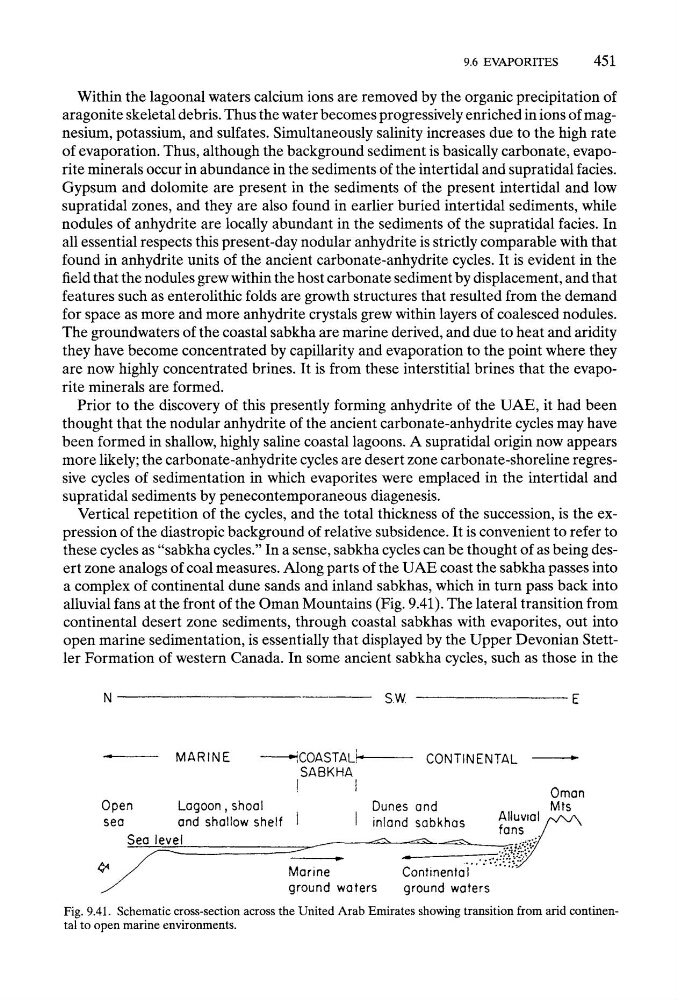
these cycles as "sabkha cycles." In a sense, sabkha cycles can be thought of as being desert zone analogs of coal measures. Along parts of the UAE coast the sabkha passes into
a complex of continental dune sands and inland sabkhas, which in turn pass back into
alluvial fans at the front of the Oman Mountains (Fig. 9.41). The lateral transition from
continental desert zone sediments, through coastal sabkhas with evaporites, out into
open marine sedimentation, is essentially that displayed by the Upper Devonian Stettler Formation of western Canada. In some ancient sabkha cycles, such as those in the
N
S.W.
E
MARINE
--~COASTAL~
CONTINENTAL
SABKHA
[
l
Oman
Open
Lagoon, shoal
Dunes and
Mts
sea
and shallow shelf I
I inland sabkhas
Ailuv,al
Sea level
~_~
~
~
~~...~./
... ~
4.
..
tip,
~
Marine
Continental
ground waters
ground waters
Fig. 9.41. Schematic cross-section across the United Arab Emirates showing transition from arid continental to open marine environments.
451
Within the lagoonal waters calcium ions are removed by the organic precipitation of
aragonite skeletal debris. Thus the water becomes progressively enriched in ions of magnesium, potassium, and sulfates. Simultaneously salinity increases due to the high rate
of evaporation. Thus, although the background sediment is basically carbonate, evaporite minerals occur in abundance in the sediments of the intertidal and supratidal facies.
Gypsum and dolomite are present in the sediments of the present intertidal and low
supratidal zones, and they are also found in earlier buried intertidal sediments, while
nodules of anhydrite are locally abundant in the sediments of the supratidal facies. In
all essential respects this present-day nodular anhydrite is strictly comparable with that
found in anhydrite units of the ancient carbonate-anhydrite cycles. It is evident in the
field that the nodules grew within the host carbonate sediment by displacement, and that
features such as enterolithic folds are growth structures that resulted from the demand
for space as more and more anhydrite crystals grew within layers of coalesced nodules.
The groundwaters of the coastal sabkha are marine derived, and due to heat and aridity
they have become concentrated by capillarity and evaporation to the point where they
are now highly concentrated brines. It is from these interstitial brines that the evaporite minerals are formed.
Prior to the discovery of this presently forming anhydrite of the UAE, it had been
thought that the nodular anhydrite of the ancient carbonate-anhydrite cycles may have
been formed in shallow, highly saline coastal lagoons. A supratidal origin now appears
more likely; the carbonate-anhydrite cycles are desert zone carbonate-shoreline regressive cycles of sedimentation in which evaporites were emplaced in the intertidal and
supratidal sediments by penecontemporaneous diagenesis.
Vertical repetition of the cycles, and the total thickness of the succession, is the expression of the diastropic background of relative subsidence. It is convenient to refer to
these cycles as "sabkha cycles." In a sense, sabkha cycles can be thought of as being desert zone analogs of coal measures. Along parts of the UAE coast the sabkha passes into
a complex of continental dune sands and inland sabkhas, which in turn pass back into
alluvial fans at the front of the Oman Mountains (Fig. 9.41). The lateral transition from
continental desert zone sediments, through coastal sabkhas with evaporites, out into
open marine sedimentation, is essentially that displayed by the Upper Devonian Stettler Formation of western Canada. In some ancient sabkha cycles, such as those in the
N
S.W.
E
MARINE
--~COASTAL~
CONTINENTAL
SABKHA
[
l
Oman
Open
Lagoon, shoal
Dunes and
Mts
sea
and shallow shelf I
I inland sabkhas
Ailuv,al
Sea level
~_~
~
~
~~...~./
... ~
4.
..
tip,
~
Marine
Continental
ground waters
ground waters
Fig. 9.41. Schematic cross-section across the United Arab Emirates showing transition from arid continental to open marine environments.